A Guide for Commercial Real Estate Buyers, Lenders, and Investors in NJ and PA
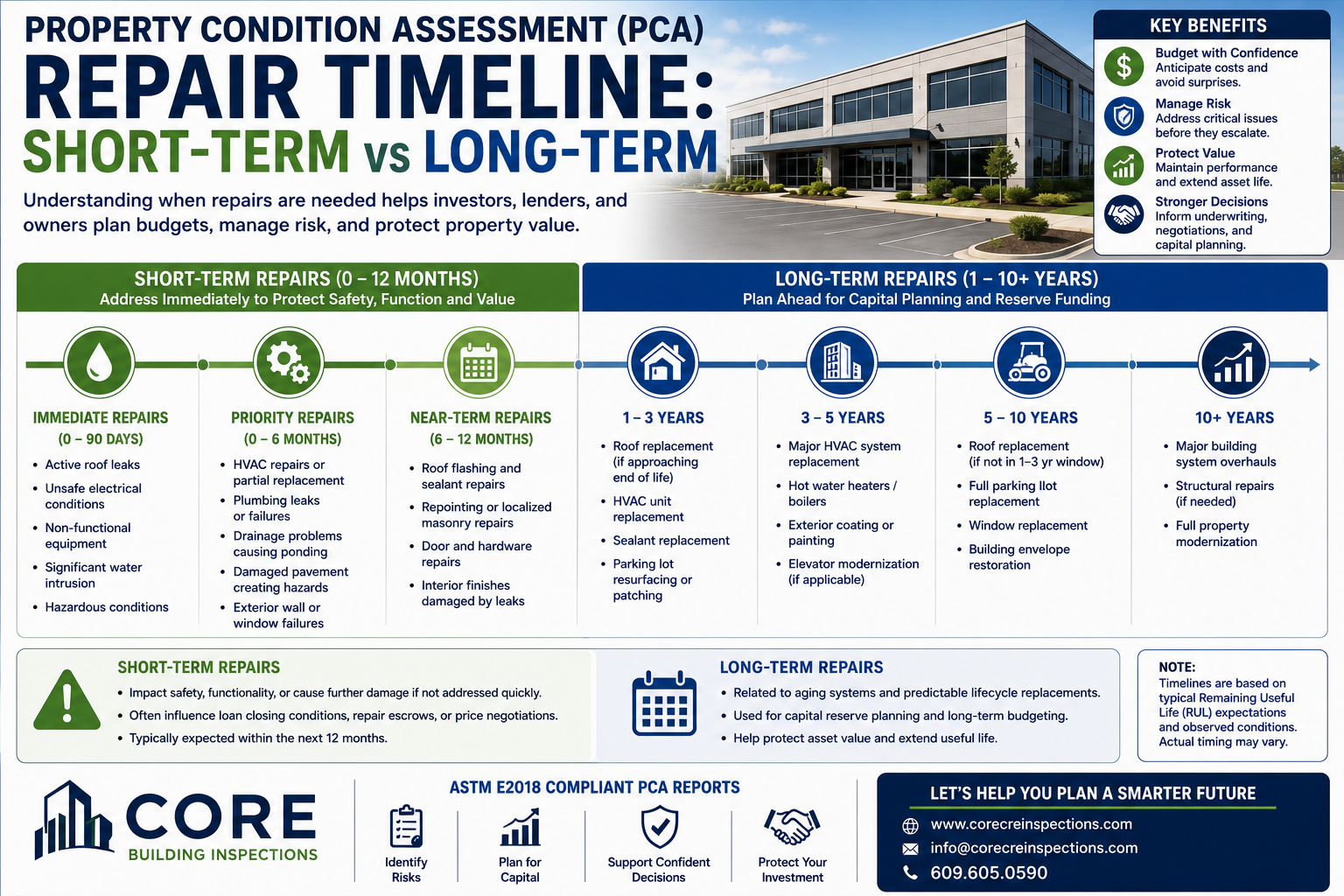
When purchasing, refinancing, or evaluating commercial real estate, understanding potential environmental liabilities is just as important as evaluating the physical condition of the building. A property can appear to be in excellent shape while still carrying environmental risks that affect its value, its financing eligibility, its redevelopment potential, and the long-term liability exposure of anyone who takes title.
A Phase 1 Environmental Site Assessment — commonly referred to as a Phase I ESA — is the industry-standard process used to identify those risks before a transaction closes. For most commercial real estate purchases and a significant share of refinancing transactions, a Phase I ESA is required by lenders and is considered a non-negotiable component of thorough due diligence.
What a Phase 1 ESA Actually Is
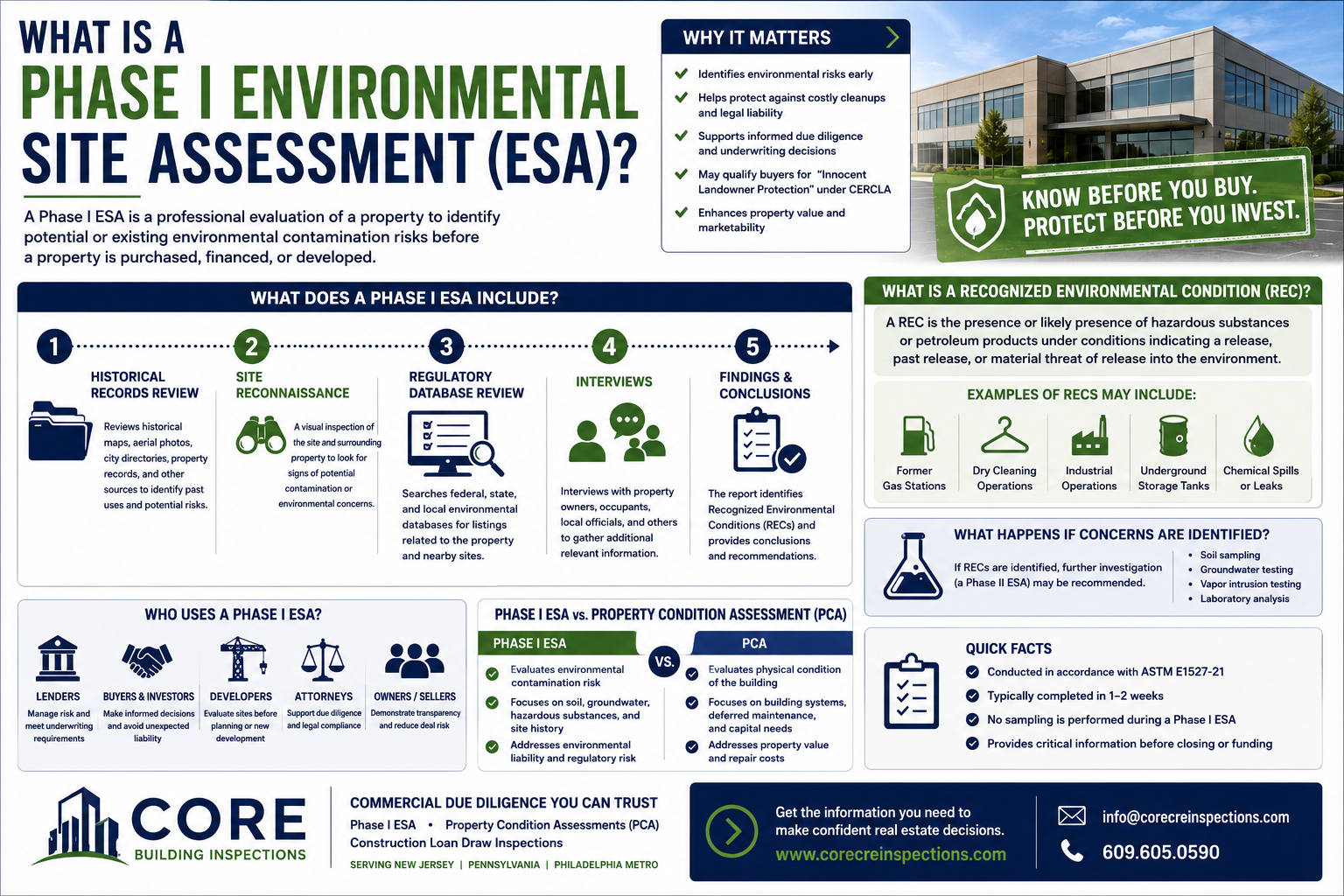
A Phase 1 Environmental Site Assessment is a non-invasive investigation conducted to identify existing or potential environmental contamination liabilities associated with a subject property. The assessment is performed in accordance with ASTM E1527-21, the current industry standard recognized by the United States Environmental Protection Agency under its All Appropriate Inquiries (AAI) rule.
Unlike a Phase II ESA, a Phase I does not involve soil sampling, groundwater testing, or laboratory analysis. The environmental professional evaluates historical land use, regulatory records, environmental databases, and physical site conditions to determine whether evidence exists suggesting a release — or threatened release — of hazardous substances or petroleum products at or near the property.
The central objective is to identify what ASTM and the EPA define as Recognized Environmental Conditions, or RECs.
Why Environmental Due Diligence Matters
Environmental contamination is expensive to remediate, slow to resolve, and capable of affecting a property’s value and marketability for years. Common contamination sources found during Phase I investigations in commercial real estate include petroleum releases from underground storage tanks, solvent contamination from dry cleaning operations, industrial chemical use, improper hazardous waste disposal, and legacy manufacturing activity — all of which appear with regularity in older commercial building stock throughout New Jersey and the Philadelphia region.
A buyer who acquires contaminated property without conducting proper due diligence may face cleanup obligations, regulatory enforcement, lender complications, and reduced resale value — often with limited ability to recover those costs from a prior owner. A Phase I ESA, when properly completed under ASTM E1527-21, allows a purchaser to establish certain statutory liability protections under federal environmental law, including the innocent landowner defense under CERCLA. That protection is only available if All Appropriate Inquiries were conducted prior to acquisition.
What a Recognized Environmental Condition Is
A Recognized Environmental Condition, or REC, is the presence or likely presence of hazardous substances or petroleum products under conditions that indicate a release, a past release, or a material threat of a release into structures on the property or into the ground, groundwater, or surface water. RECs are the primary deliverable of a Phase I ESA — the assessment either identifies them, rules them out, or documents the data gaps that prevented a determination.
RECs can arise from conditions directly on the subject property — petroleum staining, active or former underground storage tanks, known regulatory enforcement cases — or from nearby properties whose contamination plumes may have migrated onto the site. Not every REC results in documented contamination, but any REC identified in a Phase I report typically warrants additional investigation before a transaction closes.
ASTM E1527-21 also recognizes two related categories: Historical Recognized Environmental Conditions (HRECs), which represent past releases that have been remediated to applicable standards, and Controlled Recognized Environmental Conditions (CRECs), which involve completed remediation subject to ongoing use restrictions or Activity and Use Limitations (AULs).
What a Phase 1 ESA Includes
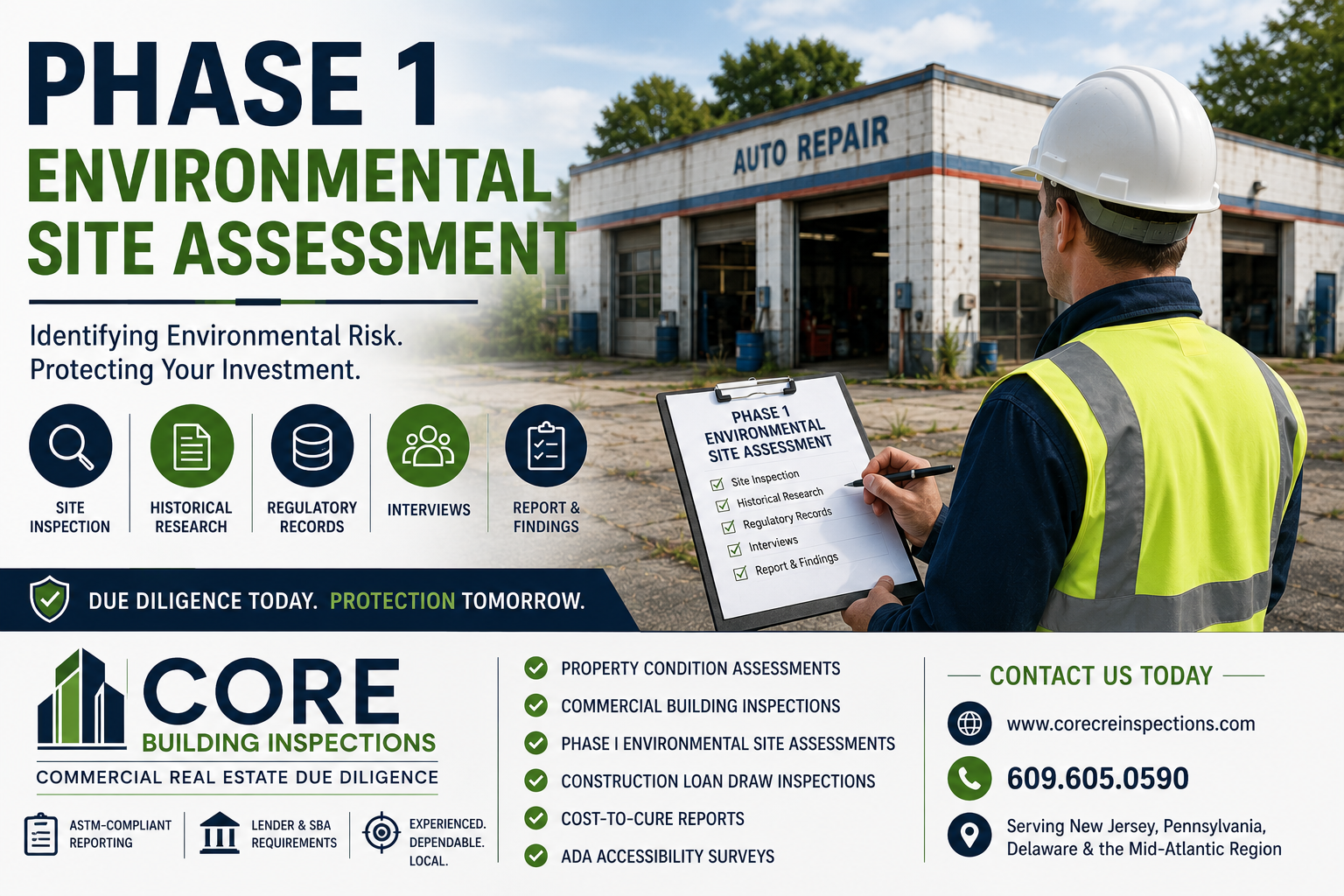
A Phase I Environmental Site Assessment conducted under ASTM E1527-21 consists of four core components, each of which contributes to the environmental professional’s overall conclusions.
Site Reconnaissance. The environmental professional conducts a physical inspection of the subject property to observe and document conditions of potential environmental concern. This includes storage areas for chemicals or hazardous materials, floor drains, drums and containers, evidence of staining or spills, transformers, waste handling areas, and any indication of former fueling operations or industrial activity. Adjacent properties are observed to the extent visible without trespassing.
Historical Records Review. Understanding how a property has been used over time is central to identifying environmental risk. Historical research typically draws on Sanborn Fire Insurance Maps, historical aerial photographs, city directories, topographic maps, and other records that document prior land use going back fifty years or more. Properties that appear to be straightforward commercial sites today may have histories involving manufacturing, auto service, fuel storage, or other activities with environmental implications.
Regulatory Database Review. A government records search identifies regulatory listings associated with the subject property and surrounding area. This includes federal Superfund sites, state cleanup cases, underground storage tank registrations, leaking storage tank incidents, hazardous waste generator records, and environmental permit histories. The search radius applied to each database type is defined by ASTM and the EPA.
Interviews. The environmental professional conducts interviews with current owners, property managers, tenants, and others with knowledge of the property’s history and current operations. The owner or a key manager is also required to complete an All Appropriate Inquiries questionnaire that documents their knowledge of prior uses, known contamination, storage tanks, and other relevant conditions. Per current ASTM E1527-21 requirements, that completed questionnaire is included as an appendix in the final report.
Report. All findings are documented in a formal written report identifying any RECs, HRECs, CRECs, data gaps, and recommendations for additional investigation where warranted.
When a Phase 1 ESA Is Required
A Phase I ESA is standard practice — and frequently required — in a range of commercial real estate scenarios.
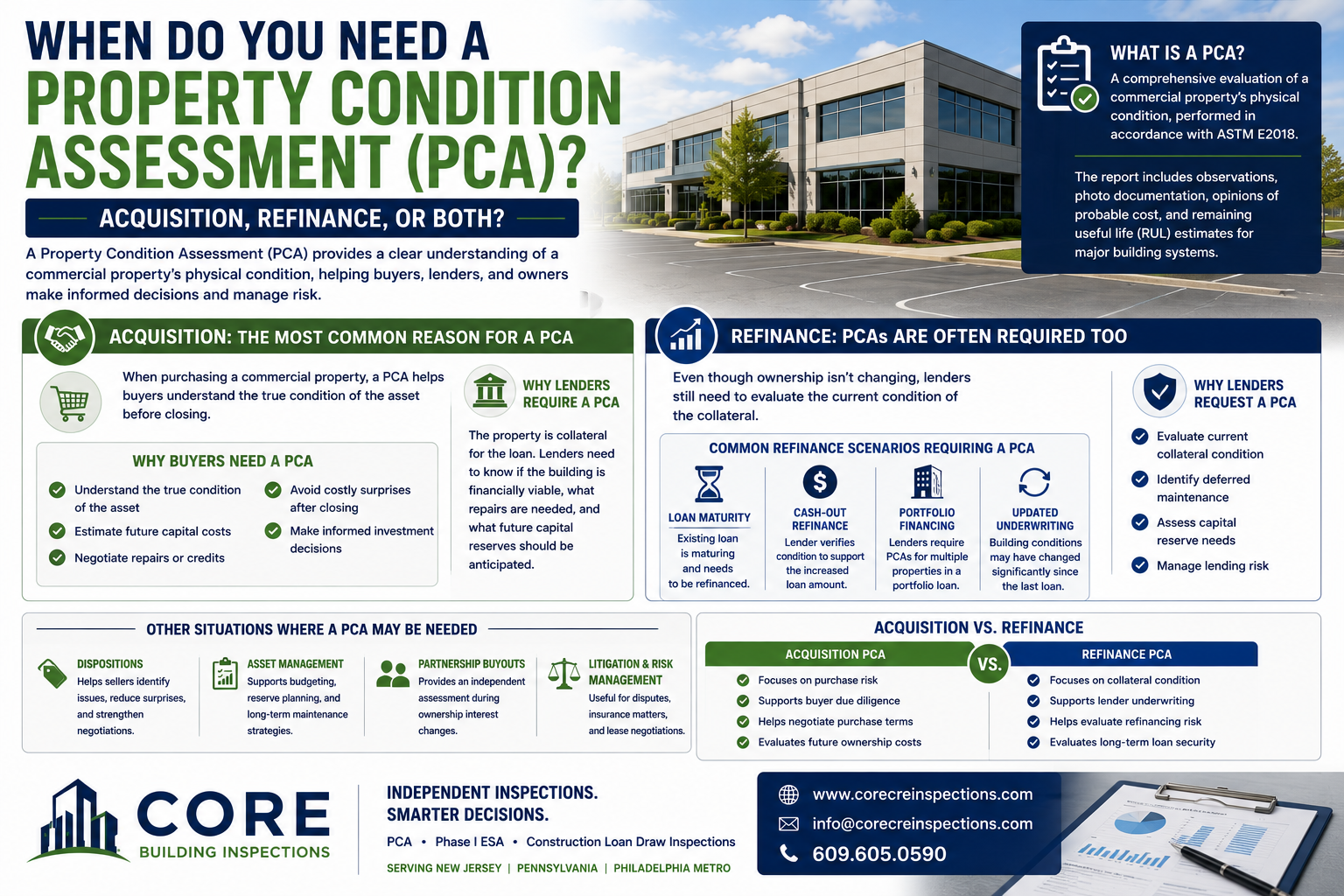
Most sophisticated buyers commission a Phase I ESA before closing on any commercial acquisition, regardless of whether the lender requires it, because the liability protection under CERCLA is only available if All Appropriate Inquiries were completed prior to taking title. Commercial lenders underwriting mortgage transactions routinely require a Phase I ESA as a condition of funding. SBA lending programs require environmental due diligence for a broad range of property types and loan categories, with specific requirements defined under SBA SOP 50 10. Refinancing transactions often require an updated Phase I when the existing assessment is beyond its five-year shelf life or when property conditions have changed.
What Happens When RECs Are Identified
When an environmental professional identifies a REC, the Phase I report will typically recommend additional investigation in the form of a Phase II Environmental Site Assessment. A Phase II involves physical sampling — soil borings, groundwater monitoring wells, vapor intrusion testing, or other methods — to determine whether contamination is actually present and, if so, at what concentrations relative to applicable regulatory standards.
The identification of a REC in a Phase I report is not a finding of contamination. It is a finding that conditions exist that warrant further evaluation before a buyer, lender, or investor accepts the associated risk. Some RECs lead to Phase II investigations that come back clean. Others confirm contamination that affects transaction terms, pricing, or feasibility. The purpose of the Phase I is to surface that question before closing, not after.
Turnaround Time and What Affects It
A standard Phase I Environmental Site Assessment is typically delivered within ten to twelve business days from the date all required information and access are in place. Expedited delivery of five to six business days is available when transaction timelines require it. Factors that can affect turnaround include the complexity of the property’s regulatory history, the availability of municipal records, access to the site, and the responsiveness of owners and property managers in completing the required AAI documentation.
Phase 1 ESAs in New Jersey and Pennsylvania
Commercial properties throughout New Jersey and the greater Philadelphia metro area carry environmental due diligence considerations that reflect the region’s industrial history. South Jersey and the Route 1 corridor have significant concentrations of former manufacturing, automotive, and petroleum-related operations. Philadelphia’s commercial neighborhoods and inner-ring suburbs include substantial redevelopment activity on sites with mixed and sometimes poorly documented histories. The Delaware Valley’s older commercial building stock — much of it built between the 1940s and 1980s — reflects an era when environmental regulations were limited and land use practices were very different from today’s standards.
In this environment, a Phase I ESA is not a formality. It is a substantive investigation with real implications for buyers, lenders, and investors who need to understand what they are acquiring before the transaction closes.
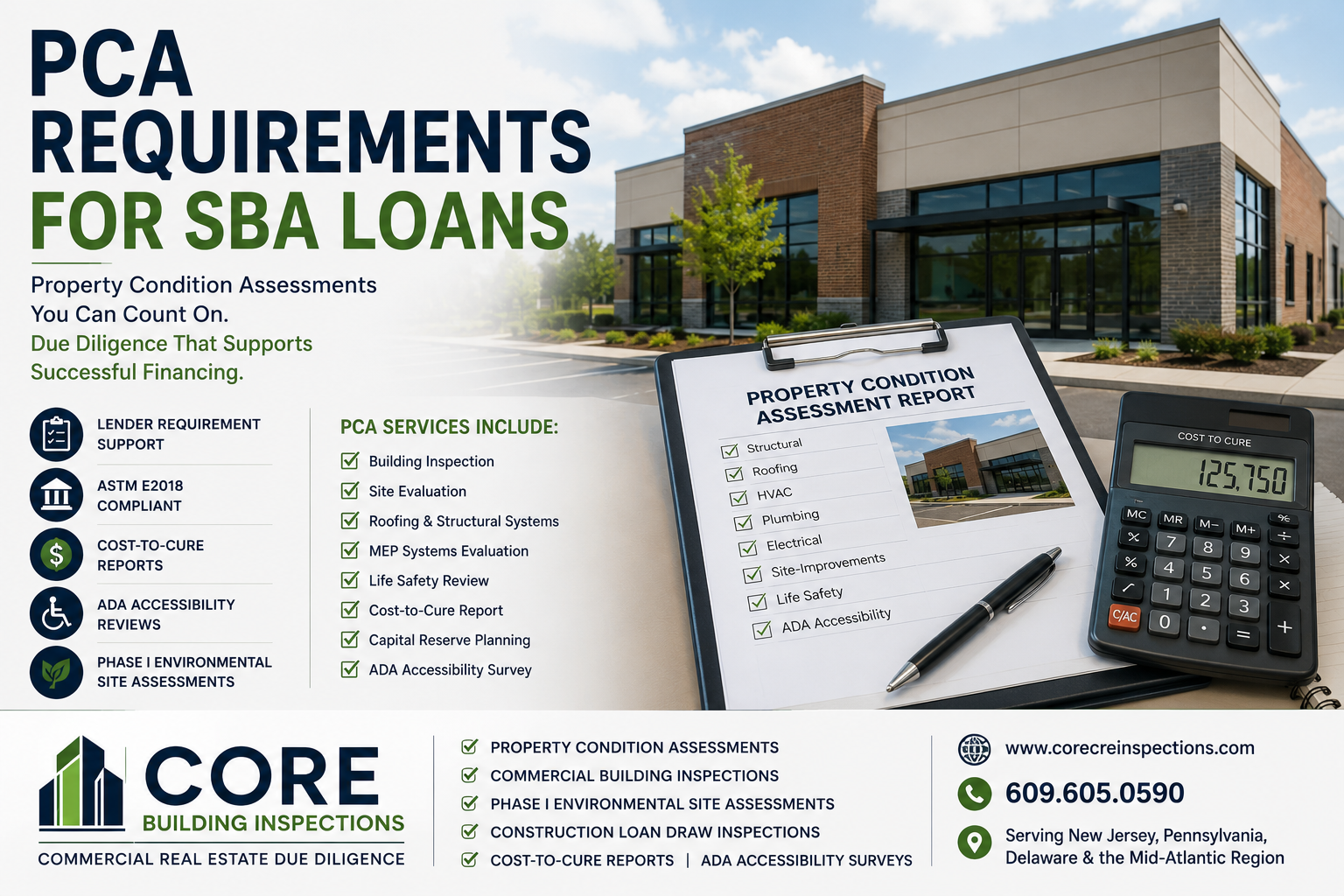
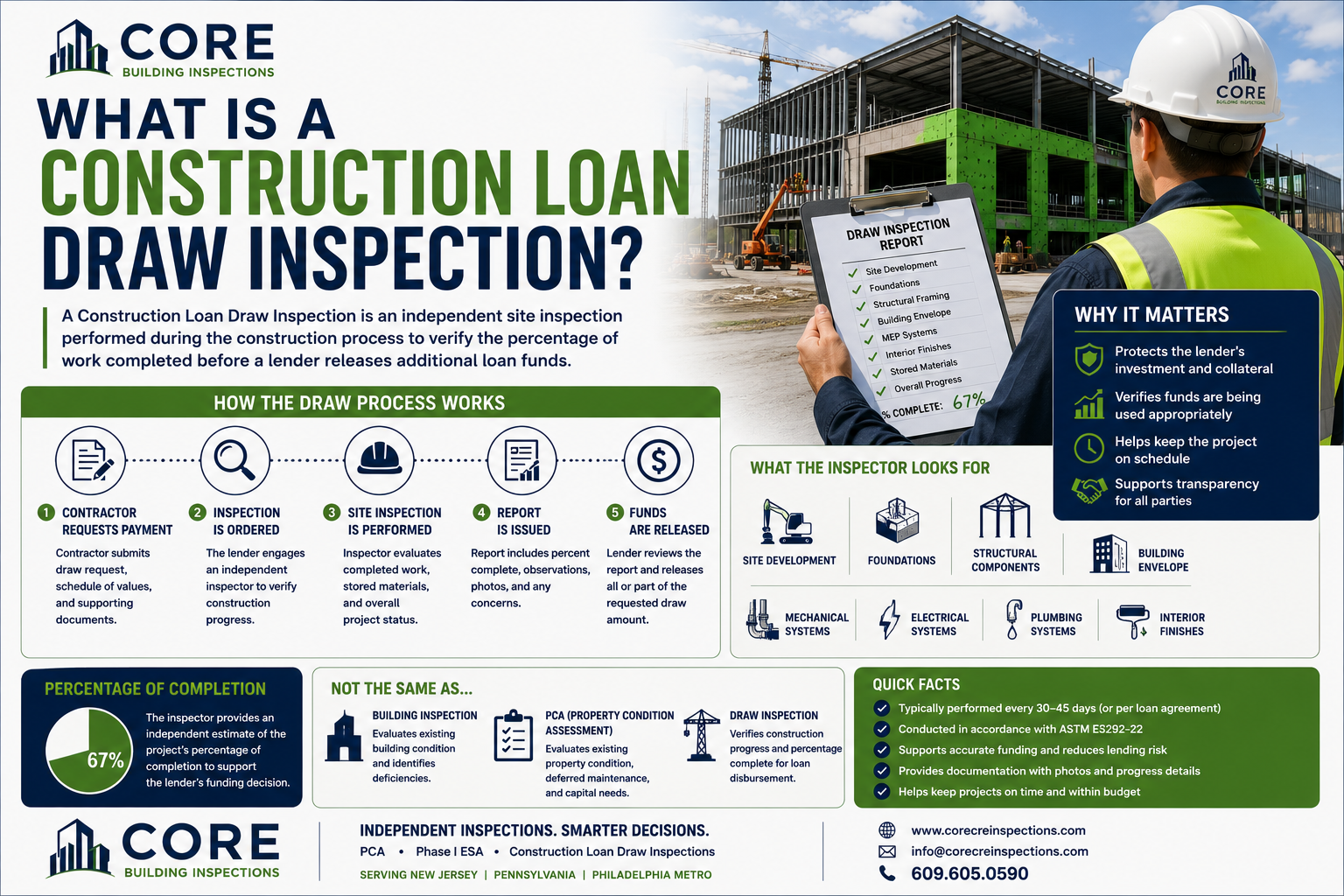
Core Building Inspections provides Phase I Environmental Site Assessments, Property Condition Assessments, Construction Loan Draw Inspections, and commercial real estate due diligence services throughout New Jersey, Pennsylvania, and the surrounding Mid-Atlantic region. If you are purchasing, refinancing, or evaluating a commercial property and need ASTM-compliant environmental due diligence, contact us at corecreinspections.com or call 609.605.0590.