A due diligence guide for commercial property buyers, lenders, and investors in New Jersey and the Philadelphia metro area.
Physical building condition tells one part of the story. Environmental risk tells another. In commercial real estate, skipping the environmental side of due diligence can expose buyers, lenders, and developers to liability that no amount of deferred maintenance budgeting will cover. That is where the Phase I Environmental Site Assessment comes in.
A Phase I Environmental Site Assessment—commonly called a Phase I ESA—is one of the most consequential reports produced during commercial real estate due diligence. Understanding what it covers, why lenders require it, and how it interacts with a Property Condition Assessment is essential knowledge for anyone acquiring or financing commercial property in New Jersey or the greater Philadelphia area.
What Is a Phase I Environmental Site Assessment?
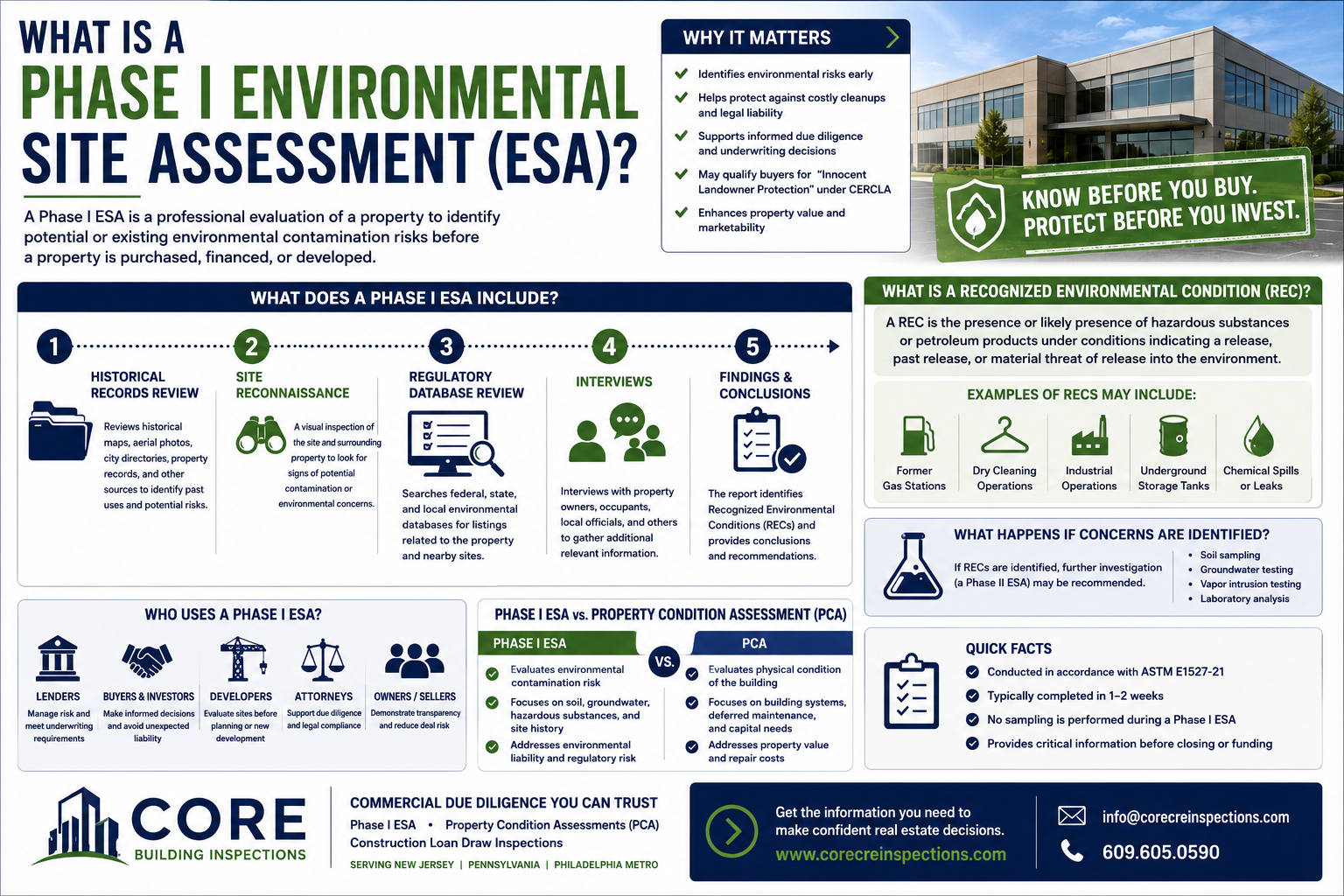
A Phase I Environmental Site Assessment is a professional environmental due diligence report designed to identify recognized environmental conditions—known in the industry as RECs—associated with a commercial property. The assessment evaluates whether hazardous substances or petroleum products are present, or may have been released, at the site.
Phase I ESAs are conducted in accordance with ASTM E1527-21, the current industry standard, and are structured to satisfy the federal All Appropriate Inquiry (AAI) requirements under CERCLA—the Comprehensive Environmental Response, Compensation, and Liability Act. Satisfying AAI is a prerequisite for a buyer to claim innocent landowner protection under federal law, which is a meaningful legal shield that no commercial buyer should forfeit.
The report is prepared by a qualified environmental professional and does not involve any soil sampling, groundwater testing, or physical media collection. It is a records-and-reconnaissance driven assessment. If the Phase I ESA identifies significant concerns, it may recommend a Phase II ESA, which does involve laboratory sampling and testing.
What Does a Phase I ESA Include?
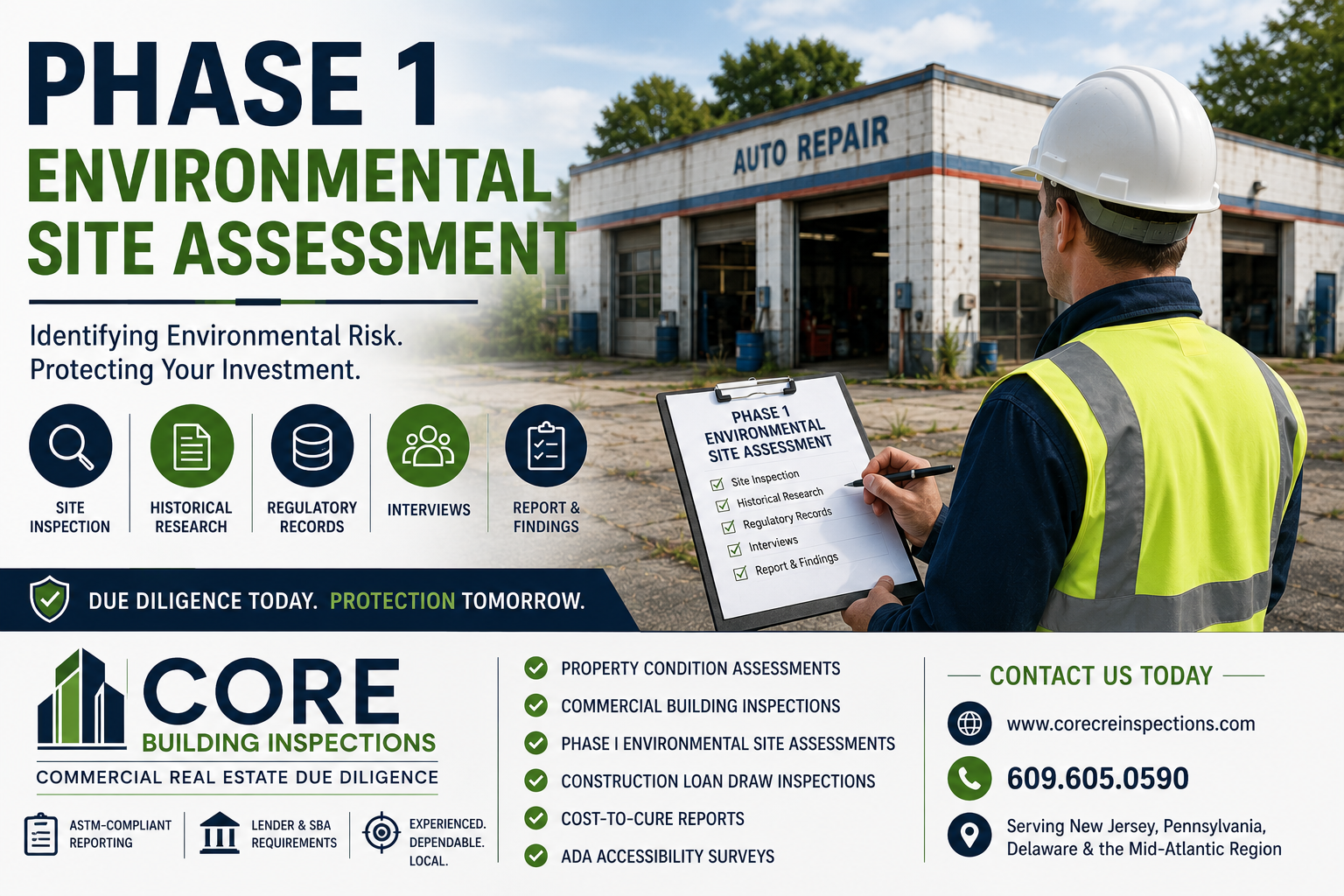
A thorough Phase I ESA is built from four primary components: a historical records review, a site reconnaissance, a regulatory database review, and stakeholder interviews. Each component is designed to surface risk that may not be visible during a standard property walkthrough.
Historical Records Review
The environmental professional examines historical aerial photographs, fire insurance maps, city directories, and property records to reconstruct the site’s operational history. In older industrial markets like New Jersey and the Philadelphia metro, this step is particularly important—properties that appear to be straightforward retail or warehouse assets today may have spent decades as automotive facilities, dry cleaners, or light manufacturing operations that handled regulated substances.
Site Reconnaissance
The environmental professional conducts a visual inspection of the property and its immediate surroundings. The reconnaissance looks for physical indicators of contamination risk: underground storage tanks or vent pipes, chemical storage areas, distressed or discolored vegetation, staining on pavement or soil, improper waste handling practices, or evidence of spills and releases. Adjacent properties are also observed, since contamination does not respect property lines.
Regulatory Database Review
Environmental databases maintained at the federal, state, and local levels are searched to determine whether the subject property or nearby sites appear on lists related to leaking underground storage tanks, hazardous waste generators, spill incidents, landfills, or known contamination events. In New Jersey, where NJDEP maintains extensive environmental records, this step frequently surfaces historical activity that predates current ownership.
Stakeholder Interviews
The environmental professional may interview current and former property owners, occupants, maintenance personnel, and local officials. These conversations can surface information about prior environmental incidents, remediation activities, or operational practices that would not appear in any database—particularly for properties with informal or undocumented histories.
What Is a Recognized Environmental Condition?
The central output of a Phase I ESA is a determination of whether Recognized Environmental Conditions—RECs—exist at the property. A REC is defined as the presence or likely presence of hazardous substances or petroleum products in conditions that indicate a release, past release, or material threat of release into the environment.
Common REC triggers include former gas station or petroleum storage operations, dry-cleaning facilities, automotive service businesses, industrial chemical handling, and agricultural chemical use. The environmental professional may also identify Controlled Recognized Environmental Conditions (CRECs), which are RECs that have been addressed through a regulatory program but may still impose use restrictions, or Historical Recognized Environmental Conditions (HRECs), which reflect past contamination that has been remediated to unrestricted use standards.
RECs do not automatically kill a transaction—but they require informed handling. Understanding what type of REC is present, how the regulatory process has or has not addressed it, and what residual risk remains is exactly the analysis a Phase I ESA is designed to support.
Why Lenders Require Phase I ESAs
Commercial lenders require Phase I ESAs because environmental contamination directly threatens collateral value. A property sitting on or adjacent to a contaminated site may face cleanup cost obligations that exceed its market value, regulatory restrictions that impair its use, and title or financing complications that make resale or refinancing difficult. Lenders protect their financial interest by verifying that the collateral they are underwriting is not carrying hidden environmental liability.
Most institutional lenders, CMBS platforms, SBA lenders, and life company lenders require a Phase I ESA prepared in accordance with ASTM E1527-21 by a qualified environmental professional as a condition of financing. In some cases, lenders also require that the report be addressed to them directly and fall within an established reliance period—typically 180 days from the report date for a current transaction.
Why Buyers Should Never Skip a Phase I ESA
Environmental contamination can arrive at closing as an invisible line item. Cleanup obligations under CERCLA and New Jersey’s Industrial Site Recovery Act (ISRA) can be imposed on current property owners regardless of whether they caused the contamination. Buyers who skip the Phase I ESA—or who accept a stale report from a seller without independent review—are assuming environmental liability they may not even know exists.
Beyond cleanup costs, undisclosed environmental conditions can delay redevelopment approvals, trigger mandatory remediation before a change in use, and create financing complications when the owner later attempts to sell or refinance. In New Jersey, ISRA is triggered when certain industrial operations are sold or transferred, imposing specific investigation and remediation obligations that a buyer unprepared for this requirement can find deeply disruptive.
Even properties that present as low-risk—suburban office buildings, neighborhood retail strips, older apartment conversions—can carry environmental history tied to prior uses on the same site or from neighboring operations. The cost of a Phase I ESA is a fraction of the exposure that skipping one can create.
Property Types That Typically Warrant Closer Environmental Scrutiny
Certain commercial property types generate elevated environmental concern based on their operational histories and the substances associated with their prior uses. Gas stations and petroleum distribution facilities top the list, given the near-universal presence of underground storage tanks and decades of hydrocarbon handling. Dry-cleaning operations are similarly high-risk due to perchloroethylene (PCE) contamination, which is one of the most frequently detected groundwater contaminants in older commercial districts.
Automotive service facilities, machine shops, industrial warehouses, and manufacturing operations round out the common high-risk categories. Older commercial properties in densely developed markets like Newark, Trenton, Camden, and the older Philadelphia-area suburbs often carry layered environmental histories precisely because these markets supported heavy industrial activity through much of the twentieth century.
Phase I ESA vs. Property Condition Assessment: Understanding the Difference
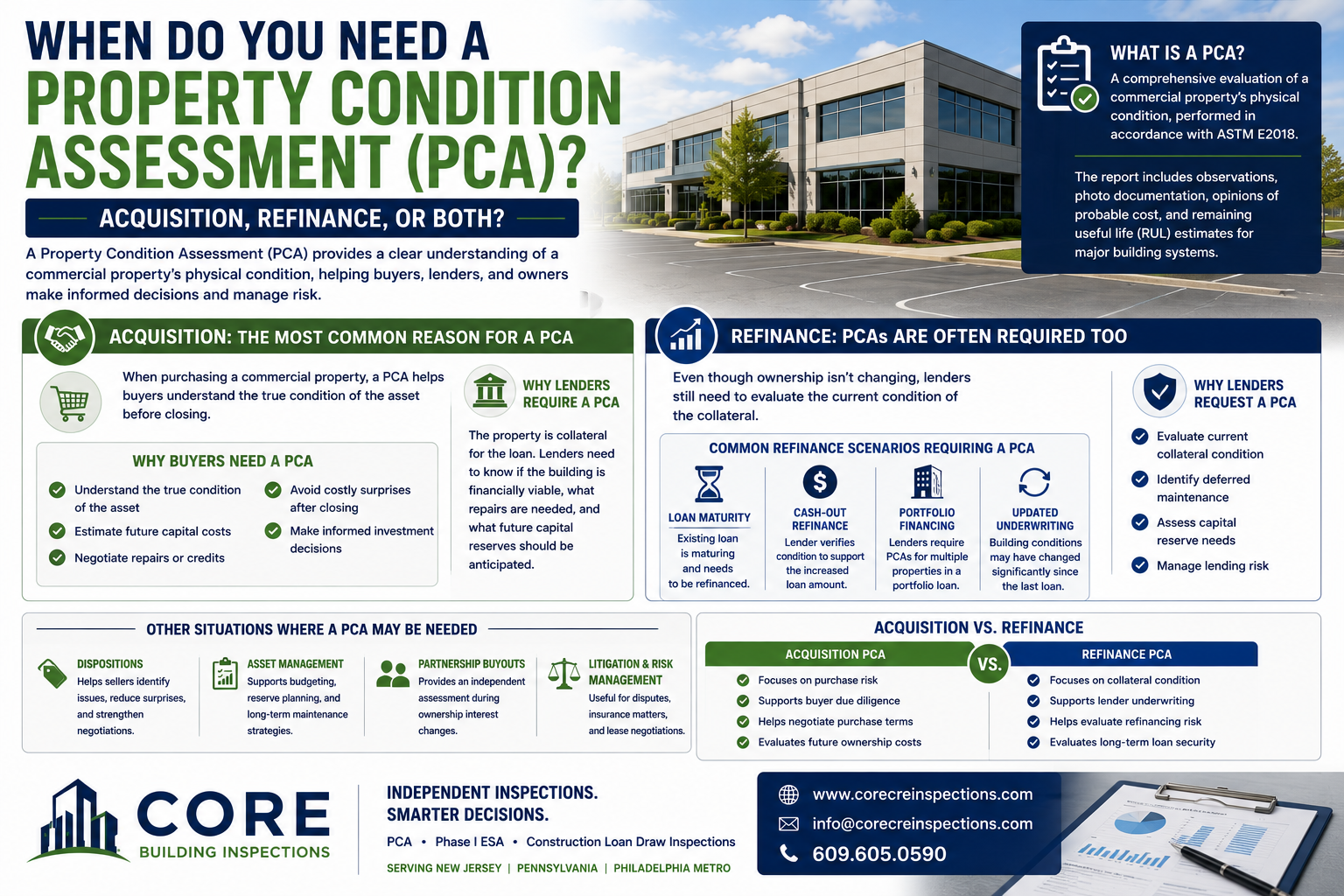
A Phase I ESA and a Property Condition Assessment are complementary reports that address entirely different categories of risk. The PCA evaluates the physical condition of a building—its structural systems, roof, mechanical and electrical systems, site improvements, and estimated capital expenditure requirements. The Phase I ESA evaluates environmental contamination risk associated with the land and its history.
Neither report substitutes for the other. A building in excellent physical condition can sit on contaminated ground. A pristine site can host a building with significant deferred maintenance. Many institutional lenders and sophisticated investors require both during commercial due diligence, and for good reason: together, the two reports provide a materially complete picture of risk before closing.
At Core Building Inspections, we specialize in Property Condition Assessments under ASTM E2018-15 for commercial properties throughout New Jersey and the Philadelphia metro area. For clients who need both reports coordinated during the same due diligence period, we work alongside qualified environmental professionals and can assist in organizing that process.
Environmental Due Diligence in New Jersey and the Philadelphia Metro
New Jersey and the Philadelphia metro area present a specific environmental due diligence landscape that buyers and lenders need to understand. New Jersey’s industrial history runs deep—chemical manufacturing, petroleum refining, textile operations, and heavy manufacturing were concentrated throughout the state for over a century. That history is reflected in the density of contaminated sites, regulated properties, and NJDEP enforcement activity that environmental professionals encounter when running database searches for properties across the state.
New Jersey also operates under some of the most rigorous state environmental laws in the country. ISRA imposes mandatory investigation and remediation obligations on industrial establishments when operations cease or ownership transfers, and the New Jersey Spill Compensation and Control Act creates strict liability for any person responsible for the discharge of hazardous substances. Buyers unfamiliar with these frameworks can find that a transaction they assumed was straightforward carries regulatory obligations they did not anticipate.
In Pennsylvania and the Philadelphia metro, older industrial boroughs, former rail corridors, and converting manufacturing properties present similar risk profiles. Environmental due diligence adapted to these specific market conditions is not generic compliance—it is substantive risk management.
Final Thoughts
A Phase I Environmental Site Assessment is a foundational component of commercial real estate due diligence. It identifies environmental risk before closing, supports lender underwriting, and provides buyers with the information they need to make informed decisions about liability, financing, and future property use. In a market like New Jersey and greater Philadelphia—where industrial history is dense and state environmental regulation is rigorous—environmental due diligence is not optional. It is a standard of practice that protects everyone at the table.
Ready to Coordinate Your Commercial Due Diligence?
If you are acquiring or financing a commercial property in New Jersey or the Philadelphia metro area, Core Building Inspections delivers Property Condition Assessments under ASTM E2018-15 with the rigor and regional expertise your transaction requires. Contact us at corecreinspections.com to discuss your due diligence timeline.