When a commercial construction project is financed through a construction loan, the lender’s exposure doesn’t end at closing — it deepens with every draw request. Unlike a conventional mortgage where a completed building serves as collateral from day one, a construction lender is funding a project that exists only in progress: footings being poured, steel going up, mechanical systems rough-framed but not yet operational, finishes still months away. The loan balance grows with each disbursement while the collateral — the building itself — remains incomplete. That gap between capital deployed and value delivered is the defining risk of construction lending, and it is precisely the risk that a Construction Loan Draw Inspection is designed to manage. For lenders, borrowers, developers, and contractors operating in today’s commercial construction environment, understanding how the draw inspection process works is not optional background knowledge. It is foundational to how construction financing functions.
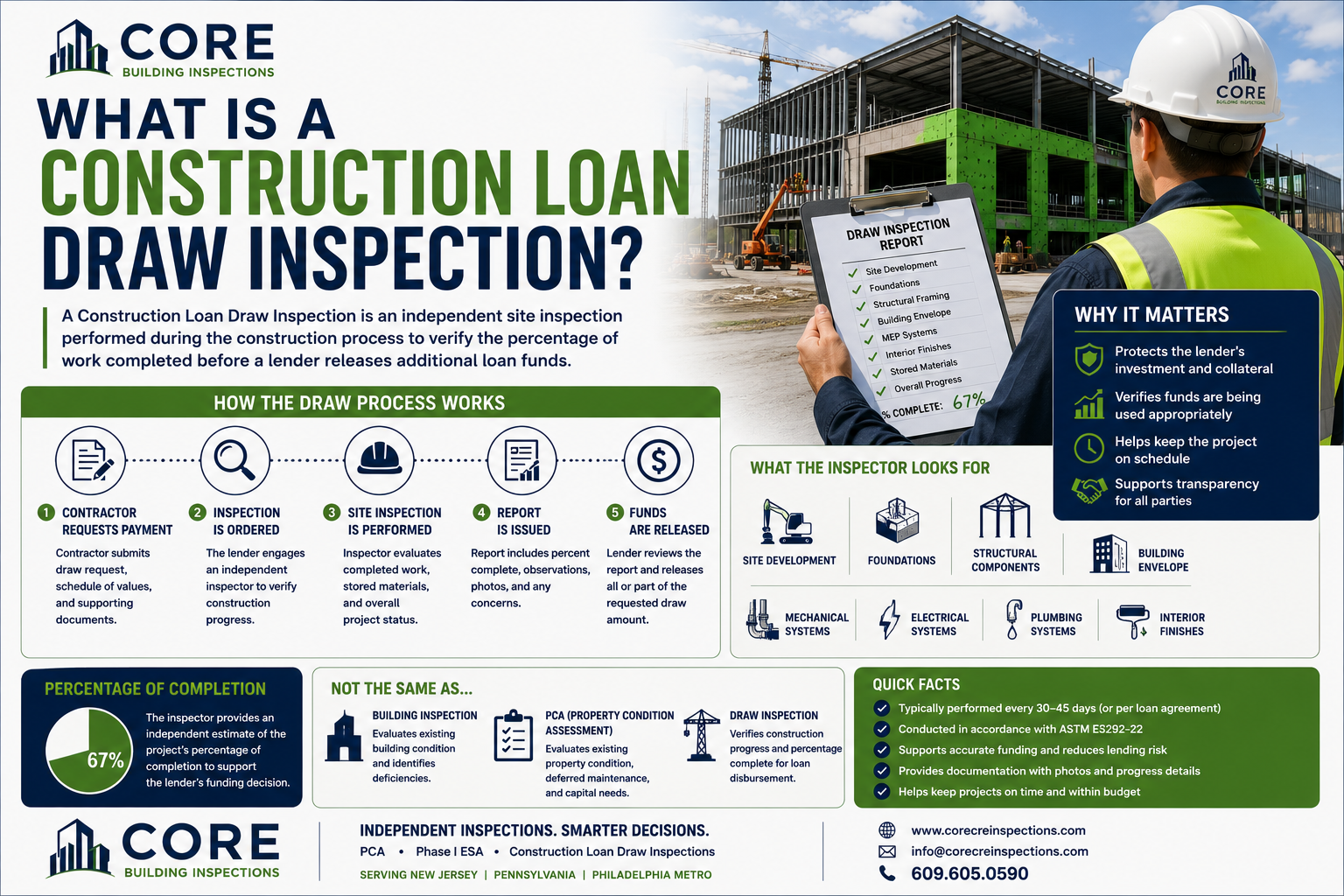
A Construction Loan Draw Inspection is an independent, third-party site inspection performed during the active construction period to verify the percentage of work completed before a lender releases additional loan funds. The inspector is engaged by the lender — not the borrower and not the general contractor — and that independence is not incidental. It is the entire point. The inspector’s obligation runs to the lender and the integrity of the reporting process, not to the project team’s draw schedule or the developer’s closing timeline. When the inspector visits a site, he is answering one question on the lender’s behalf: has enough work actually been completed to justify releasing more money?
The draw process itself follows a consistent sequence. The general contractor submits a draw request to the lender, typically accompanied by a schedule of values, a payment application, and supporting documentation such as invoices, subcontractor lien waivers, and materials certifications. The lender then orders an independent inspection before releasing any funds. The inspector visits the property, walks the site, and evaluates construction progress against the contractor’s submitted schedule of values — line item by line item, trade by trade. Site work, foundations, structural framing, building envelope, mechanical systems, electrical, plumbing, interior finishes: each component is assessed and assigned a percentage of completion based on what the inspector observes in the field. The resulting report documents those percentages, describes current site conditions, includes photographic evidence, and flags any discrepancies between what the contractor has claimed and what the inspector has actually found. The lender reviews the report and makes a funding decision — releasing the full requested amount, releasing a reduced amount consistent with the documented progress, or withholding funds pending resolution of identified concerns.
What the inspector is evaluating is progress, not perfection. This distinction is frequently misunderstood and worth stating plainly. A draw inspector is not a building inspector in the traditional sense, and he is not functioning as a code compliance officer or a quality-control agent on behalf of the borrower. A conventional building inspection evaluates the physical condition of a structure — identifying deficiencies, safety concerns, and maintenance needs. A Property Condition Assessment goes further, documenting deferred maintenance, system useful lives, and capital reserve requirements for existing, occupied buildings. A draw inspection does neither of those things. Its scope is narrowly and intentionally defined: is the work shown on the schedule of values actually complete to the percentage the contractor is claiming? If the framing is listed at eighty percent complete and the inspector finds it closer to sixty, that discrepancy is the finding. The quality of the framing, or whether it will pass a municipal inspection, is outside the draw inspector’s scope. Lenders and borrowers who conflate these roles often find themselves with misaligned expectations — and the distinction matters most when a draw is contested or a project runs into trouble.
The consequences of inadequate draw inspection are not theoretical. Construction lending has historically been one of the higher-risk categories in commercial real estate finance, and the failure modes are well documented. Without independent progress verification, lenders are exposed to contractor fraud — intentional overstating of completion percentages to accelerate cash flow at the lender’s expense. They are exposed to cost overruns that erode the loan-to-value ratio before the project is complete. They are exposed to project abandonment, where a developer who has already pulled significant equity out through overfunded draws walks away from a half-finished building that cannot be readily sold or refinanced. Each of these scenarios represents not just a lending loss but a collateral problem — a property that is worth less, in many cases substantially less, than the outstanding loan balance. Rigorous draw inspections, performed consistently throughout the construction period, are the primary mechanism by which these risks are identified early enough to be addressed.
For SBA-financed construction projects, the draw inspection requirement is not discretionary. The SBA’s Standard Operating Procedures mandate independent progress verification as a condition of construction loan disbursement, and SBA lenders must comply regardless of project size or borrower track record. Conventional commercial lenders have increasingly adopted the same standard, particularly as construction loan volumes have grown and project complexity has increased across the region. Multifamily developers, retail center redevelopers, industrial and warehouse builders, office renovation sponsors, and mixed-use project teams throughout New Jersey and the Philadelphia metro area are all operating in an environment where their lenders expect — and in many cases contractually require — independent draw inspections at each disbursement interval. The inspector is not an adversary in that process. He is a neutral third party whose documentation protects everyone: the lender from overfunding, the borrower from a loan that outpaces the project, and the project itself from the funding gaps that derail construction timelines.
For lenders, the value of a well-executed draw inspection program extends beyond any single disbursement decision. The cumulative inspection record — site visit by site visit, draw by draw — creates a documented timeline of project progress that supports underwriting decisions, satisfies regulatory examination requirements, and provides an evidentiary foundation in the event of a loan default or construction dispute. Credit committees reviewing troubled construction loans consistently find that the projects with the strongest inspection records are the ones where problems were identified early, draw amounts were appropriately calibrated, and the lender maintained meaningful leverage throughout the construction period. The projects where inspections were waived, delayed, or performed superficially are invariably the ones where the first clear signal of trouble came far too late to be cost-effectively addressed.
For borrowers and developers, a rigorous draw inspection process is not a burden — it is a structural support. Timely, accurate inspections facilitate timely fund releases. They create a documented record of project milestones that can be referenced in disputes with subcontractors, suppliers, or municipal inspectors. They maintain lender confidence through the inevitable complications that arise in any significant construction project, providing an objective basis for conversations about schedule adjustments, scope changes, or contingency draws. Developers who have worked through a well-managed draw inspection program consistently report that the discipline it imposes on their own documentation and scheduling practices makes them better at running projects — not just better at satisfying lenders.
The commercial construction market throughout New Jersey and the greater Philadelphia region continues to generate significant activity across asset classes. Ground-up multifamily development, warehouse and logistics construction, retail center redevelopment, mixed-use infill projects, and major building renovation and adaptive reuse work are all active in the market, and all of them are generating construction financing that requires independent draw inspection services. As construction costs remain elevated and lending standards continue to tighten in response to interest rate volatility and project risk, the demand for qualified, experienced draw inspectors who understand both the physical construction process and the documentation expectations of institutional lenders is only growing. The inspector who can walk a job site, accurately assess completion percentages across all major construction trades, identify discrepancies before they become funding problems, and produce a report that holds up to credit committee scrutiny is providing a service that is genuinely indispensable to the commercial lending process.
If your bank, credit union, or lending institution requires independent construction progress verification for a commercial project in New Jersey or the Philadelphia metro area, Core Building Inspections provides professional Construction Loan Draw Inspection services designed to support accurate funding decisions and protect your lending position throughout the construction period. Our inspectors bring direct commercial construction knowledge and a clear understanding of lender documentation requirements to every site visit — delivering the kind of independent, objective reporting that credit committees and loan officers can rely on. To discuss your project and learn how we can support your construction lending program, visit us at corecreinspections.com or reach out directly to schedule a consultation.