One of the most common statements heard during commercial real estate due diligence is some version of: “That was just repaired.” Sellers say it. Brokers repeat it. And buyers, lenders, and investors often accept it as reassurance that a potential problem has been resolved.
It hasn’t — at least not necessarily.
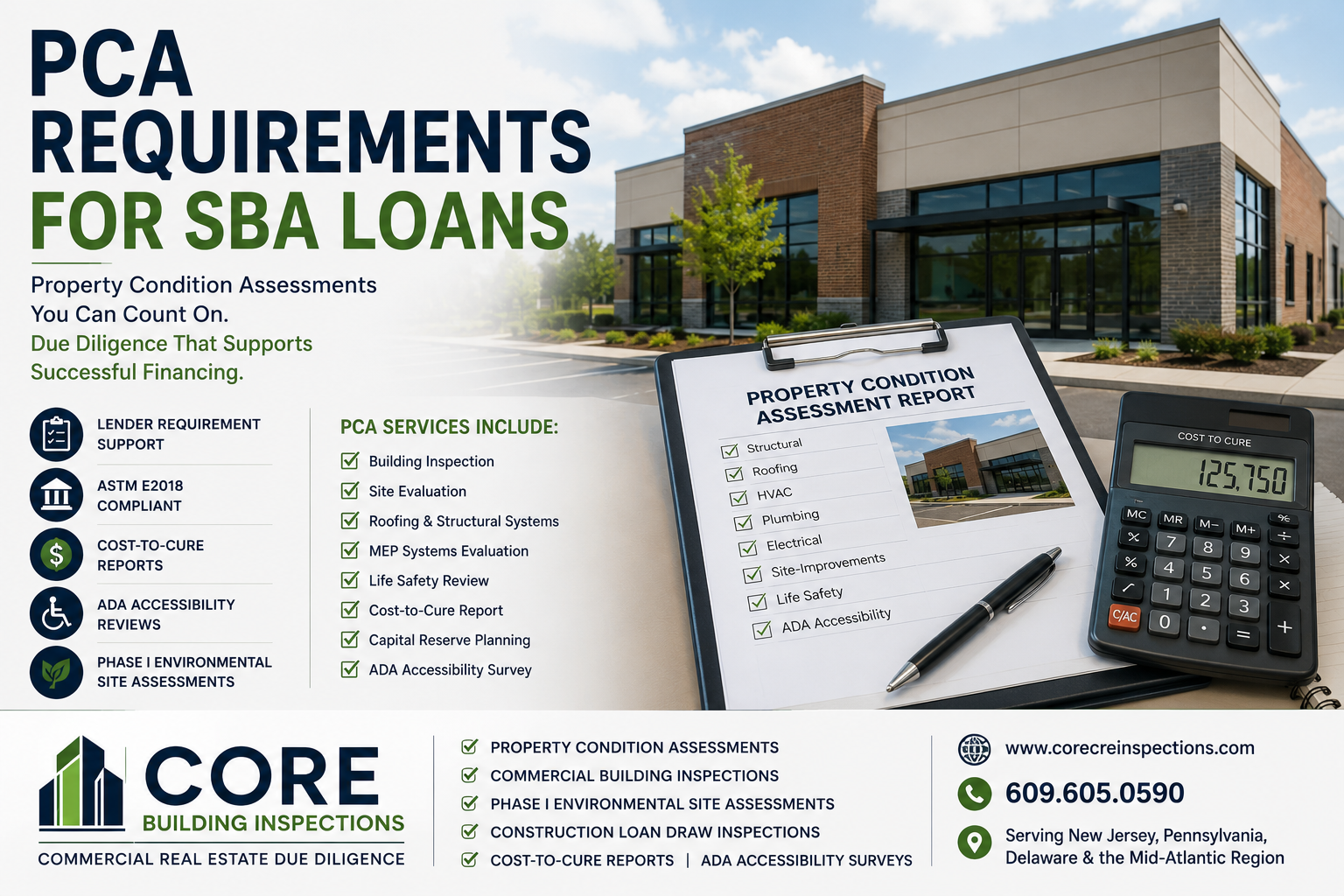
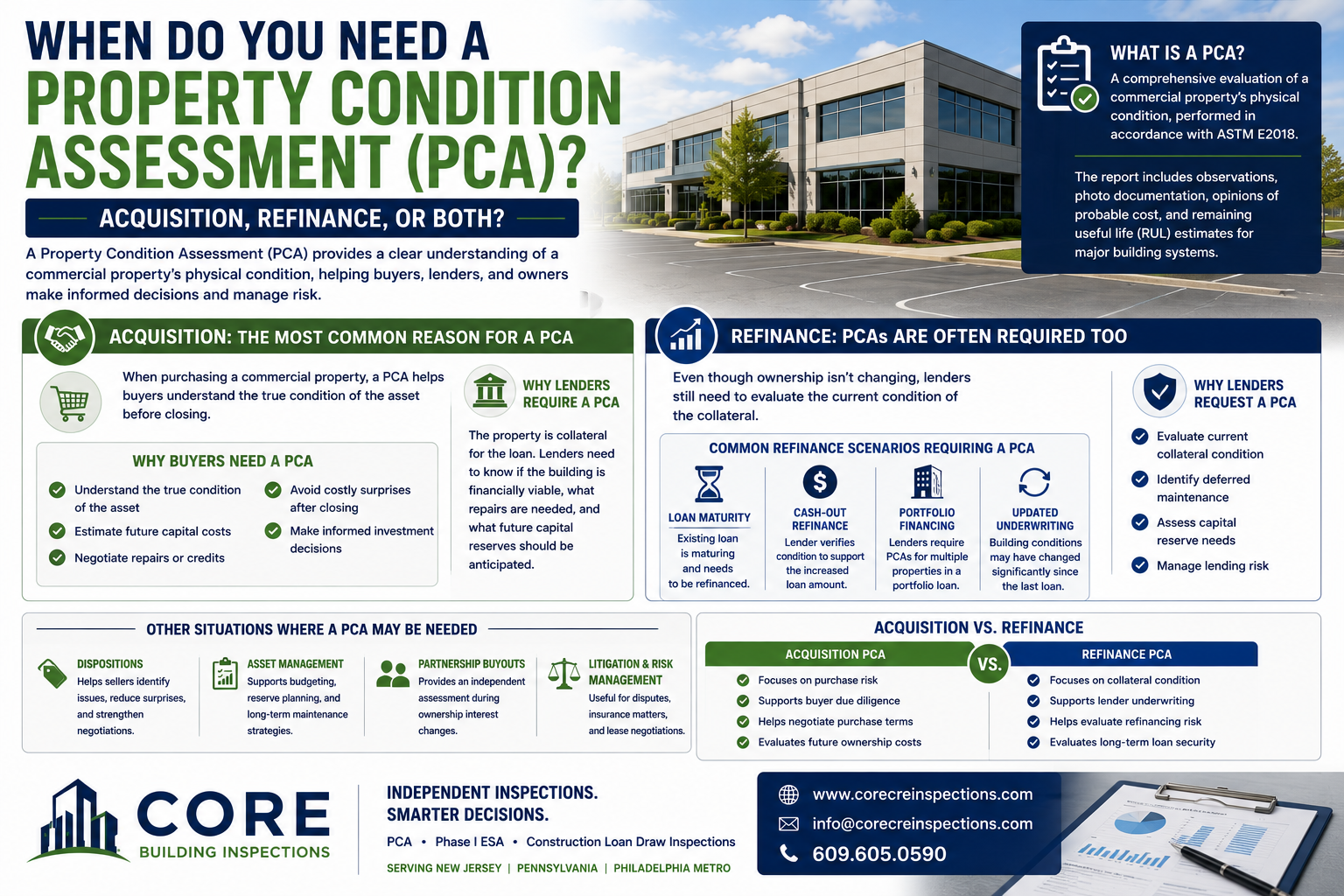
In commercial real estate, a recent repair is a data point, not a verdict. Understanding the difference between a repair that was made and a system that is actually in good condition is one of the most important distinctions a buyer or lender can make before closing. It is also one of the core reasons a Property Condition Assessment (PCA) conducted under ASTM E2018-15 remains one of the most valuable tools in the CRE due diligence process.
Why Recent Repairs Create a False Sense of Security
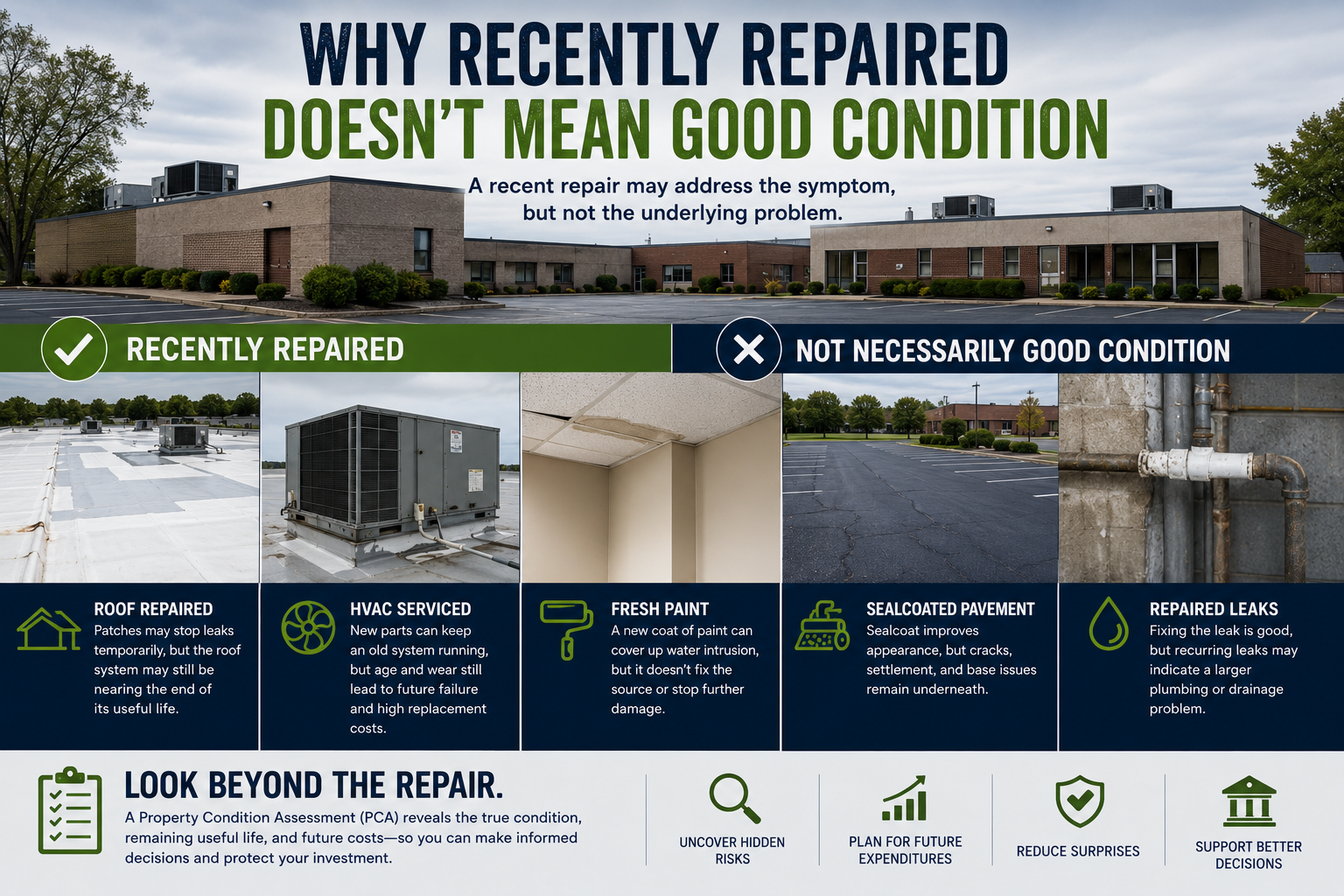
Repairs vary enormously in scope, quality, and lasting effect. A building owner who reports that a roof was repaired last year is telling the truth — but that truth may be incomplete. The repair may have corrected a single point of failure while leaving the surrounding membrane aged, brittle, and within a few seasons of requiring full replacement. The same applies to HVAC systems, pavement, structural components, and virtually every major building system.
The real questions are not whether a repair occurred. They are whether the root cause was addressed, how much useful life the system realistically has remaining, and what capital exposure the new owner is assuming at acquisition. A Property Condition Assessment answers all three.
Roof Systems: The Most Common Example
Roof repairs are the single most frequently misunderstood component in commercial property due diligence. A seller may truthfully report that the roof was patched, recoated, or had flashings replaced within the past year. A PCA inspection may still identify active moisture intrusion, widespread membrane deterioration, multiple prior repair areas, and a system that is five to ten years past its typical service life.
In those cases, the repair extended the roof’s performance by a season or two. It did not meaningfully change the Estimated Remaining Useful Life (RUL), and it did not eliminate the capital expenditure that a buyer will eventually face. An experienced inspector evaluates the system as a whole — age, condition, failure patterns, repair quality, and performance trajectory — not simply whether work was recently performed.
HVAC: New Parts in an Old System
Commercial HVAC is another area where recent repairs routinely create misleading impressions. A rooftop unit may have a new compressor, a replaced blower motor, and a stack of recent service records. It may also be twenty years old, operating well past its expected service life, and statistically likely to experience further component failures in the near term.
Replacing a single component does not reset the age or condition of the overall system. From a capital planning perspective, a recently serviced unit that is chronologically old still represents a near-term replacement liability. That liability belongs on the buyer’s capital plan — not buried under the assumption that recent service means the system is sound.
Fresh Paint and Cosmetic Work
Cosmetic improvements are perhaps the most straightforward example of appearance diverging from condition. Fresh paint, new flooring, and updated finishes can make a building look excellent while concealing water intrusion behind walls, prior moisture damage, or years of deferred maintenance on structural and mechanical systems. A building that photographs beautifully can still carry a six-figure deferred maintenance liability that only a thorough field inspection will surface.
This is not an indictment of sellers who invest in cosmetic improvements. It is simply a reminder that appearance and condition are different things, and due diligence has to address both.
Parking Lots: When Seal Coating Masks Base Failure
A freshly seal-coated parking lot is one of the more visually deceptive conditions in commercial property assessment. Seal coating improves appearance and provides modest surface protection, but it does not repair base failure, correct drainage problems, or address alligator cracking that indicates structural pavement deterioration underneath. A parking lot that looks like new on the day of inspection may have underlying conditions that will require full reconstruction within two to three years.
A Property Condition Assessment evaluates pavement condition beyond the surface — looking for base failure indicators, settlement patterns, drainage issues, and the integrity of curbing and perimeter conditions that a surface treatment cannot mask.
What Inspectors Are Actually Evaluating
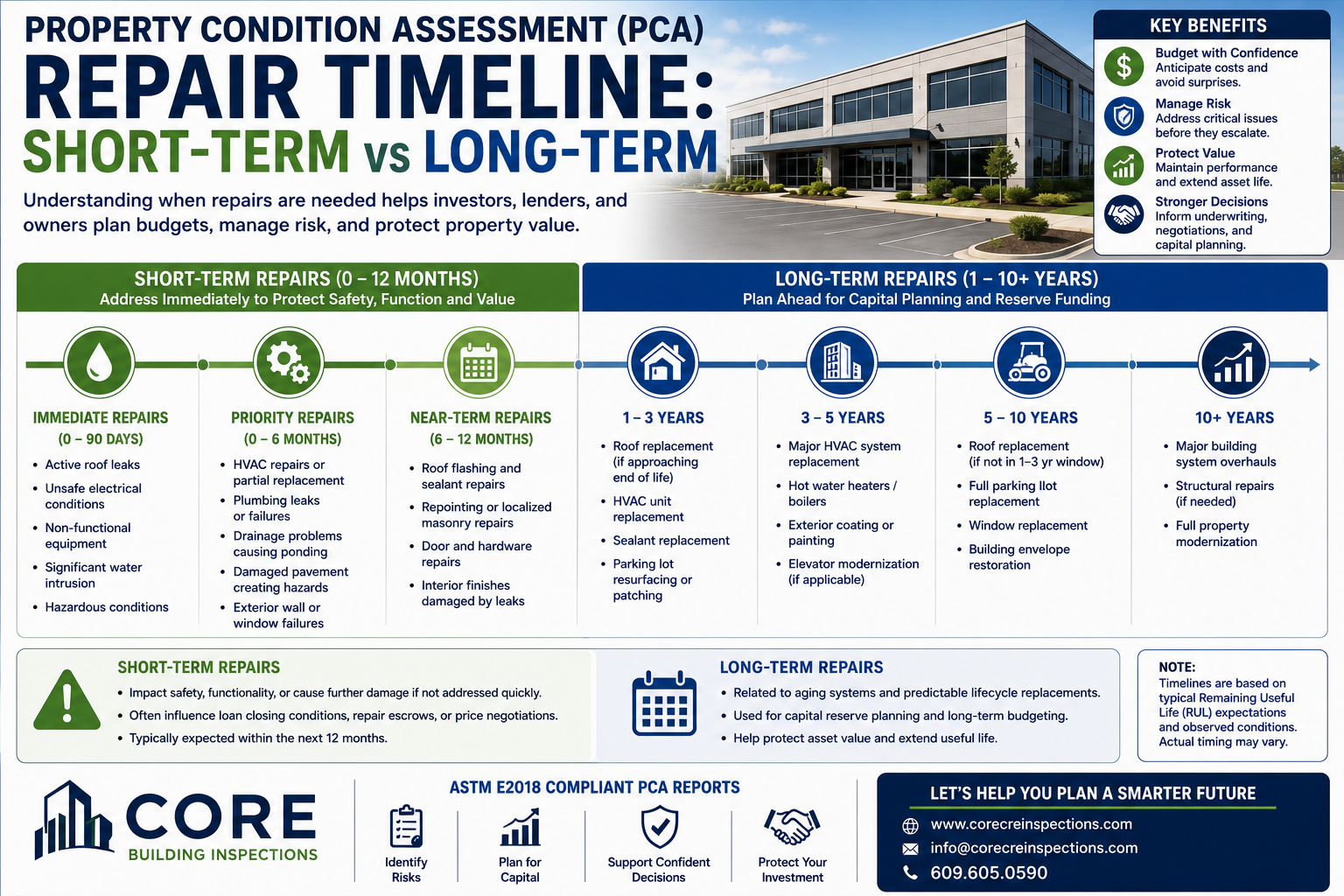
A PCA does not document whether repairs were made. It evaluates whether the building’s systems are likely to perform adequately going forward and what investment will be required to keep them performing. The framework inspectors use focuses on overall system age, observed deterioration, the quality and permanence of prior repairs, evidence of recurring problems, and the probable cost and timing of future capital expenditures.
The distinction between a temporary repair and a corrective repair matters significantly in this context. A temporary repair — patching a roof, sealing an active leak, spot-treating pavement — reduces an immediate problem and may delay a larger expenditure. It does not address the root cause or extend useful life in any meaningful way. A corrective repair — replacing a roof, replacing an HVAC system, stabilizing a structural element — addresses the underlying condition and legitimately changes the capital outlook. Experienced inspectors distinguish between the two in every report.
What Lenders Want to Know
Commercial lenders underwriting against a property are not primarily interested in whether repairs were recently made. They are interested in the long-term condition of the collateral, the stability of the asset, and the capital expenditures a borrower will face during the loan term. This is why PCA reports prepared for lending transactions emphasize Remaining Useful Life projections, immediate repair costs, and short- and long-term capital planning estimates — not repair history.
A lender who relies on “it was just repaired” as a substitute for a thorough PCA is accepting risk that the numbers in the report are designed to quantify.
What Investors Need to Factor In
For investors underwriting a commercial acquisition, recent repairs can quietly distort return projections if they are treated as condition improvements rather than what they often are: maintenance events that do not change the capital timeline. The relevant questions are whether the root cause was corrected, how much useful life the system actually has remaining, what future expenditures are realistic within the investment hold period, and whether those expenditures are already reflected in the purchase price.
Each of those answers has a direct impact on ROI. A Property Condition Assessment provides the data to answer them before the purchase closes rather than after.
Why This Is Particularly Relevant in New Jersey and the Philadelphia Metro Area
The commercial building stock in New Jersey and the greater Philadelphia area is older than average by national standards. Many properties in markets throughout South Jersey, the Route 1 corridor, and the Philadelphia suburbs were constructed between the 1950s and 1980s. These buildings have experienced decades of freeze-thaw cycles, deferred maintenance, and piecemeal repair strategies that have extended systems well past their designed service lives.
In this environment, the gap between recent repairs and actual condition tends to be wider than in markets with newer building stock. A property that has been maintained through reactive repairs rather than systematic capital reinvestment may carry a deferred maintenance backlog that is only visible through a thorough field assessment. That is the environment Core Building Inspections operates in every day, and it is the reason our clients treat a PCA as a non-negotiable part of any acquisition or refinance.
The Bottom Line
A recent repair is worth noting. It is not worth relying on. Whether you are a buyer, a lender, or an investor, understanding what a repair actually accomplished — and what it did not — is the kind of analysis that protects capital and avoids costly assumptions at closing.
A Property Condition Assessment conducted under ASTM E2018-15 is designed to make that determination rigorously, with field observation, system evaluation, and professional judgment that goes beyond repair records and seller representations.
Core Building Inspections provides ASTM E2018-15 compliant Property Condition Assessments for commercial real estate acquisitions, refinancing, and portfolio review throughout New Jersey and the Philadelphia metro area. If you are evaluating a commercial property and want to understand what you are actually buying — not just what has recently been repaired — contact us at corecreinspections.com or call 609.605.0590.