Understanding Property Condition Assessments for SBA-Financed Commercial Real Estate in NJ and PA
If you are purchasing or refinancing commercial real estate using a Small Business Administration loan, there is a reasonable chance your lender will require a Property Condition Assessment before the transaction closes. Many borrowers encounter this requirement for the first time mid-transaction and are caught off guard by what it involves, how long it takes, and what happens if the inspector finds problems.
Understanding why SBA lenders require a Property Condition Assessment — and what to expect from the process — can help you move through underwriting more efficiently and avoid the delays that come from being unprepared.
What a Property Condition Assessment Is
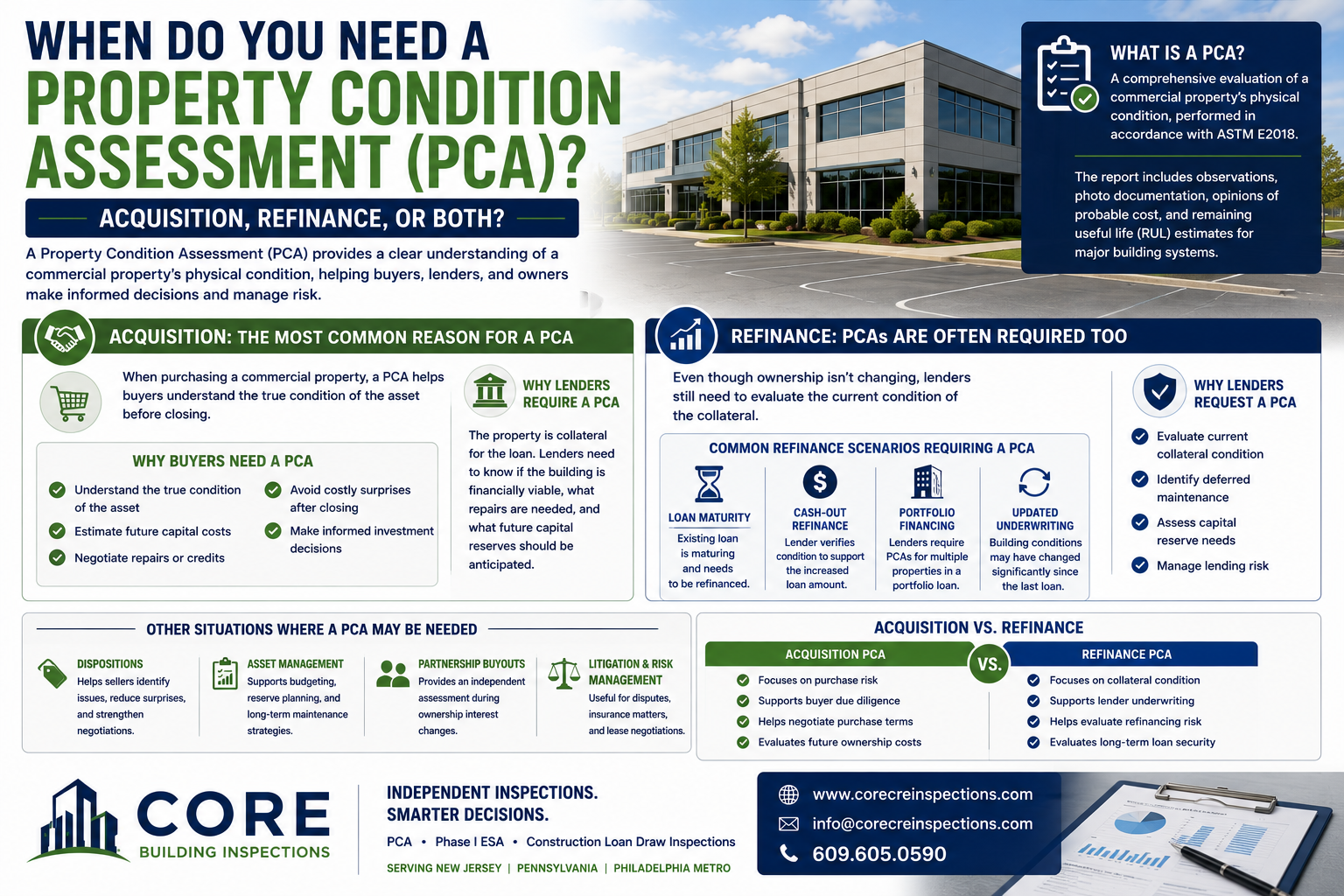
A Property Condition Assessment, or PCA, is a systematic evaluation of a commercial property’s physical condition conducted by a qualified inspector in accordance with ASTM E2018 guidelines. The assessment is specifically designed to support commercial real estate lending and investment decisions — not as a pass/fail home inspection equivalent, but as a professional analysis of building system condition, deferred maintenance exposure, and anticipated capital expenditures over a defined planning horizon.
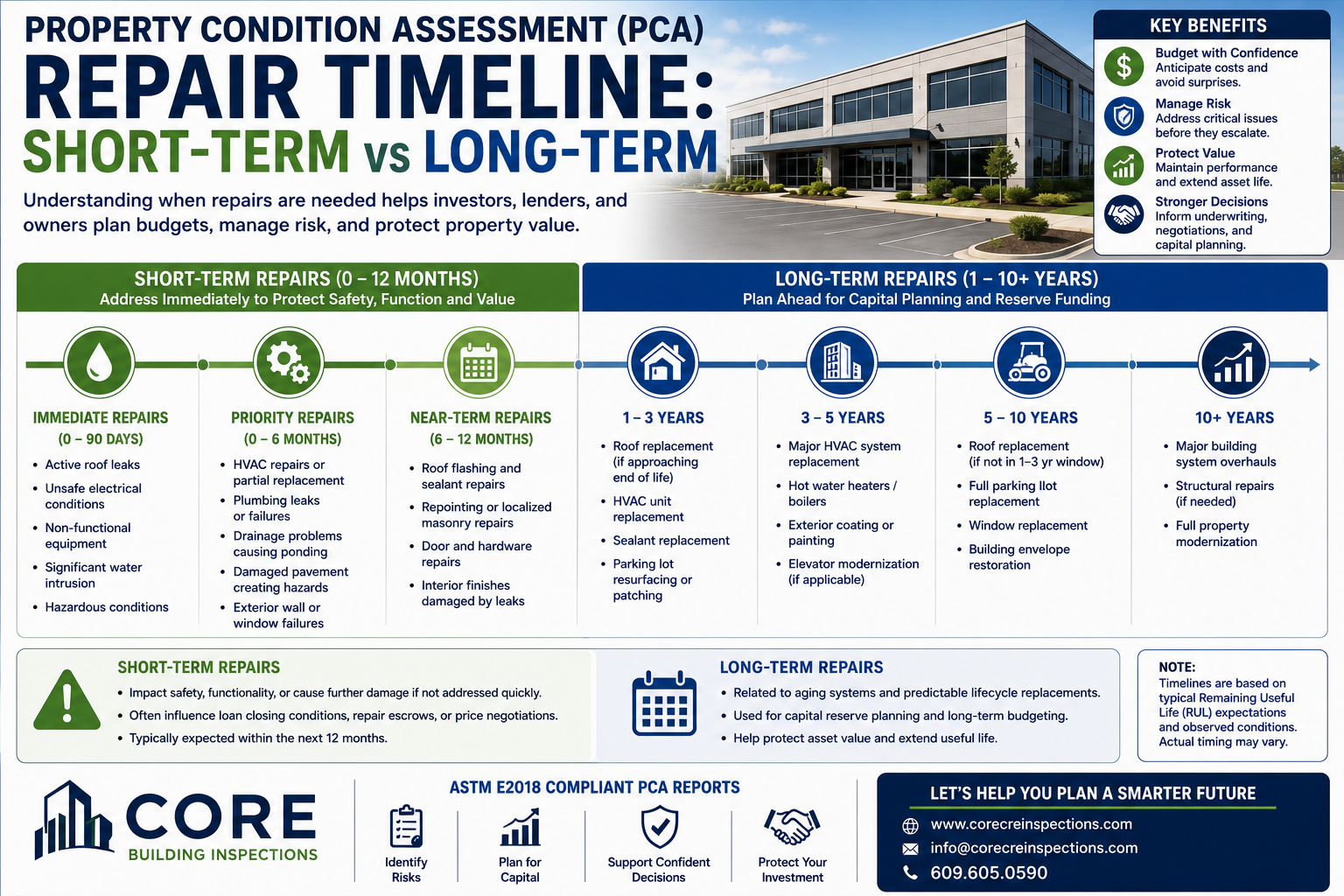
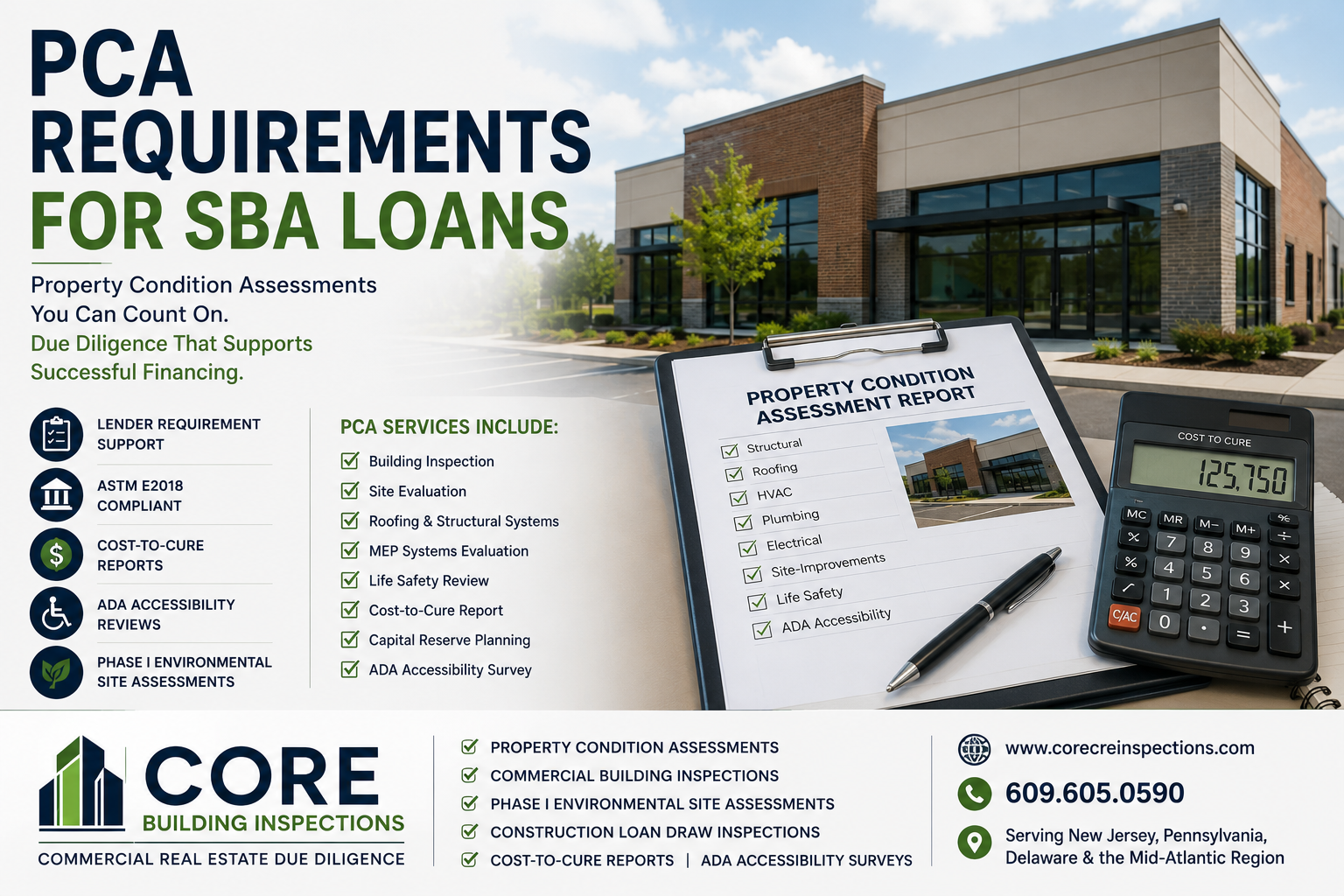
A PCA evaluates every major building system and site component: the structure, roofing, building envelope, mechanical systems, electrical systems, plumbing, life safety systems, and site improvements including parking and drainage. The report documents observed conditions, identifies immediate repair needs, estimates the Remaining Useful Life of major systems, and provides an Opinion of Probable Cost for both near-term repairs and longer-term capital replacements.
The result is a document that gives the lender — and the borrower — a clear, professional picture of what the property’s physical condition actually is and what it is likely to cost to maintain and operate going forward.
Why SBA Lenders Require It
The SBA and its participating lenders are underwriting against collateral. Before committing loan proceeds to a commercial real estate transaction, the lender needs to understand the actual condition of that collateral and the capital obligations that will follow the borrower into ownership.
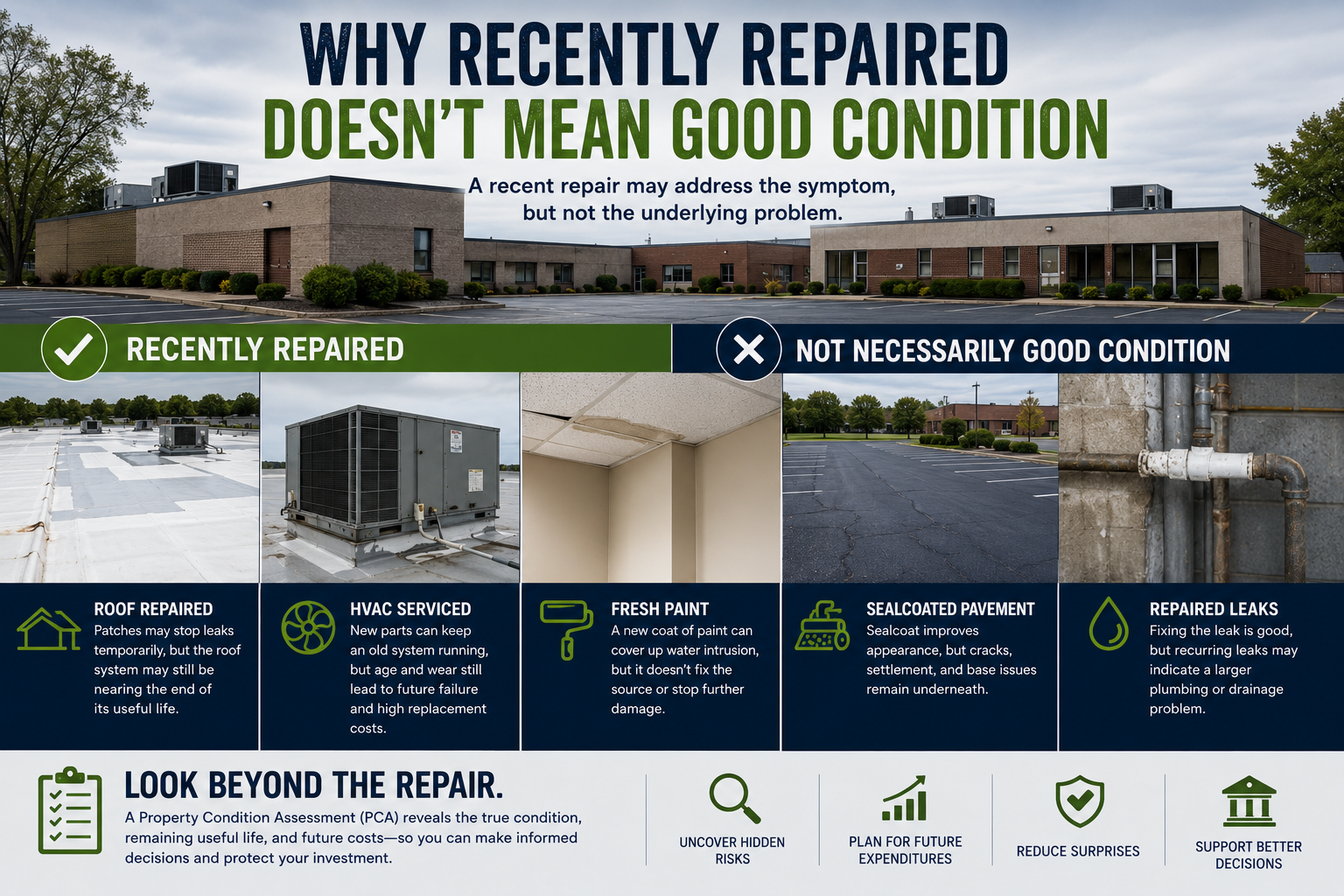
A property that looks well maintained can still carry significant deferred maintenance: a roof near the end of its service life, HVAC equipment that is a decade past its expected replacement date, a parking lot with base failure underneath a fresh seal coat, or electrical infrastructure that has not been updated since the building was originally constructed. None of those conditions necessarily disqualify a loan, but all of them affect underwriting assumptions, and all of them represent real financial obligations that will fall on the borrower. The PCA puts those obligations on paper before closing rather than after.
When a PCA Is Required for SBA Financing
SBA lending requirements vary by program, lender, and transaction characteristics, but several factors commonly trigger a PCA requirement.
Older commercial properties are the most consistent trigger. When a building’s major systems are approaching the end of their expected service lives, lenders want independent confirmation of their condition and a professional estimate of upcoming replacement costs. Properties with visible deferred maintenance or known physical concerns will almost always require a PCA regardless of age. As loan amounts increase, lenders typically require more comprehensive property evaluation — larger exposure means greater scrutiny of the collateral.
Special-use property types also receive heightened attention. Automotive repair facilities, restaurants, hotels, daycare centers, medical offices, and industrial buildings carry specialized systems and operational characteristics that standard property evaluations may not fully capture. SBA lenders underwriting these property types frequently require a PCA as a matter of course.
If your transaction involves any of these characteristics, it is worth assuming a PCA will be required and building the timeline into your closing schedule from the start.
What the Assessment Covers
A PCA conducted under ASTM E2018 evaluates the full physical condition of the property. At the site level, that includes parking lots and pavement, sidewalks, curbing, drainage, lighting, and landscaping. The structural evaluation addresses foundations, load-bearing walls, framing systems, and any visible evidence of structural distress or movement. Roofing systems are evaluated for the condition of the membrane or covering, flashings, drainage, and any evidence of active or past moisture intrusion.
The building envelope — exterior walls, windows, doors, sealants, and penetrations — is evaluated for water intrusion concerns and deterioration. Mechanical systems including HVAC equipment, ventilation, and heating and cooling infrastructure are assessed for condition, age, and anticipated service life. Electrical systems are evaluated from the service entrance through distribution panels and visible branch wiring. Plumbing covers supply distribution, drainage systems, and water heating equipment. Life safety systems including fire alarm, fire suppression, emergency lighting, and exit signage are observed and documented.
The report produced from these observations includes both a narrative assessment of each system and a cost table summarizing immediate repair needs and anticipated capital expenditures over a one- and ten-year planning horizon.
Cost-to-Cure Reports and ADA Reviews
Many SBA lenders require a Cost-to-Cure Report alongside the PCA. Where a PCA documents overall system condition and capital planning, a Cost-to-Cure Report focuses specifically on identified deficiencies and provides line-item cost estimates for correcting them. This gives the lender a quantified picture of the financial gap between current condition and a defined acceptable standard — information that directly informs decisions about repair escrows, loan adjustments, or pre-closing remediation requirements.
ADA Accessibility Surveys are also frequently requested in conjunction with SBA PCAs. The purpose is to identify apparent accessibility deficiencies that could represent future liability or capital planning exposure. Common observations include deficiencies in accessible parking configuration and signage, ramp and path-of-travel conditions, door hardware and threshold clearances, and restroom accessibility. An ADA review does not constitute a legal compliance determination, but it documents observable conditions that a prudent buyer and lender should understand before closing.
What Happens When Deficiencies Are Found
A PCA that identifies deficiencies does not automatically jeopardize a loan. Deficiencies are common, expected, and in many cases manageable within the transaction structure. What matters is how significant the deficiencies are, how the lender chooses to address them, and how the borrower responds.
Depending on the nature and cost of the findings, a lender may require certain repairs to be completed prior to closing, establish a repair escrow to ensure post-closing remediation, request additional contractor estimates to validate PCA cost projections, or adjust underwriting assumptions to account for near-term capital requirements. In some cases, significant findings affect loan terms or require renegotiation of purchase price. The PCA creates the information that allows all of those conversations to happen with accurate data rather than assumptions.
The worst outcome is not a PCA that identifies problems. The worst outcome is closing without a PCA and discovering those problems after the borrower has taken title.
Timing and What Affects Turnaround
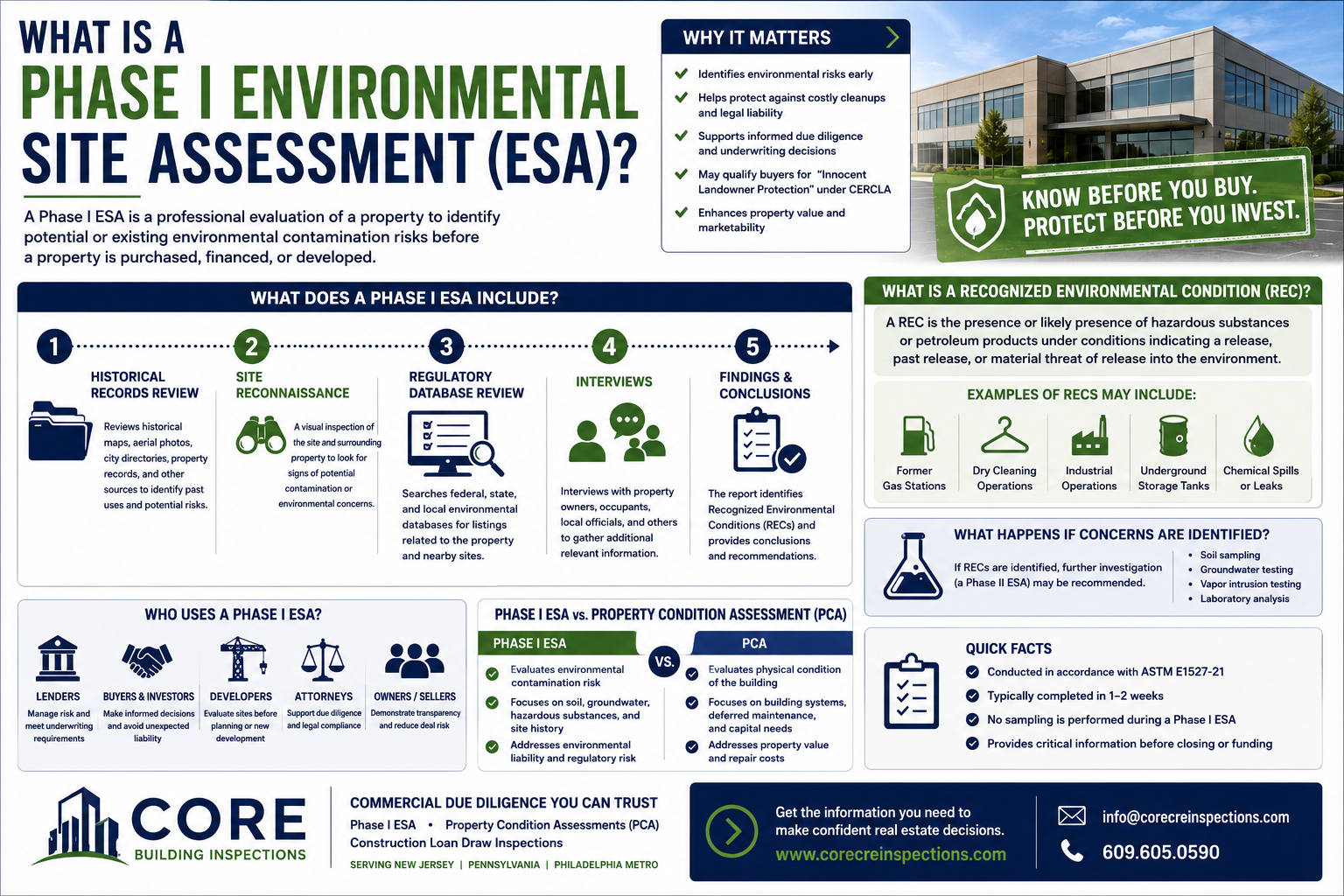
Most Property Condition Assessments are delivered within five to ten business days of the site inspection, depending on property size, complexity, occupancy, and the scope of services requested. Borrowers who schedule due diligence early in the transaction process — ideally concurrent with the appraisal order — are the least likely to experience closing delays related to the PCA.
Delays are most common when site access is difficult to coordinate, when lenders or borrowers wait until late in the transaction to initiate the assessment, or when the scope of services requires multiple site visits or specialized system evaluations. Building the PCA timeline into your transaction schedule from the outset is the most straightforward way to avoid those delays.
Selecting a PCA Provider for SBA Financing
Not every commercial building inspection satisfies SBA lender requirements. Borrowers should select a provider with demonstrated experience in ASTM E2018-compliant Property Condition Assessments, familiarity with SBA lending standards and report format requirements, and the ability to deliver Cost-to-Cure Reports and ADA Accessibility Reviews as part of an integrated due diligence package. Experience with lender-facing transactions is important — a PCA prepared for SBA underwriting has specific requirements that differ from a general commercial inspection.
SBA Due Diligence in New Jersey and the Philadelphia Metro Area
Commercial real estate transactions throughout New Jersey and the Philadelphia suburbs regularly involve SBA lending, and the region’s building stock — much of it constructed between the 1950s and 1980s — presents a consistent set of due diligence considerations. Aging mechanical and electrical systems, roofing at or near the end of its service life, and pavement that has been surface-treated rather than structurally rehabilitated are among the most common findings in PCA reports for this market.
Core Building Inspections has experience with SBA-required due diligence across a wide range of commercial property types throughout South Jersey, the Route 1 corridor, and the greater Philadelphia area. We understand what participating lenders expect from a PCA, how to structure findings in a format that moves through underwriting cleanly, and how to deliver assessments on the timelines that commercial transactions require.
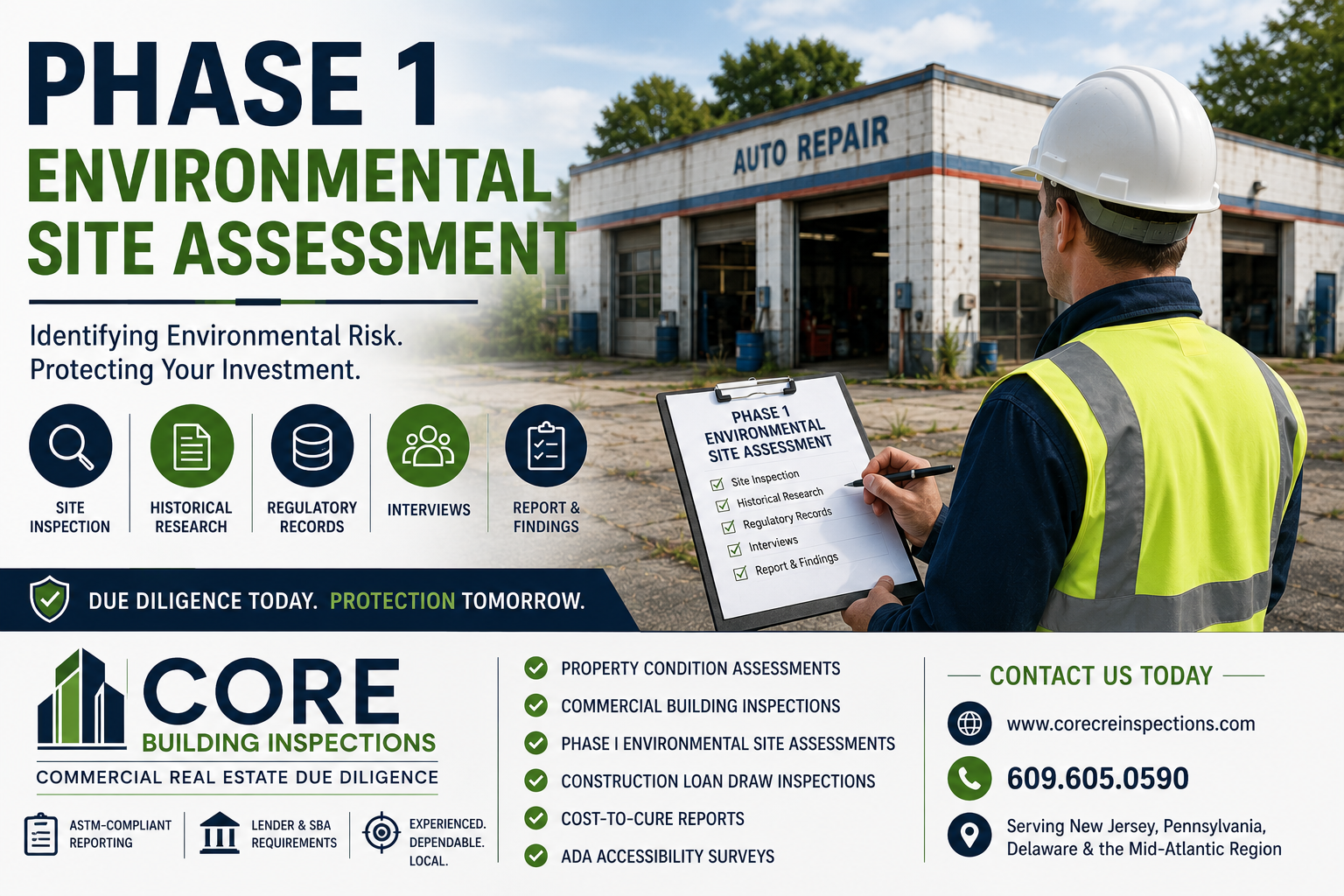
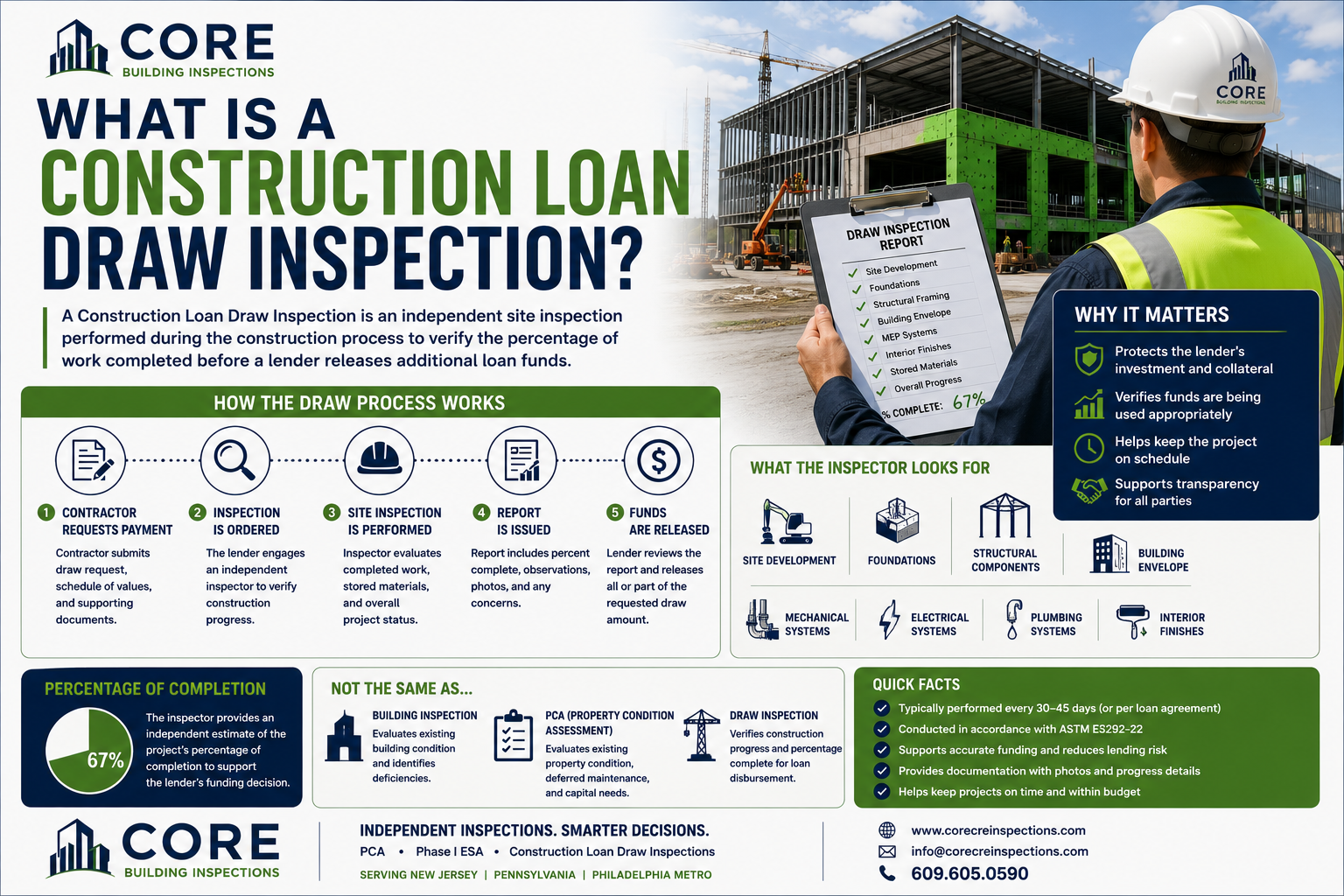
Core Building Inspections provides ASTM E2018-compliant Property Condition Assessments, Cost-to-Cure Reports, ADA Accessibility Surveys, Phase I Environmental Site Assessments, and Construction Loan Draw Inspections for commercial real estate transactions throughout New Jersey, Pennsylvania, and the surrounding Mid-Atlantic region. If you are working through SBA due diligence requirements on an upcoming transaction, contact us at corecreinspections.com or call 609.605.0590.