When a lender, investor, or buyer orders a Property Condition Assessment, they are not simply asking whether a building has problems. They are asking when those problems become financial obligations. The distinction between short-term and long-term repairs is one of the most consequential outputs of a well-executed PCA — and one of the most misunderstood. Understanding how repair timing is evaluated under ASTM E2018 can mean the difference between a deal that closes cleanly and one that unravels in underwriting.
What a Property Condition Assessment Actually Evaluates
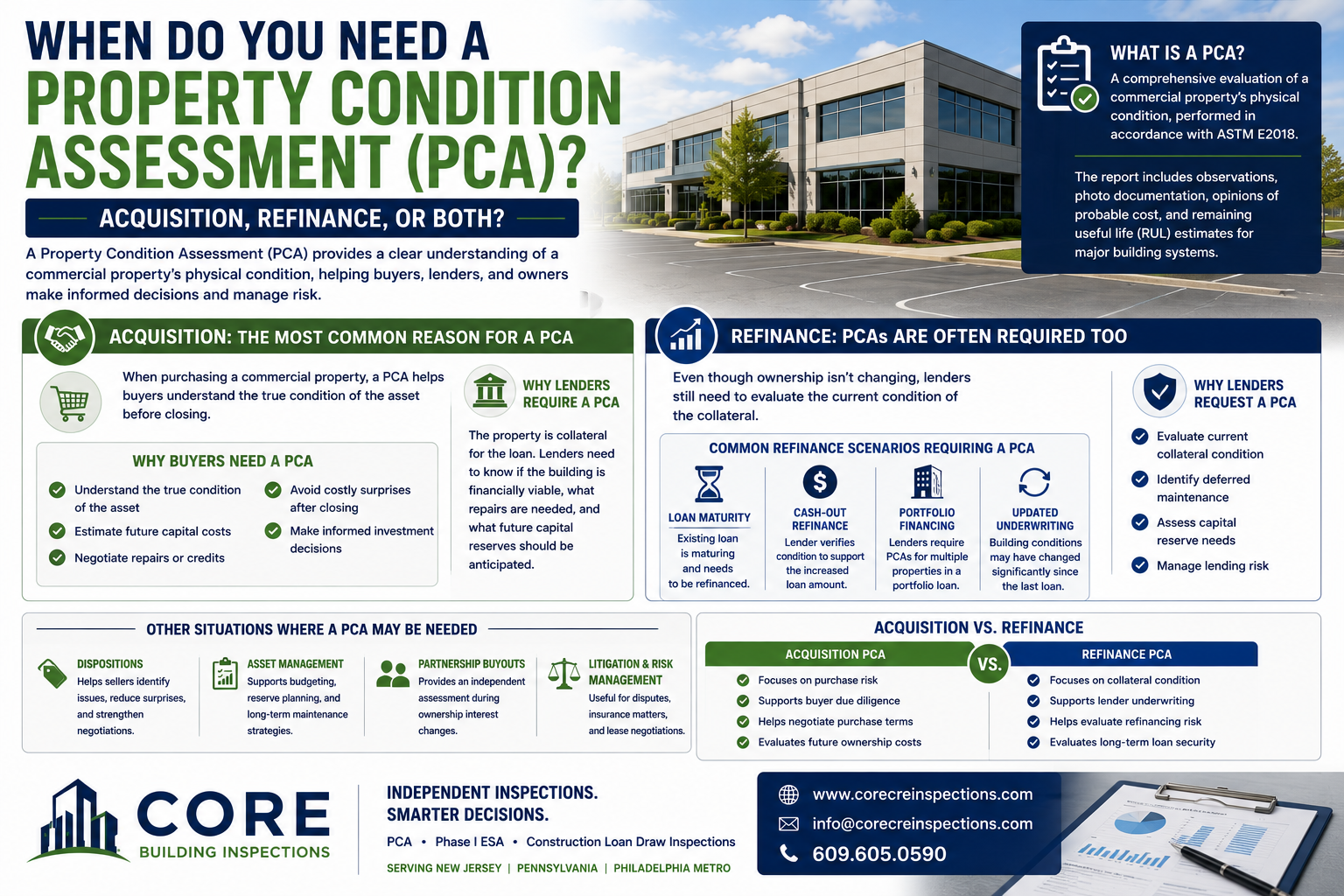
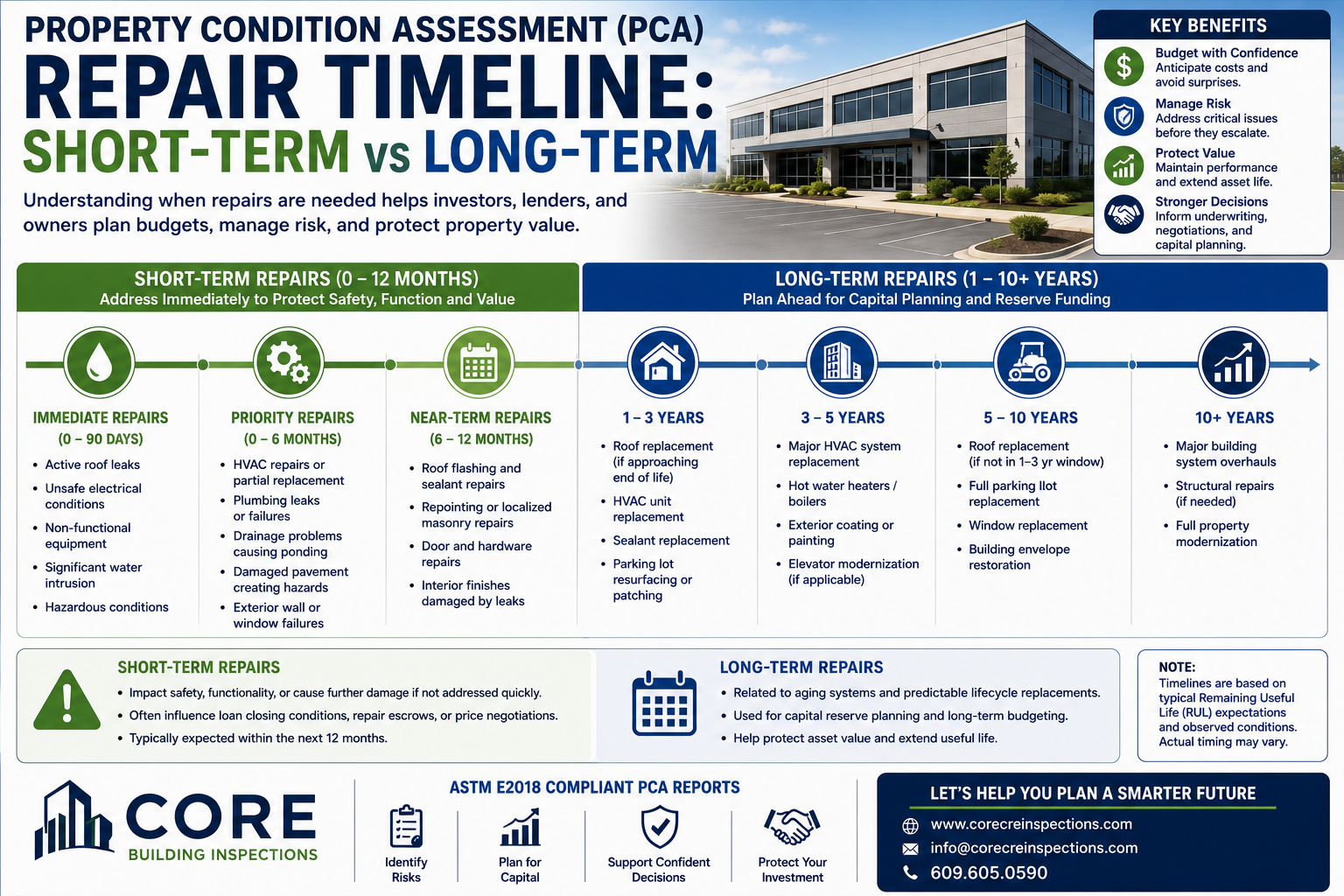
A Property Condition Assessment conducted under ASTM E2018-15 is a systematic evaluation of a commercial property’s physical condition. The inspector walks every accessible system and component — roofing, structure, envelope, mechanical, electrical, plumbing, site — and documents not only what is deficient today, but what is likely to become deficient over a defined planning horizon. That planning horizon typically spans one, three, five, and ten years, and the repair recommendations associated with each timeframe carry very different implications for deal structure, capital reserves, and loan conditions.
Short-Term Repairs: What They Are and Why They Matter
Short-term repairs are deficiencies that require attention within approximately twelve months of the assessment date. In practice, these fall into two categories: immediate repair items, which present active safety hazards or conditions causing ongoing damage, and priority repair items, which are urgent but not yet causing secondary harm. Either category can affect the path to closing.
An active roof leak is the clearest example. Left unaddressed, it degrades insulation, invites mold, attacks structural members, and compounds repair costs with each storm. Unsafe electrical conditions — exposed conductors, double-tapped breakers, evidence of overheating in panels — create liability exposure that no lender will accept without a remediation plan. Failing HVAC equipment that cannot maintain conditioned space in a tenant-occupied building is both an operational and a lease-compliance problem. Improper site drainage that directs water toward the foundation accelerates settlement and water intrusion in ways that become structurally significant over time.
Lenders pay close attention to short-term repair findings because they speak directly to collateral condition at the time of underwriting. A property with unresolved immediate deficiencies may trigger repair escrows, holdbacks, or hard conditions that must be satisfied before loan proceeds are released. For buyers, these items represent costs that should be negotiated into the purchase price or addressed through seller credits prior to close.
Long-Term Repairs: Planning Ahead, Not Reacting Later
Long-term repairs are anticipated capital expenditures associated with systems and components that are currently functional but aging. These items are not emergencies today — but they represent predictable financial obligations that will arrive on a schedule determined by the Remaining Useful Life (RUL) of each system.
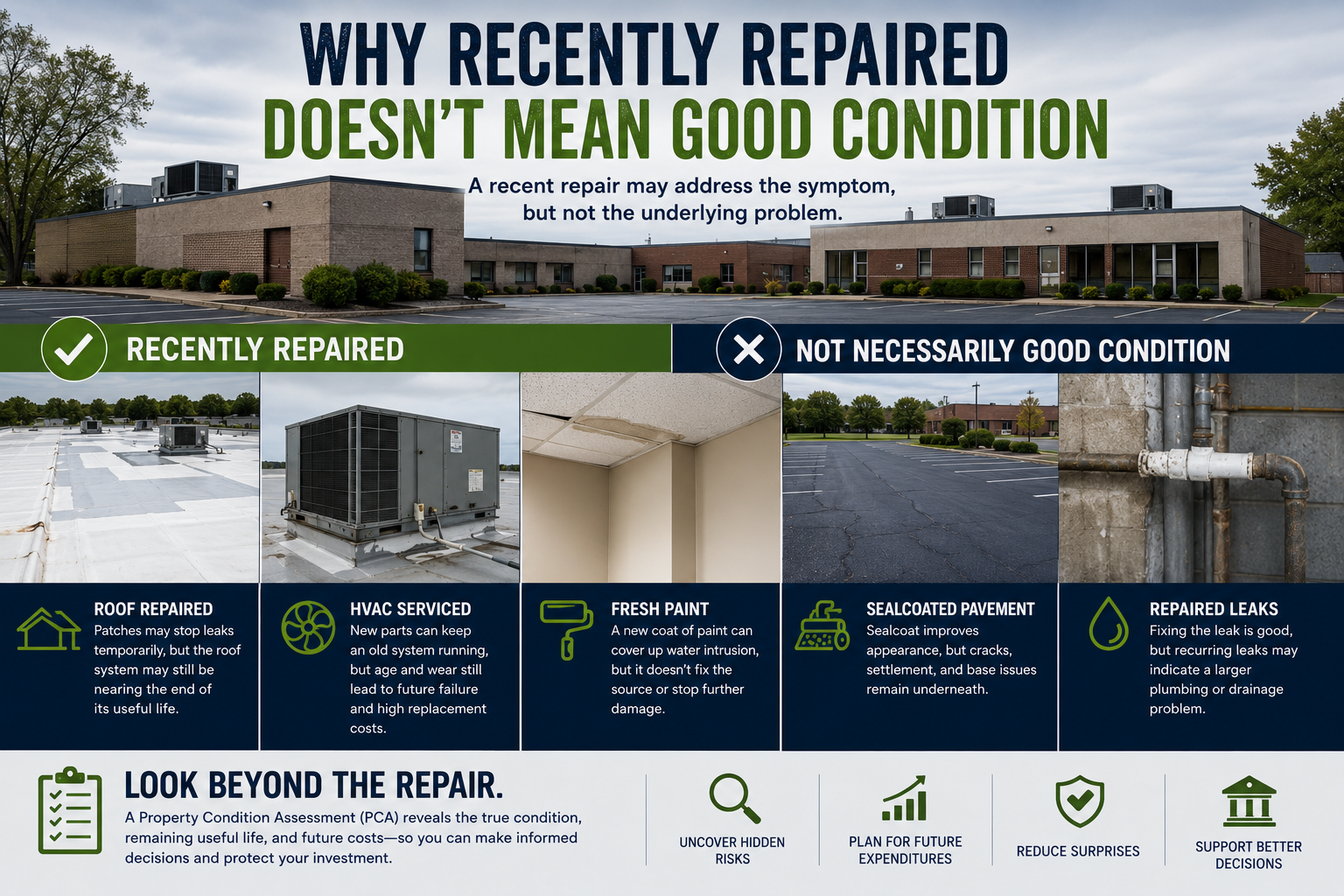
A roof with five to seven years of remaining useful life is not failing. But it is on a trajectory toward replacement, and an investor who does not account for that cost in their underwriting will eventually absorb it unplanned. The same logic applies to rooftop HVAC units operating beyond their expected service life — they may be running, but they are costing more to maintain, running less efficiently, and generating incremental repair expenses that erode cash flow. Asphalt paving with significant alligator cracking and surface oxidation may not require immediate replacement, but it will within the planning horizon, and the cost is not trivial. Exterior sealants around windows, expansion joints, and penetrations have finite lifecycles, and their deterioration is a reliable precursor to water intrusion and envelope damage.
The purpose of documenting long-term repairs is not to alarm a buyer — it is to give them an honest capital planning framework. A property with $400,000 in deferred and near-term capital needs over a ten-year horizon is not necessarily a bad investment. It is a known quantity. The investor who understands that figure can underwrite accordingly, structure reserves appropriately, and make an informed decision about whether the deal pencils at the asking price.
Remaining Useful Life: The Foundation of Capital Planning
Remaining Useful Life is the single most important analytical tool in translating physical observations into financial projections. When an inspector documents that a built-up roof has an estimated RUL of four years, that observation immediately converts into a capital line item with a predictable cost and timeline. When an HVAC unit is operating fifteen years beyond its expected service life, the RUL observation signals that replacement is not a matter of if but when — and that continued deferral is accumulating maintenance liability.
RUL estimates draw on manufacturer data, observed maintenance history, installation dates, current condition, and regional climate factors. A well-executed PCA does not simply assign generic industry averages — it applies those benchmarks against the specific conditions observed at the property. A fifteen-year-old roof in Voorhees, New Jersey that has been maintained, re-coated, and shows no active moisture penetration carries a different RUL than an identically aged roof with multiple patch repairs and active ponding.
Why Repair Timing Matters in NJ and PA Markets
The commercial building stock across New Jersey and the greater Philadelphia metro area includes a significant concentration of properties built between the 1960s and 1990s. Many of these assets have experienced deferred maintenance, multiple ownership transitions, and varying levels of capital reinvestment over their lives. The regional climate — with freeze-thaw cycles, summer humidity, and persistent moisture exposure — accelerates deterioration of roofing membranes, exterior masonry, paving, and building envelope sealants in ways that require an inspector with local experience to assess accurately.
In this market, distinguishing between what needs to happen before closing, what needs to happen in year two, and what can be addressed in year five is not an academic exercise. It is a direct input into deal structure, loan terms, and ownership economics.
How Lenders Use PCA Repair Findings
Most commercial lenders require a third-party PCA as part of their due diligence process, and they read the repair findings with a specific purpose in mind. Immediate repair items inform whether the collateral is acceptable in its current state. If a property has active structural issues, life-safety concerns, or deferred maintenance that materially affects its value or function, the lender will either require remediation as a loan condition or adjust the loan terms to reflect the risk.
Long-term capital expenditure projections feed directly into reserve analysis. A lender evaluating a ten-year loan on a property with significant capital needs in years four through seven wants to know that the borrower has a plan for funding those replacements without jeopardizing debt service. Repair escrows and replacement reserves are structured in part based on what the PCA projects over the loan term. A thorough, well-organized PCA that clearly distinguishes short-term from long-term obligations gives a lender confidence in the asset — and gives the borrower a stronger position in the financing conversation.
What Investors Should Take Away
A commercial property is not just an income stream — it is a physical asset that depreciates and requires reinvestment. The PCA is the instrument that quantifies that reinvestment requirement on a timeline. Investors who treat the PCA as a pass/fail checklist miss the point. The real value is in understanding the full capital picture: what must be addressed immediately, what can be budgeted over the hold period, and what the total cost of ownership looks like against the projected return.
A property with manageable long-term capital needs is not a problem. It is a known quantity, and known quantities can be underwritten. What creates risk is the acquisition where those needs were never assessed — where the buyer closes without a clear picture, and the capital requirements surface after the ink is dry.
Schedule a Property Condition Assessment in New Jersey or Pennsylvania
Core Building Inspections provides ASTM E2018-15 compliant Property Condition Assessments for buyers, lenders, and investors throughout New Jersey and the Philadelphia metro area. Our reports give you a clear, prioritized picture of short-term repair obligations and long-term capital planning needs — so you can make informed decisions before you close, not after.
Contact Core Building Inspections at www.corecreinspections.com to schedule your assessment.