One of the most common questions I hear from commercial real estate buyers, borrowers, and property owners is some version of: When does a Property Condition Assessment actually get required? The answer surprises a lot of people — because it’s not just acquisitions. Lenders, investors, and owners across New Jersey and the Philadelphia metro area trigger PCA requirements in more situations than most expect, and understanding those triggers before a transaction starts can save you significant time, money, and headaches during due diligence.
What a Property Condition Assessment Actually Evaluates
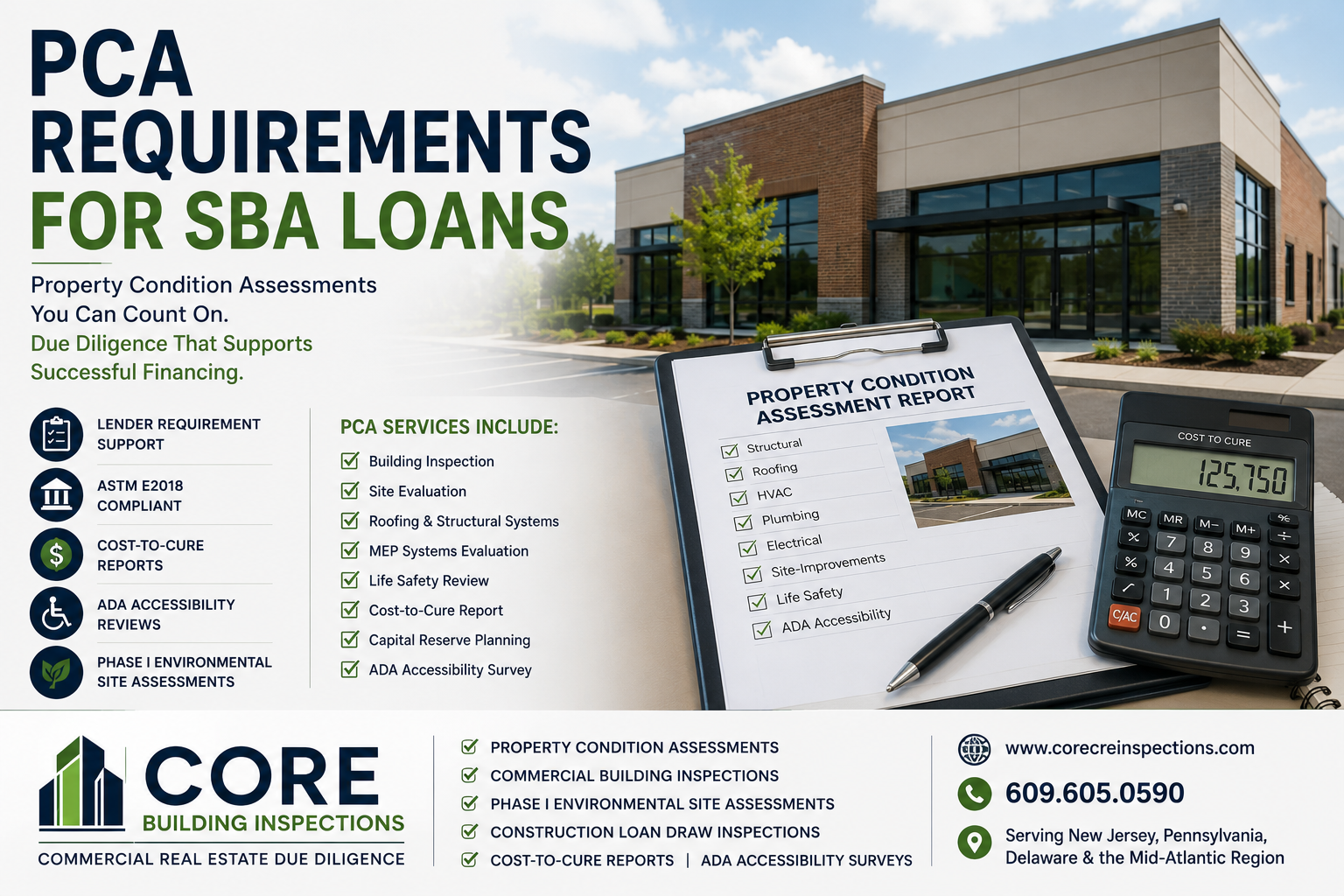
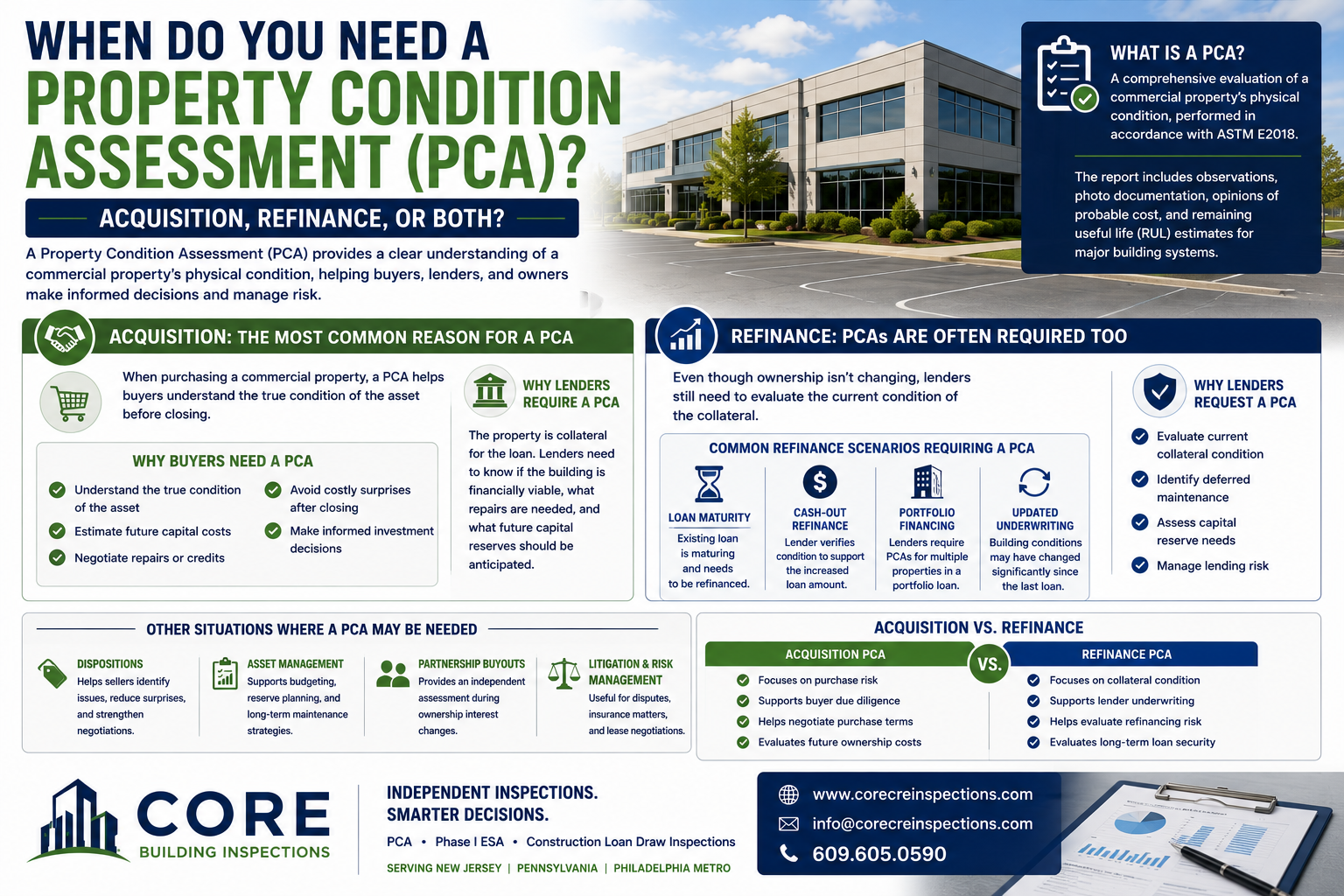
A Property Condition Assessment is a comprehensive physical evaluation of a commercial property, conducted in accordance with ASTM E2018-15. The inspector evaluates the major building systems — roof, structure, HVAC, electrical, plumbing, and site improvements — and documents existing conditions, deferred maintenance, and observed deficiencies throughout.
The resulting report delivers more than just a list of problems. It includes opinions of probable cost for near-term repairs, Remaining Useful Life estimates for major systems, and capital reserve projections designed to inform ownership planning over a multi-year horizon. That combination of physical findings and financial framing is what makes the PCA the standard instrument for commercial due diligence, rather than a simple building inspection.
Property Acquisitions: The Most Common PCA Trigger
The majority of PCA reports are ordered in connection with a commercial property acquisition, and there are two independent reasons for that — one driven by the buyer, and one driven by the lender.
From a buyer’s perspective, the PCA answers a question that no amount of seller disclosure can reliably answer: what is this building actually going to cost me to own? A property with aging HVAC equipment, a roof approaching end of useful life, and years of deferred maintenance carries a materially different risk profile than one with recently upgraded systems — and that difference should be reflected in either the purchase price, a negotiated repair credit, or the buyer’s capital reserve assumptions going forward. Walking into closing without that information is a risk that experienced buyers and their advisors consistently work to avoid.
From a lender’s perspective, the calculus is different but leads to the same requirement. The building is collateral, and the lender needs confidence that the collateral is physically and financially viable over the loan term. If major systems are near the end of useful life or immediate repairs are required, those facts bear directly on the lender’s underwriting assumptions. A PCA provides the objective, third-party documentation lenders need to evaluate those risks before the loan closes.
Refinance Transactions Require PCAs Too
A significant number of property owners assume PCAs are an acquisition-only requirement. That assumption regularly causes delays.
Commercial lenders frequently require PCAs during refinancing, for many of the same reasons they require them at acquisition. Even though ownership hasn’t changed, the lender is still evaluating collateral condition — and building conditions can shift substantially over the life of a loan. A property that was in solid physical condition five or seven years ago may now be carrying deferred maintenance, aging mechanical systems, or roof deterioration that affects its value as loan security.
Three refinance scenarios come up most often in the NJ and Philadelphia market. The first is loan maturity: when an existing commercial loan matures and the borrower is seeking a new term, updated due diligence on the property’s current condition is a standard lender requirement. The second is cash-out refinancing, where a borrower is extracting equity from the property. Lenders in those situations frequently want independent verification that the asset supports the increased loan amount. The third is portfolio financing, where multiple commercial properties are being refinanced under a single loan structure — PCAs provide a consistent baseline assessment across the portfolio.
Other Situations Where a PCA Adds Value
Acquisitions and refinances are the highest-volume triggers, but they’re not the only ones worth understanding.
Sellers increasingly order PCAs before listing commercial properties. A pre-listing PCA gives the seller an accurate picture of the building’s condition before buyers and their inspectors arrive, reduces the risk of late-stage surprises that can derail negotiations, and positions the seller as a credible, transparent party in the transaction.
Asset managers and ownership groups use PCA reports for capital planning and budgeting, independent of any transaction. When a portfolio needs a defensible basis for reserve funding or a maintenance prioritization framework, the PCA report structure — with system-by-system cost projections and RUL estimates — provides exactly that.
Partnership buyouts and ownership restructurings represent another use case. When an ownership interest in a commercial property changes hands, an independent assessment of the building’s physical condition protects all parties and removes disputes about deferred maintenance from the negotiating table.
Finally, PCAs are used in litigation support, insurance matters, and complex lease negotiations where documented evidence of a building’s condition at a specific point in time becomes material to the outcome.
Why This Matters Specifically in New Jersey and the Philadelphia Metro Area
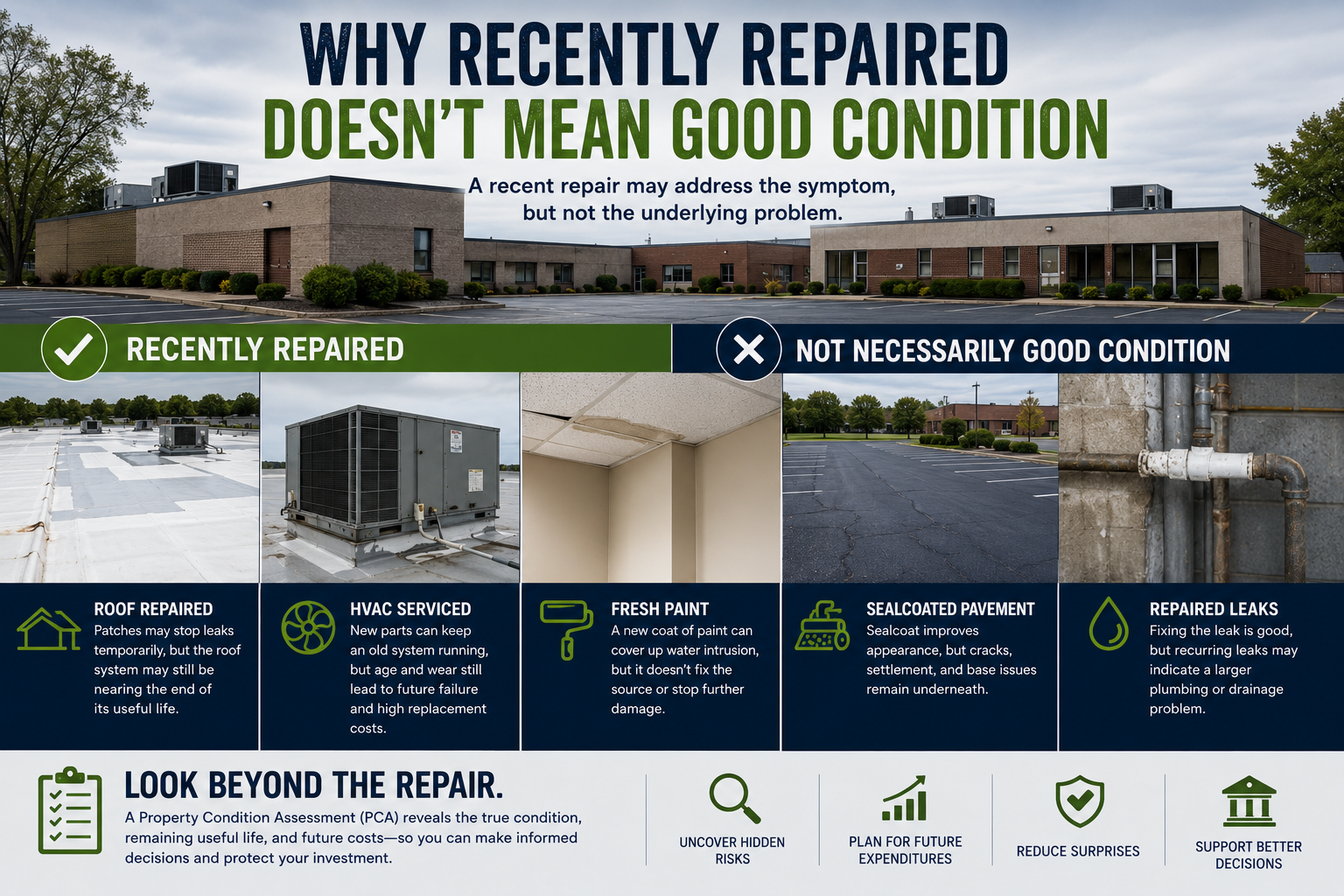
The commercial building stock in South Jersey and the greater Philadelphia market skews older. Properties built between the 1950s and the 1990s are common across retail corridors, industrial parks, and mixed-use assets throughout Burlington, Camden, Gloucester, and Atlantic counties — and throughout the Philadelphia suburbs on the Pennsylvania side. Buildings in that age range frequently carry deferred maintenance, original or aging mechanical systems, and roofing that has been repaired and re-coated rather than replaced.
That physical context makes lenders in this market particularly attentive to PCA findings, and it’s why the freeze-thaw cycle that drives deterioration in masonry, pavement, and building envelopes throughout this region shows up consistently in the risk sections of PCA reports. Regional experience matters when you’re evaluating buildings that have been weathering New Jersey and Pennsylvania winters for 40 or 50 years.
The Bottom Line
If you’re trying to determine whether a Property Condition Assessment will be required for your transaction, the safe assumption is yes. Lenders in the commercial real estate market — whether you’re acquiring, refinancing, or restructuring — treat the PCA as a standard instrument of due diligence, not an optional one. And for buyers and owners who are making multi-million dollar decisions about physical assets, the cost of a PCA is consistently dwarfed by the value of what it surfaces.
The question isn’t really whether you need one. It’s whether you’re working with an inspector who understands the asset class, the lending environment, and the market you’re operating in.
Core Building Inspections provides ASTM E2018-15 compliant Property Condition Assessments for commercial properties throughout New Jersey and the Philadelphia metro area. If you’re approaching a transaction and want to understand what the process looks like, contact us to discuss your project.