
When I walk a commercial property in South Jersey or the Philadelphia suburbs, I’m rarely looking at a building in isolation. I’m looking at a building that has spent decades in conversation with one of the most demanding climates in the country. The Northeast doesn’t make things easy on commercial structures. It freezes them, thaws them, soaks them, bakes them, and then repeats the whole cycle about as reliably as tax season.
Understanding how that process plays out across a building’s major systems is not abstract theory — it’s the foundation of sound due diligence.
The Freeze-Thaw Problem
The single most destructive environmental force acting on Northeast commercial buildings is the freeze-thaw cycle, and it operates below the level of visibility. Water finds its way into hairline cracks in concrete, masonry, and pavement — through capillary action, poor sealant, or simple gravity — and then the temperature drops. Ice expands. The crack widens. Temperatures rise, water moves in again, temperatures drop again. After enough cycles, what was a hairline becomes a structural concern.
This is why masonry facades on 1970s and 1980s commercial buildings in New Jersey and Pennsylvania look the way they do. It’s why I pay close attention to brick spalling, mortar joint deterioration, and control joint conditions during a Property Condition Assessment. What looks like cosmetic weathering on the surface often reflects years of cumulative freeze-thaw damage working its way through the building envelope.
Roofs Take the Full Brunt
Flat and low-slope roofs — the dominant roof type on commercial properties throughout this region — are particularly vulnerable in the Northeast climate. Snow loads stress the deck and structure. Ice dams form at parapet edges and drain sumps, trapping water behind them. When temperatures rise and that ice melts, it has nowhere to go if the drains are compromised or the membrane has lost its integrity.
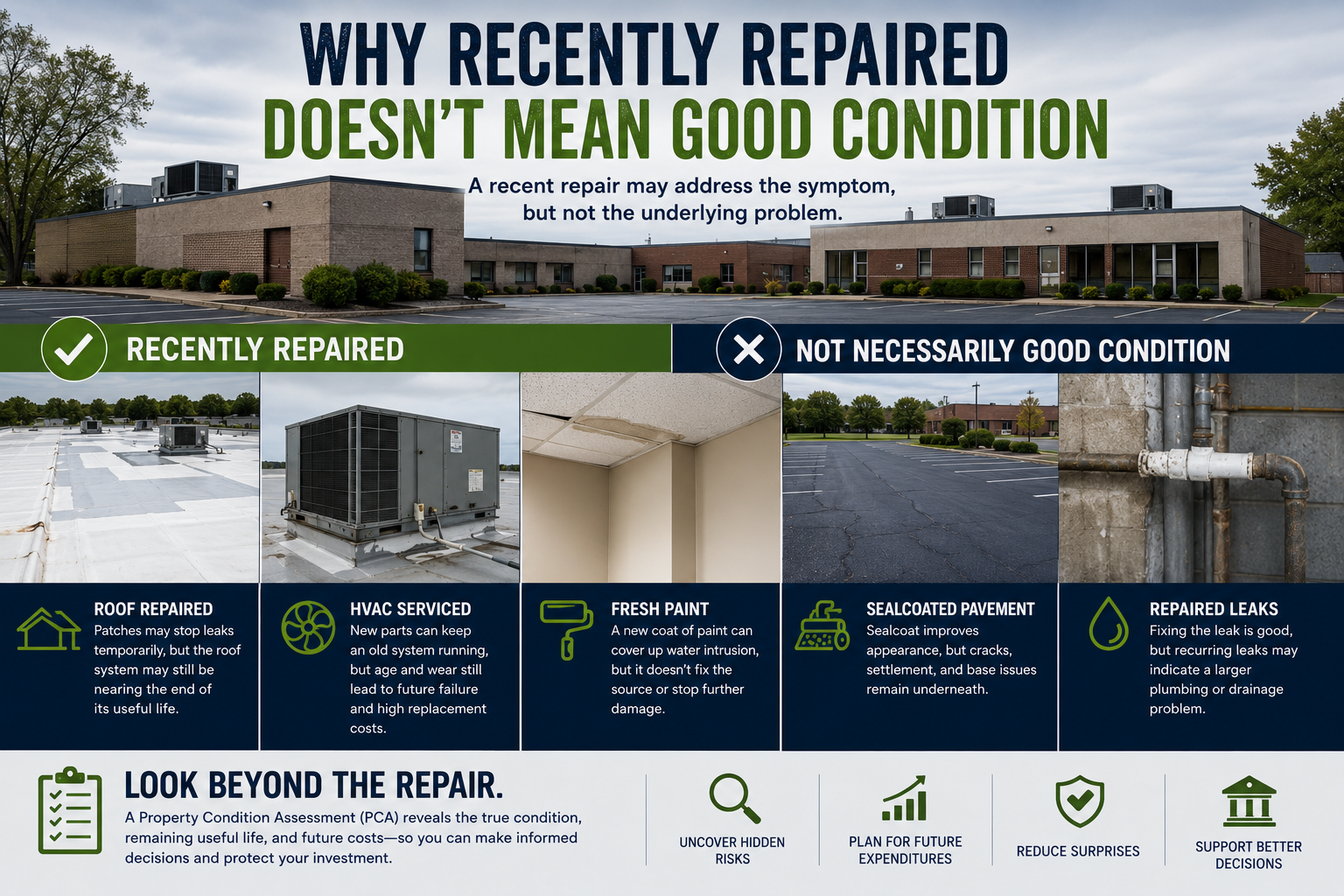
Summer brings a different set of stresses: UV degradation breaks down roofing membranes over time, and thermal cycling — the daily expansion and contraction of the roof assembly as temperatures rise and fall — fatigues fasteners, seams, and flashings. By the time a building is 15 to 20 years old, a flat roof in this region has been through enough stress cycles to warrant careful evaluation of remaining useful life. In my experience, deferred roof maintenance is one of the most common and most costly findings on PCAs of older retail and industrial properties in NJ and PA.
Moisture Intrusion and the Building Envelope
The Northeast is a wet climate. Annual precipitation across New Jersey and southeastern Pennsylvania consistently runs 45 to 50 inches, distributed throughout the year. That moisture has to go somewhere, and on older commercial buildings with aging sealants, deteriorated caulking, and compromised flashings, it often finds its way in.
Moisture intrusion is insidious because the damage it causes — degraded insulation, mold growth, corroded structural elements, interior finishes damage — often accumulates silently over years before it becomes visible. By the time staining appears on a ceiling tile or efflorescence shows up on an interior masonry wall, the water has typically been traveling through the building envelope for a long time. During a PCA, I probe for evidence of historic moisture intrusion in addition to active issues, because the pattern of past damage tells you a lot about what to expect going forward.
HVAC Systems in a Heating and Cooling Climate
Unlike commercial properties in the Sun Belt, where mechanical systems operate primarily in cooling mode, Northeast buildings demand both serious heating and serious cooling. That dual demand accelerates wear. HVAC equipment in this region cycles harder, seasons longer, and ages faster than comparable equipment in more temperate markets.
Older rooftop units on strip retail, warehouse, and mixed-use properties throughout New Jersey are a common PCA finding. Many were designed for a 15-to-20-year service life and are operating well past it. Beyond the core equipment, ductwork, controls, and distribution components are all subject to the same thermal cycling and moisture exposure that affects the rest of the building. When I’m evaluating an HVAC system on a 30-year-old commercial building, I’m not just looking at whether it runs — I’m assessing how much useful life remains and what deferred replacement will cost.
Site Work and Paving
Parking lots and site improvements are among the most visible victims of Northeast climate conditions, and they’re frequently underestimated in capital reserve planning. Asphalt is sensitive to both temperature extremes: it softens and tracks in summer heat, and freeze-thaw cycles drive cracking, potholing, and base failure over time. Poor surface drainage accelerates both processes by keeping water in contact with the pavement longer.
On a typical suburban commercial property in New Jersey, the parking lot is often 20 to 25 years old, has received periodic seal coating but no major reconstruction, and is quietly accumulating deferred maintenance. That’s not a cosmetic issue — it’s a liability and a capital expenditure waiting to happen.
What This Means for a PCA
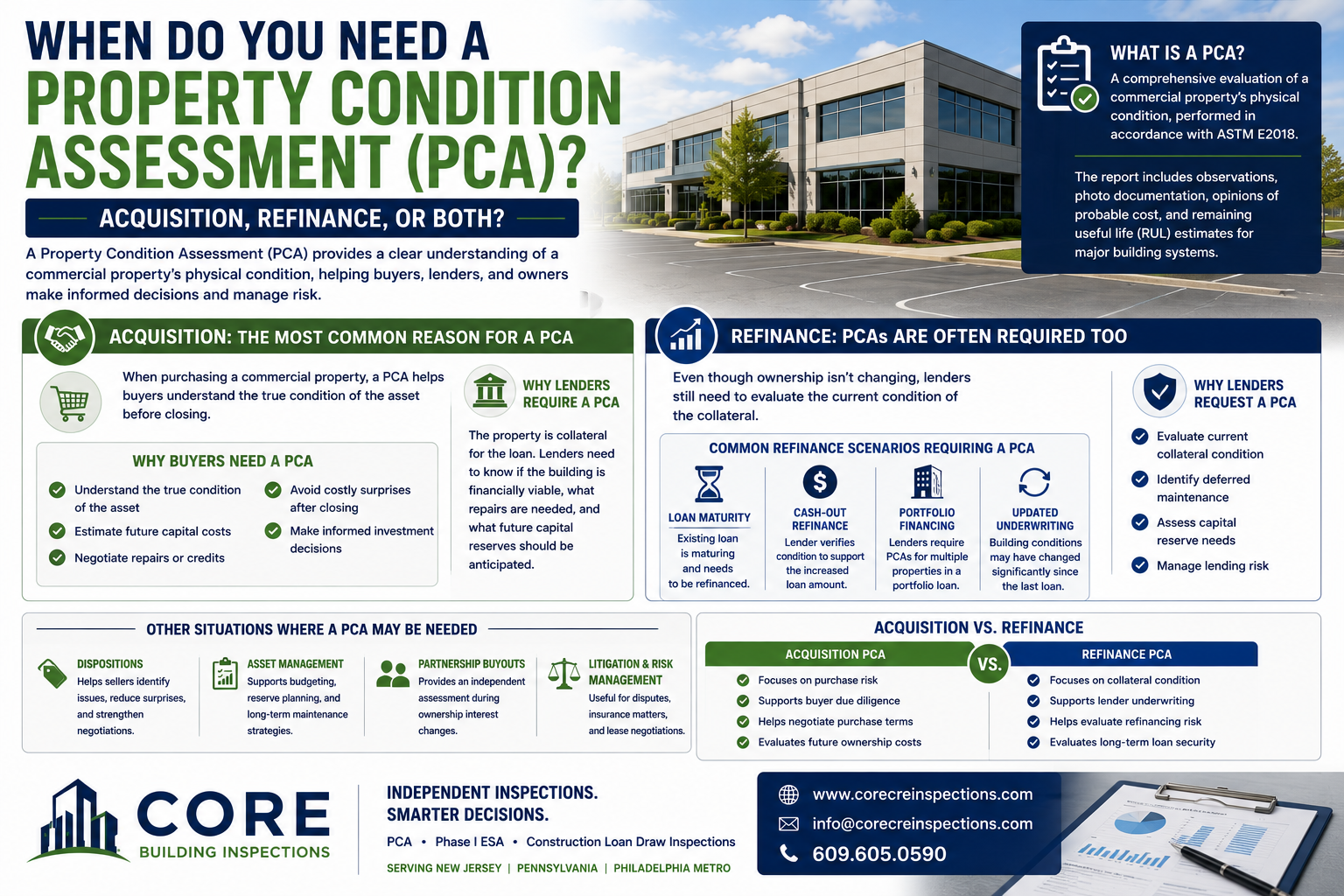
ASTM E2018 requires that a Property Condition Assessment account for the physical condition of building systems as actually observed, supported by an opinion of remaining useful life and estimated costs for deferred maintenance and capital reserves. In the Northeast, that evaluation has to be informed by an understanding of how regional climate conditions have stressed those systems over time.
A PCA performed by someone who understands what 30 winters of freeze-thaw cycles do to a CMU building in southern New Jersey is going to produce meaningfully different findings — and more defensible Opinions of Probable Cost — than one performed without that context. That regional knowledge isn’t a credential you can shortcut. It comes from time spent on the ground, in these buildings, in this climate.
If you’re evaluating a commercial property in New Jersey or the Philadelphia metro area, the condition assessment should reflect where the building actually is — not where a generic national template assumes it might be. Core Building Inspections performs ASTM E2018-compliant PCAs throughout the NJ/PA region, with the regional experience to translate what we observe into capital planning you can rely on. Reach out at www.corecreinspections.com to discuss your next acquisition or portfolio review.