For owners, buyers, and lenders, the roof is one of the most critical — and expensive — components of a commercial building. Yet roof replacement is often underfunded, poorly timed, or completely overlooked during due diligence. Understanding commercial roof lifecycle and reserve planning is essential to protecting asset value, avoiding surprise capital expenses, and making informed investment decisions.
In New Jersey and Pennsylvania, where commercial roofs are exposed to freeze-thaw cycles, heavy rainfall, snow loads, and aging building stock, roof failures frequently become deal-level issues. A properly planned reserve strategy helps ensure roof costs are anticipated rather than reactive.
Why Roof Lifecycle Matters in Commercial Real Estate
Every commercial roof has a finite useful life, regardless of material or maintenance history. What matters most is not the original manufacturer’s warranty, but how the roof has actually performed over time.
In older NJ and PA commercial buildings, we commonly see roofs that are:
- Beyond their intended service life
- Covered with years of patch repairs
- Experiencing hidden moisture intrusion
- Budgeted incorrectly in capital reserve schedules
Understanding roof lifecycle allows stakeholders to forecast when replacement is likely, not just when failure becomes obvious.
Typical Commercial Roof Types and Expected Lifespans
While no two roofs age exactly the same, industry standards and field experience provide reasonable lifecycle expectations.
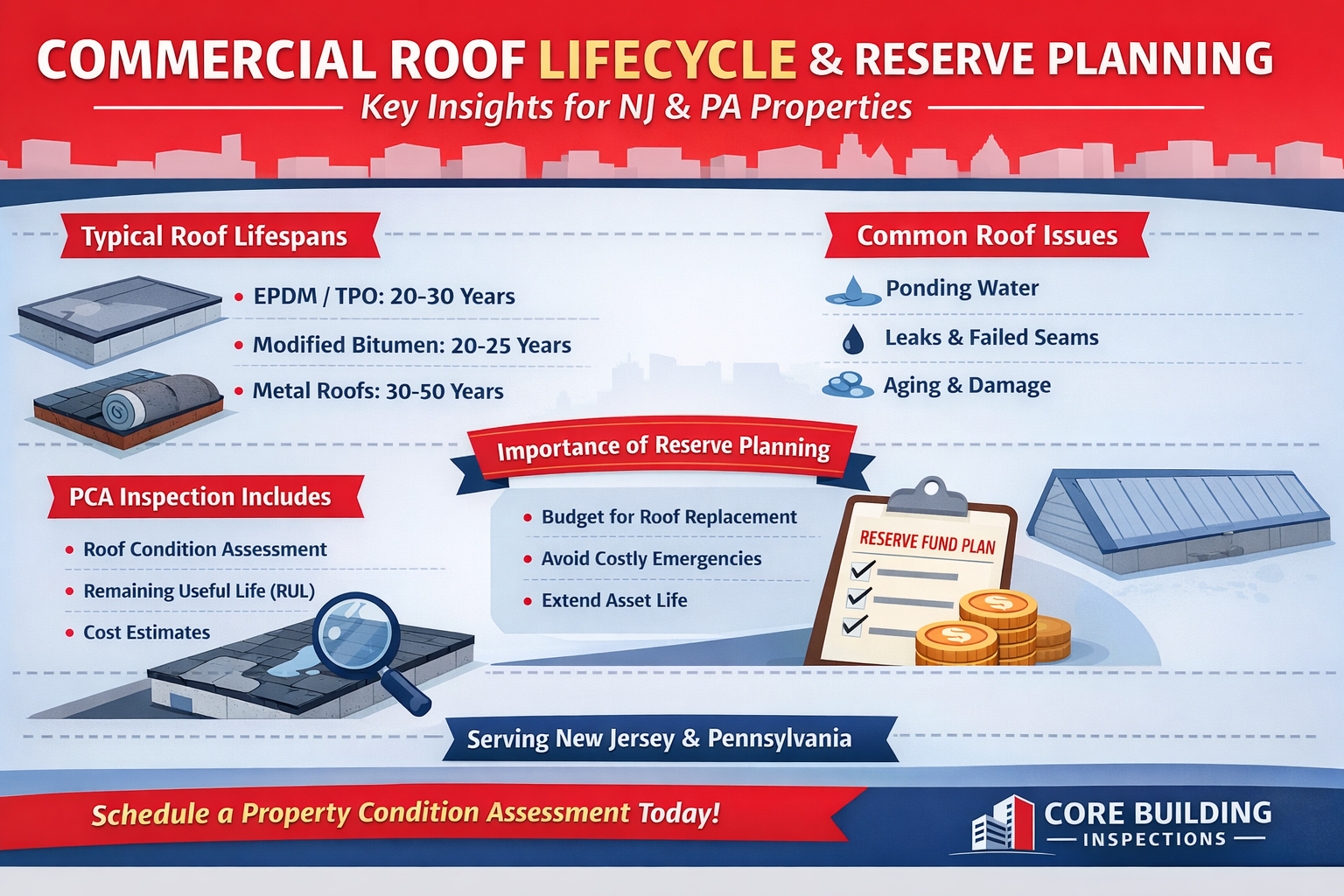
Common roof systems we encounter during inspections include:
- EPDM single-ply membranes – typically 20–30 years
- TPO and PVC membranes – typically 15–25 years
- Modified bitumen systems – typically 20–25 years
- Built-up roofing (BUR) – typically 20–30 years
- Standing-seam metal roofs – often 30–50 years with maintenance
Actual remaining useful life (RUL) depends heavily on installation quality, drainage, maintenance history, and environmental exposure — all factors evaluated during a Property Condition Assessment (PCA).
Common Roof Deficiencies That Shorten Lifecycle
During commercial roof inspections throughout the Philadelphia metro area, South Jersey, and across Pennsylvania, we routinely identify issues that significantly reduce remaining service life.
Typical deficiencies include:
- Chronic ponding water due to poor slope or clogged drains
- Repeated temporary repairs using asphalt, mastics, or coatings
- Open seams, deteriorated flashing, and failed penetrations
- Wet insulation beneath membrane systems
- Improper rooftop equipment installations
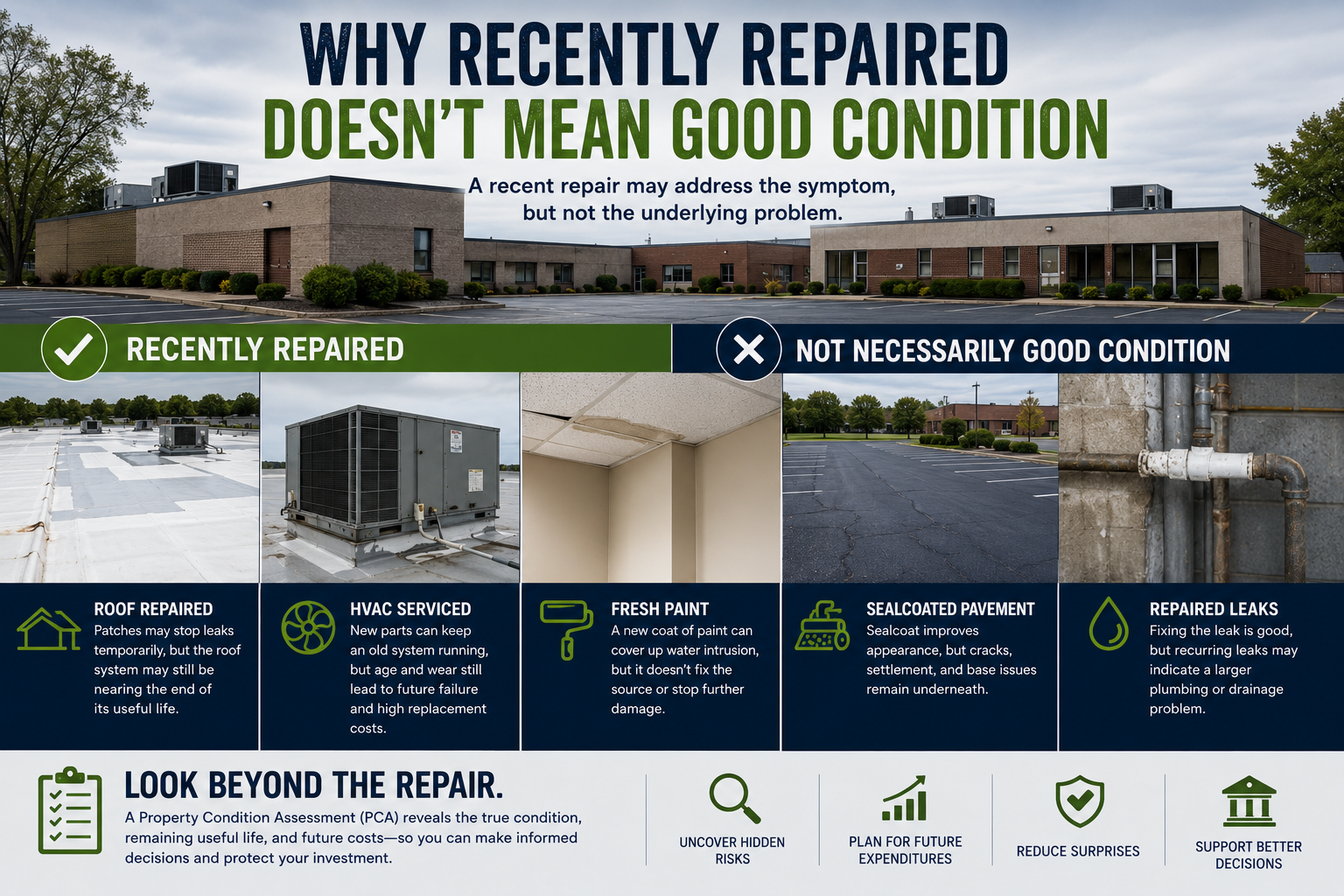
- Deferred maintenance masked by recent patching
These conditions often indicate a roof that is nearing the end of its economic life, even if it has not yet failed catastrophically.
Reserve Planning: Why “Years Left” Is Not Enough
Reserve planning is not about guessing how many years a roof might last. It is about aligning capital planning with realistic risk exposure.
Effective commercial roof lifecycle and reserve planning should account for:
- Remaining useful life (RUL), not age alone
- Probability of failure within the next 3–5 years
- Interim repair and maintenance costs
- Full replacement cost based on current market pricing
- Inflation and contractor availability
Lenders and credit committees rely on this information to evaluate risk, loan terms, and holdback requirements.
How Roofs Are Evaluated During a Property Condition Assessment
Under ASTM E2018-18 standards, roof systems are one of the most scrutinized building components in a PCA. The goal is not to certify condition, but to identify deficiencies, risks, and capital needs.
A proper roof evaluation includes:
- Visual assessment of membrane or covering condition
- Review of drainage performance
- Identification of prior repairs and failure patterns
- Estimation of remaining useful life
- Development of short-term and long-term cost projections
These findings feed directly into the capital reserve table, which lenders use to assess whether a deal is financially viable.
Financial Consequences of Poor Roof Reserve Planning
When roof reserve planning is ignored or underestimated, the consequences can be severe:
- Unexpected six-figure replacement costs
- Emergency repairs that disrupt tenants or operations
- Insurance claims complications
- Loan covenant issues
- Reduced property value or failed transactions
In many cases, roof condition is the single largest contributor to capital expenditure risk identified during due diligence.
Regional Considerations in NJ & PA
Local conditions matter. In New Jersey and Pennsylvania, roof systems face:
- Freeze-thaw cycles that accelerate membrane fatigue
- Snow loads that stress aging assemblies
- Coastal and industrial corrosion exposure in some markets
- A large inventory of buildings constructed between the 1970s–1990s now reaching lifecycle limits
These regional factors are why localized inspection experience is critical when developing reserve forecasts.
Tying Roof Planning Back to Due Diligence
Roof lifecycle and reserve planning should never be isolated from broader due diligence efforts. Roof findings often intersect with:
- Property Condition Assessments (PCA) for capital planning
- ADA Accessibility Inspections, when rooftop access or drainage affects pedestrian paths
- Phase I Environmental Site Assessments, when roof drainage or historical uses raise environmental concerns
Integrated inspections provide a clearer picture of overall asset risk.
Final Thoughts: Plan Early, Avoid Surprises
Understanding commercial roof lifecycle and reserve planning allows buyers, owners, and lenders to move from reactive repairs to proactive asset management. A roof doesn’t need to be leaking to be a financial liability — it just needs to be unplanned.
If you are acquiring, refinancing, or managing a commercial property in New Jersey or Pennsylvania, a professional inspection can provide the clarity needed to make informed decisions.
If you’re evaluating a commercial property or planning capital reserves, schedule a commercial building inspection or request a Property Condition Assessment with Core Building Inspections. We provide clear, defensible evaluations that help protect your investment and support smarter decision-making.