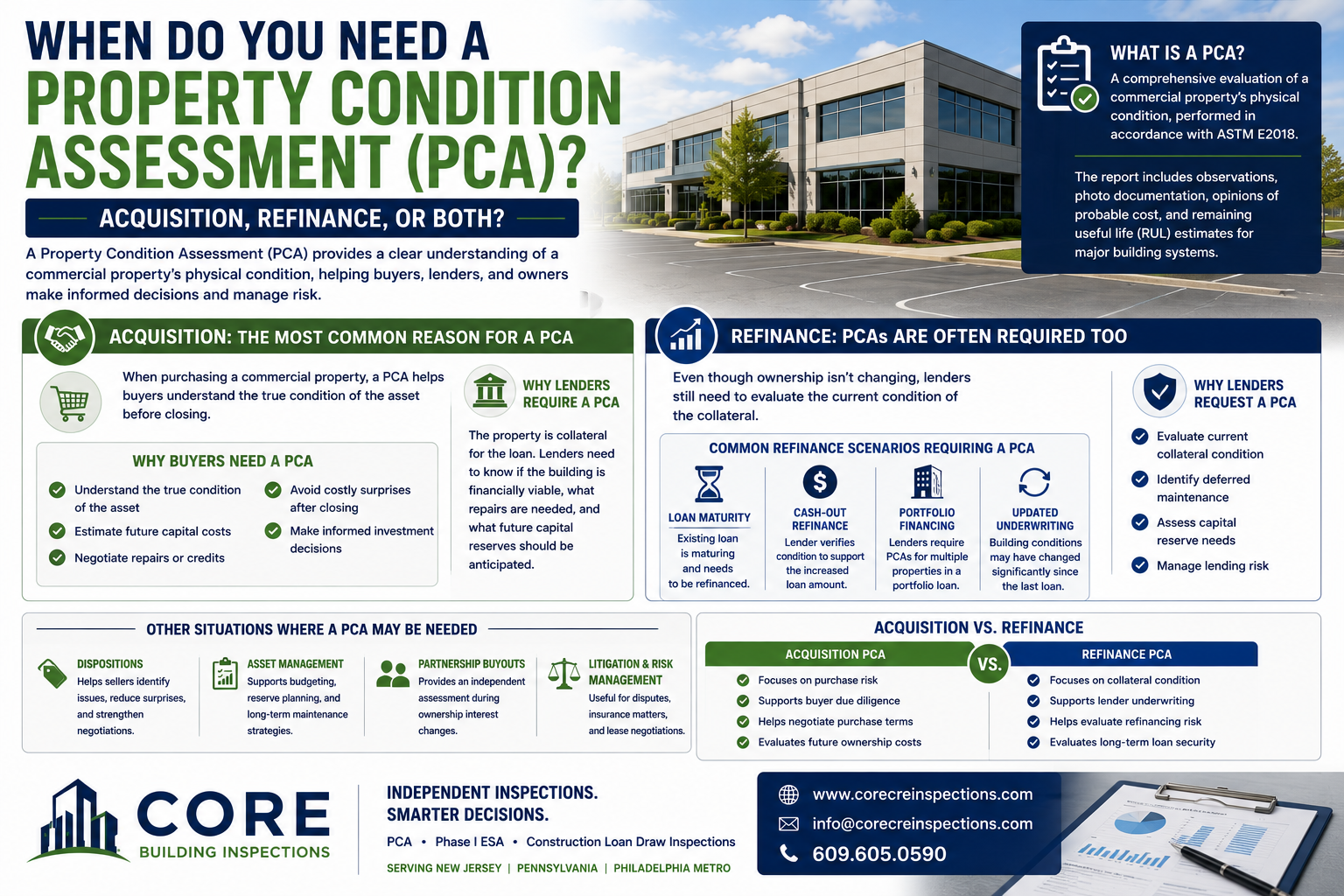
Triple net leases are among the most common commercial lease structures in New Jersey and the Philadelphia metropolitan area — and among the most misunderstood. Whether you are a tenant about to assume responsibility for a building’s maintenance, or a landlord preparing to execute a long-term lease with a new occupant, the condition of the property at lease commencement is one of the most consequential facts in the entire transaction. Yet it is one that is frequently undocumented.
An independent commercial building inspection before a NNN lease is signed is not just smart practice — in many cases, it is the only way to establish a defensible baseline that protects both parties for the full term of the lease.
What Is a Triple Net Lease, and Why Does It Create Inspection Risk?
In a triple net (NNN) lease, the tenant agrees to pay not only base rent but also some or all of the property’s operating expenses — typically property taxes, building insurance, and maintenance costs. In a fully net lease, the tenant may even be responsible for major capital repairs, including the roof, HVAC systems, and structural components.
This structure shifts significant financial risk to the tenant. If the HVAC system fails two years into a ten-year NNN lease and the tenant is contractually responsible for replacement, that tenant could be facing a $40,000 to $80,000 capital expense that was never anticipated in the deal underwriting.
The same risk exists in reverse for landlords. Without a documented baseline inspection at lease commencement, a landlord has no objective record of the property’s condition when the tenant took possession. At lease end, disputes over wear and tear, deferred maintenance, and tenant-caused damage are nearly impossible to resolve without that baseline.
What a NNN Lease Inspection Covers
A professional NNN lease inspection performed by a CCPIA-certified, ASTM-trained inspector evaluates all building systems and components likely to become a tenant or landlord responsibility under the lease terms:
Roof System
Age, condition, remaining useful life, visible deficiencies, flashing integrity, drainage performance. For a tenant assuming roof maintenance responsibility, knowing whether the roof has 15 years of life remaining or 3 years is the difference between a sound deal and an immediate capital liability.
HVAC Systems
Operating condition, approximate age based on manufacturer data plates, evidence of deferred maintenance, filter condition, refrigerant line integrity, estimated remaining service life. HVAC replacement is one of the most common unexpected capital costs for NNN tenants, and systems that are near end of life at lease commencement are a red flag that should be negotiated before signing.
Electrical Systems
Service panel condition, age of components, visible deficiencies, code concerns at accessible areas, lighting systems.
Plumbing
Visible piping condition, water heater age and condition, fixture operability, drainage performance.
Exterior Envelope
Wall system condition, window and door condition, evidence of moisture intrusion, caulking and sealant condition. These items directly affect a tenant’s utility costs and can signal concealed damage that may become a dispute at lease end.
Structural Frame and Foundation
Visible condition of accessible structural components, foundation walls, floor systems. Significant structural issues identified before lease commencement give both parties an opportunity to negotiate repair responsibility.
Parking and Site
Pavement condition, accessibility compliance, lighting, drainage.
Life Safety
Fire alarm and suppression systems, egress lighting, extinguisher maintenance. In New Jersey, fire code compliance is an ongoing landlord responsibility in most lease structures, and undisclosed violations at lease commencement are a liability for the building owner.
Why New Jersey and Philadelphia Metro Properties Require Extra Attention
The commercial building stock in New Jersey and the greater Philadelphia area is among the oldest in the country. A significant percentage of office, retail, and industrial properties in markets like Camden County, Burlington County, Middlesex County, and Philadelphia were constructed before 1990, and many date to the 1950s through 1970s.
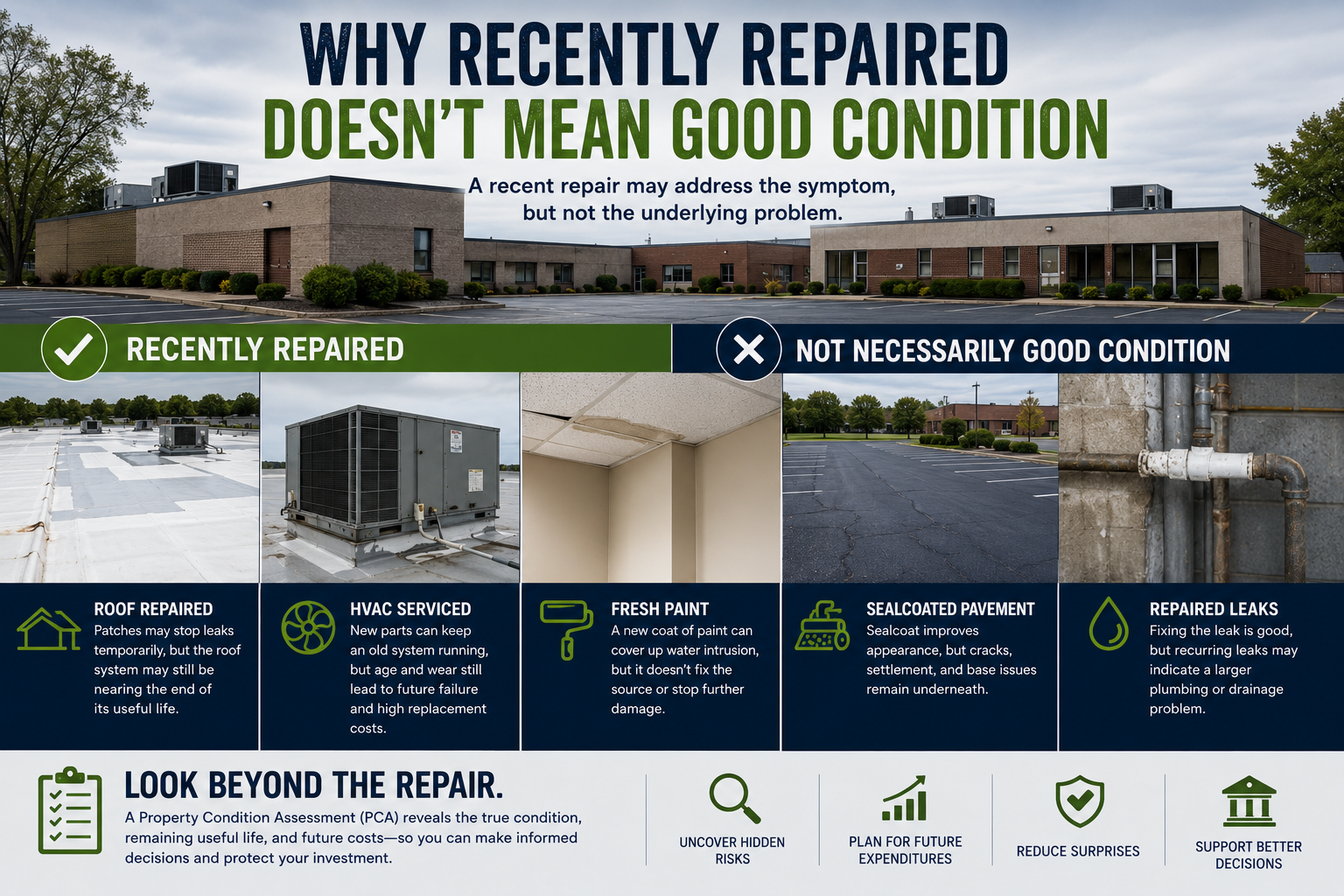
Properties of this age frequently present HVAC systems that have been repaired and patched but never fully replaced; electrical panels and service disconnects that are functional but have exceeded their expected service life; roofing systems that have been re-covered rather than fully replaced; stucco and masonry facades that have developed moisture intrusion pathways over decades; and accumulated deferred maintenance from multiple ownership and tenancy periods.
Negotiating Power Starts with Documentation
When an inspection identifies that HVAC systems have a remaining useful life of approximately three years, a sophisticated tenant can negotiate: a landlord-funded replacement prior to lease commencement, a reduced rent concession to offset anticipated capital costs, a specific carve-out exempting the tenant from HVAC replacement responsibility, or a landlord escrow for identified deferred maintenance items.
None of these negotiations are possible without an objective, documented assessment of building conditions. A handshake assurance from a landlord or a broker’s characterization of the building as “well-maintained” is not a substitute for an independent professional evaluation.
Core Building Inspections Serves All of New Jersey and the Philadelphia Region
Core Building Inspections provides ASTM-compliant, CCPIA-certified NNN lease inspections throughout New Jersey — South Jersey (Camden, Burlington, Gloucester, Salem, Atlantic, Cape May Counties), Central Jersey (Middlesex, Monmouth, Mercer, Ocean, Somerset Counties), and North Jersey (Bergen, Morris, Essex, Hudson, Passaic, Union Counties) — as well as the full Philadelphia metropolitan area including Philadelphia, Bucks, Chester, Delaware, and Montgomery Counties in Pennsylvania, and New Castle County in Delaware.
Ready to schedule a commercial inspection? Contact Core Building Inspections today.
corecreinspections.com | (609) 605-0590 | info@corecreinspections.com