Commercial real estate is not residential real estate. Buyers don’t get the same disclosure protections. In most commercial transactions, the seller has limited obligations, the contract says “as-is,” and the burden of figuring out what you’re actually buying falls squarely on the buyer.
That’s not a complaint — it’s just how the market works. But it means that when a seller doesn’t disclose a known deficiency, whether intentionally or not, the buyer is the one who ends up holding the bill. Understanding how this plays out — and how to protect yourself — is part of doing commercial real estate right.
What Sellers Are and Aren’t Required to Disclose
In commercial transactions, seller disclosure requirements are far more limited than in residential deals. Most commercial contracts are structured with “as-is” language, limited representations and warranties, and broad disclaimers that shift responsibility to the buyer to investigate.
This doesn’t mean sellers can actively lie about known conditions — fraud is still fraud. But it does mean a seller can stay quiet about a roof that’s been leaking for three years, an HVAC system that’s held together with band-aids, or a foundation that’s been moving since the last tenant left. If you didn’t ask and they didn’t tell, that’s often just the nature of the deal.
The practical takeaway: seller disclosures in commercial transactions are a starting point, not a safety net.
What Gets Left Out
In our experience working on PCAs throughout New Jersey and the Philadelphia metro area, the issues that surface most often as undisclosed — or underreported — are not always the dramatic ones. They tend to be the slow-moving, expensive-to-fix problems that sellers have learned to live with.
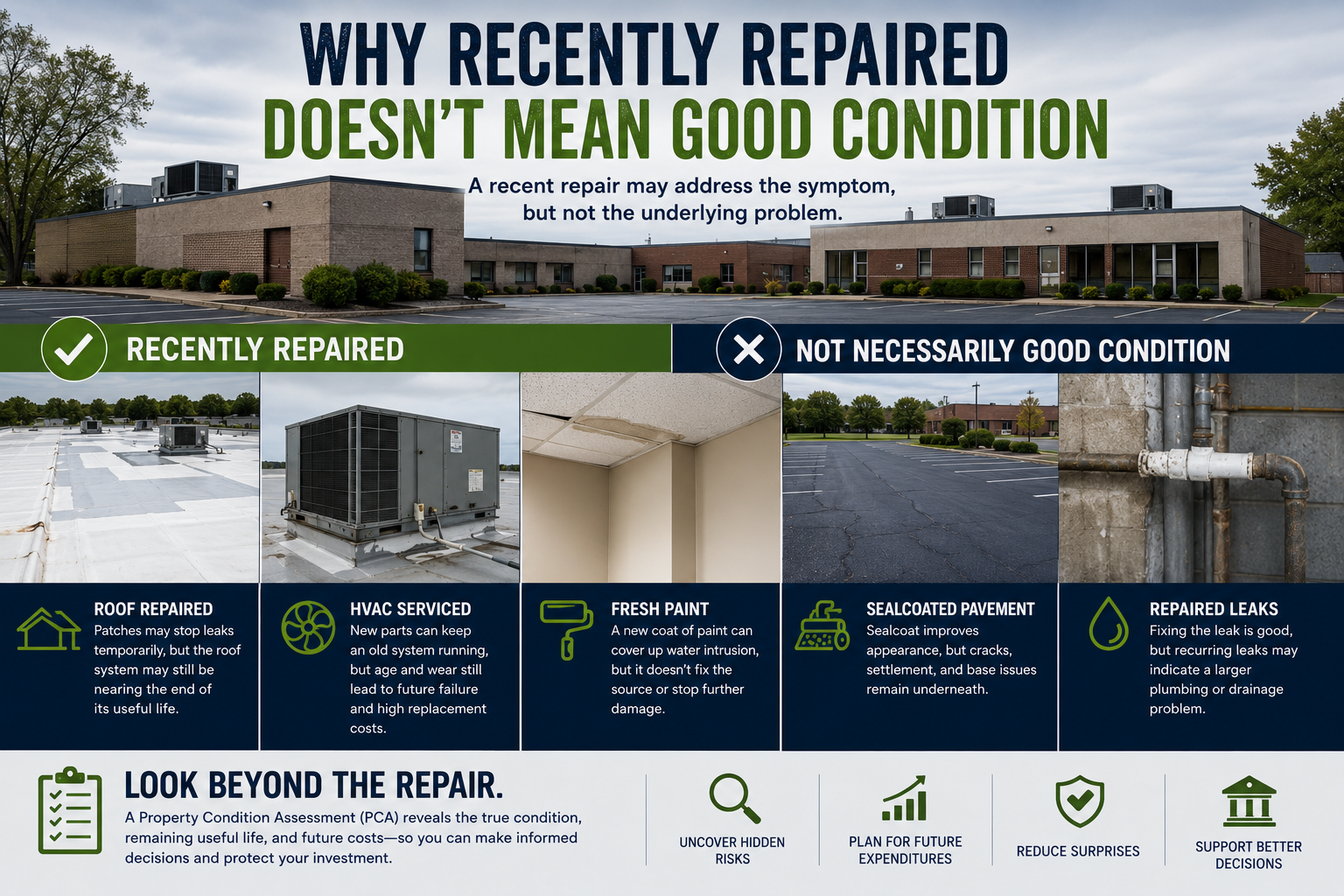
Roof systems are a consistent example. A seller who’s been managing a flat roof with annual patch repairs knows that roof is a problem. A buyer who doesn’t get a PCA may not find out until the first heavy rain after closing. The same pattern shows up with aging HVAC equipment that’s past its useful life, deferred maintenance across multiple building systems, structural movement that’s been quietly progressing for years, and prior repairs that were done cheaply and incorrectly.
None of these are necessarily catastrophic on their own. But they all carry real cost — and they all affect what the property is actually worth.
How It Plays Out After Closing
When deficiencies are discovered post-closing, the impact depends on how significant they are and what the contract says. In most cases, the options are limited.
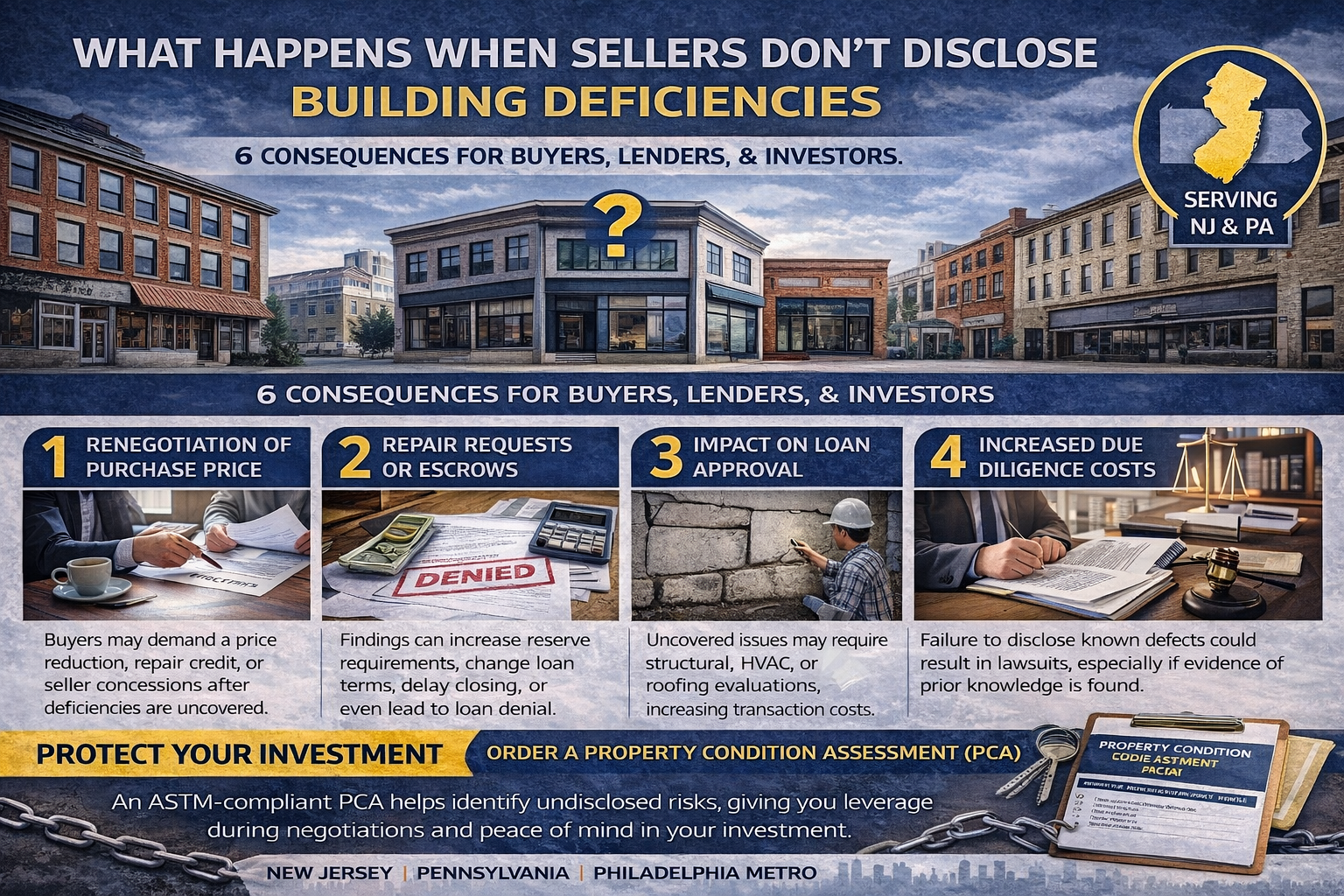
If the issues come to light during due diligence — which is the best-case scenario — buyers have real leverage. Price renegotiation, repair credits, escrow holdbacks, and capital reserve adjustments are all on the table. A well-documented PCA gives the buyer a factual basis for those conversations and takes the emotion out of the negotiation.
If the issues come to light after closing, the options narrow considerably. Lenders may require additional reserves or adjust loan terms when findings are significant. In cases where a seller knowingly concealed a material defect, there may be legal remedies — but commercial contracts are typically written to make that a difficult road. Most buyers who discover post-closing problems end up absorbing the cost.
The gap between those two outcomes — discovering it before versus after — is why the inspection matters.
“As-Is” Doesn’t Mean “No Risk”
This point comes up constantly and it’s worth saying directly: selling a property “as-is” doesn’t eliminate the buyer’s risk. It shifts it.
What “as-is” means is that the seller won’t make repairs and isn’t making representations about the property’s condition. What it doesn’t mean is that the property is fine. When a buyer waives due diligence or skips a PCA on an as-is deal, they’re not avoiding risk — they’re taking it on blind.
In a competitive market or a fast-moving deal, there’s pressure to waive contingencies or move quickly. That pressure is real. But the cost of a PCA is a fraction of what a single undisclosed deficiency can cost to remediate.
What a PCA Actually Does in This Context
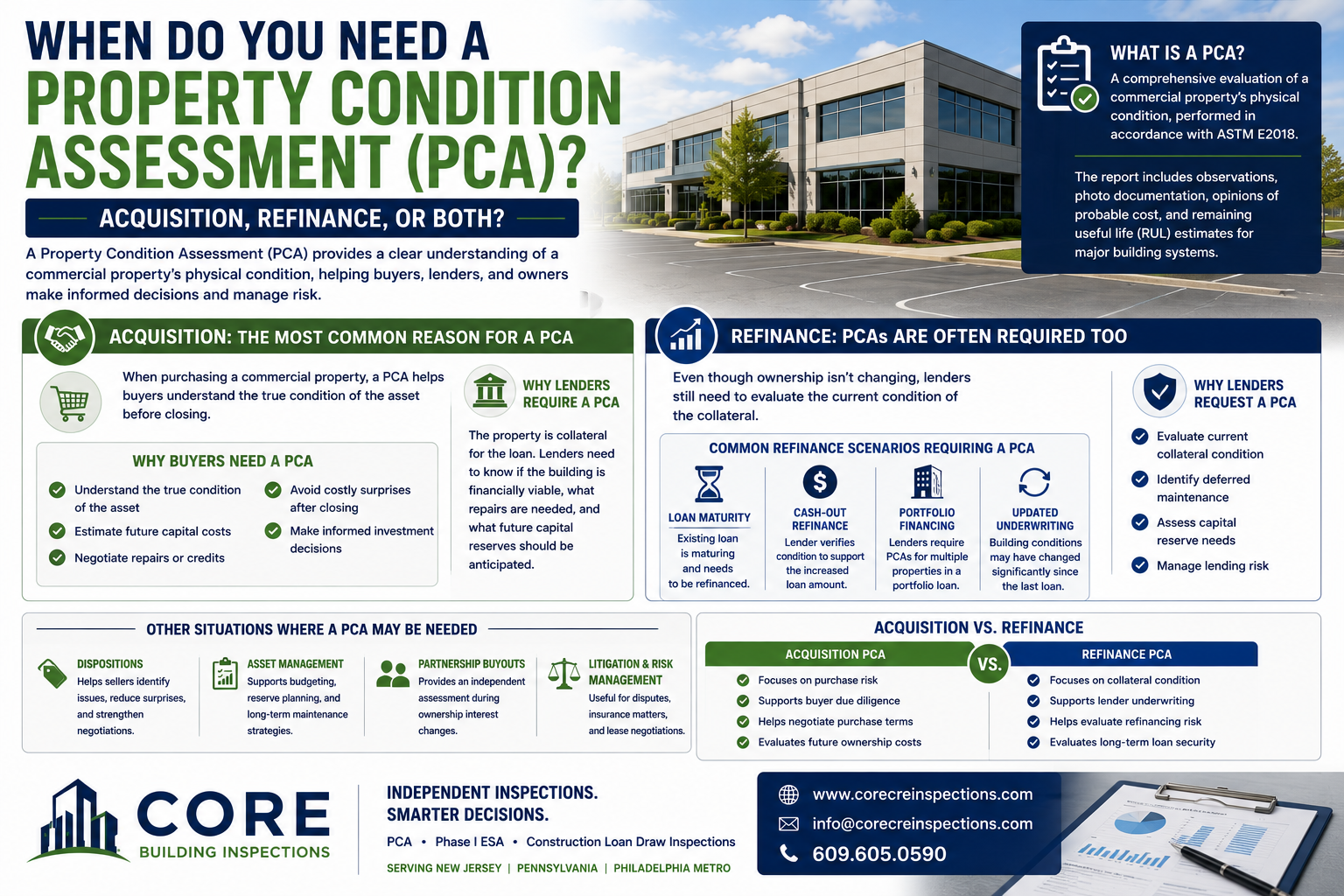
A Property Condition Assessment conducted under ASTM E2018 standards is an independent, third-party evaluation of a property’s physical condition. It doesn’t rely on seller disclosures. It doesn’t take the listing at face value. It looks at the building itself — the roof, the structure, the mechanical systems, the envelope, the site — and documents what’s there.
When we conduct a PCA, we’re evaluating visible defects across major systems, identifying deferred maintenance and end-of-life equipment, estimating repair and replacement costs, and flagging conditions that warrant further specialist review. If we find something that needs a structural engineer or a specialist inspection, we say so.
The findings become the buyer’s independent record of what they’re acquiring — independent of what the seller said or didn’t say.
Regional Context: Why This Matters More in NJ and PA
Older building stock increases the likelihood of undisclosed or underestimated deficiencies. In New Jersey and the Philadelphia metro area, we’re regularly working in buildings from the mid-20th century or earlier — properties where the mechanical systems are well past their design life, the roofs have been patched and re-patched, and the maintenance history is spotty at best.
That doesn’t mean these aren’t good investments. Many of them are. But the older the building, the more critical the independent evaluation becomes — because there’s simply more that can be hiding under the surface.
Protecting Yourself Before You Close
The most effective protection is straightforward: get a PCA before you close, review the findings carefully, and use them. Request maintenance records and repair history from the seller and compare what they say against what the inspection finds. If the PCA surfaces something significant, bring in the right specialist — a structural engineer, an HVAC contractor, a roofing consultant — before you finalize terms.
These steps don’t eliminate risk in commercial real estate. Nothing does. But they give you an accurate picture of what you’re buying, and that’s the difference between a deal that performs and one that surprises you.
Work With Core Building Inspections
Core Building Inspections conducts ASTM-compliant Property Condition Assessments throughout New Jersey and the Philadelphia metro area. If you’re evaluating a commercial property and want an independent assessment of its condition before you close, contact us to schedule your PCA.