Pre-engineered metal buildings are everywhere in New Jersey and the Philadelphia metro area. Drive through any industrial corridor in Burlington County, swing through the flex parks off Route 1 in Middlesex, or cut through the warehouse districts along I-78, and you’re looking at PEMBs. They’re practical, they’re scalable, and when they’re maintained, they perform. But when they’re not, the problems they develop are specific to how they’re built — and a general-purpose inspector who doesn’t understand the system is going to miss them.
A Property Condition Assessment on a pre-engineered metal building isn’t the same exercise as a PCA on a masonry or conventionally framed structure. The failure modes are different, the inspection priorities are different, and the capital planning implications are different. Here’s what a qualified inspector is actually looking for.
What Makes a PEMB Different
A pre-engineered metal building is a factory-fabricated steel system assembled on-site. The structure is engineered as an integrated whole — rigid steel frames, metal wall panels, roof systems, purlins, girts, and precision connection hardware — rather than built from conventional materials selected and coordinated in the field. That integration is the source of both its efficiency and its vulnerability. The system performs as designed when it’s properly installed and consistently maintained. When either of those conditions breaks down, the consequences compound across the building in ways that aren’t always obvious from the outside.
The Roof System
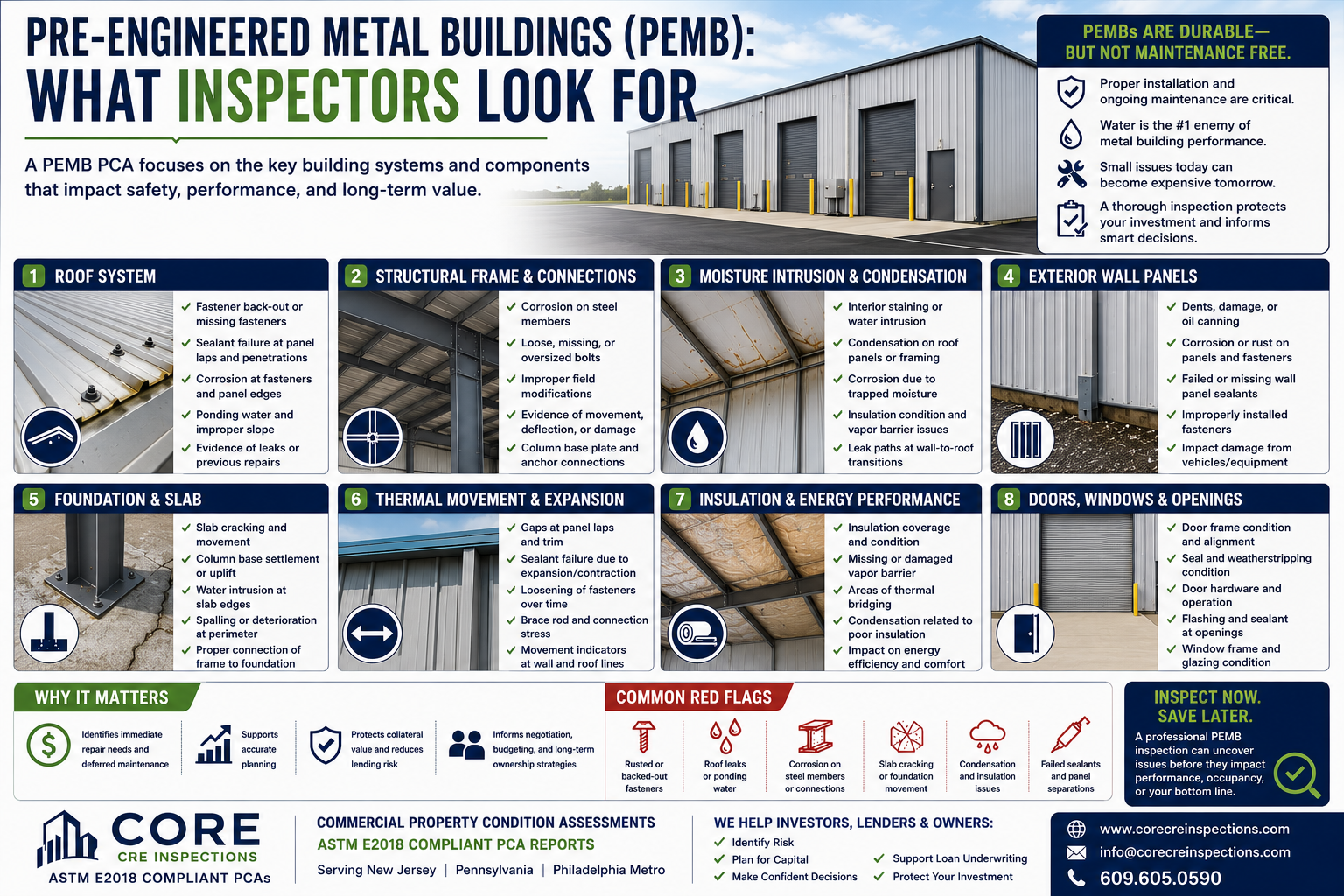
The roof is where most PEMB inspections earn their keep. Metal panel roof systems are highly susceptible to fastener back-out, sealant failure at panel laps, and corrosion at penetrations and terminations — all of which create water intrusion pathways that can go undetected until interior damage becomes apparent. In New Jersey and Pennsylvania, the seasonal temperature swing is significant. PEMBs expand and contract with every cycle, and over time that thermal movement works fasteners loose, opens sealant joints, and degrades panel connections in ways that accumulate gradually and then become expensive quickly.
During a PCA, the roof gets a thorough field evaluation: panel condition, lap sealants, penetration flashings, edge terminations, drainage patterns, and any evidence of prior repairs. Patch repairs on a metal roof tell a story — sometimes a manageable one, sometimes a sign that deferred maintenance has been ongoing long enough to warrant a full system assessment. Ponding water in low-slope sections is flagged, particularly where it concentrates at structural connections, because standing water accelerates both corrosion and fastener degradation.
Structural Frame and Connections
The steel framing is engineered to tight tolerances, which means any deviation from those tolerances — corrosion at base connections, loose or missing bolts at beam-column joints, field modifications made without engineering review — represents a meaningful concern. Inspectors look closely at base plate conditions, which are often the first place corrosion shows up due to moisture at the slab interface. Roof framing connections get attention as well, particularly in buildings that have seen interior modifications, equipment additions, or loading changes over time.
The goal isn’t to perform a structural engineering evaluation — that’s a separate engagement when warranted — but to identify visible conditions that suggest the frame has been compromised or is performing outside its design parameters, and to recommend further evaluation when those signs are present.
Moisture Intrusion and Condensation
Condensation is one of the more insidious issues in metal buildings, particularly in older facilities where insulation has deteriorated or vapor barriers were inadequately installed to begin with. When warm, humid interior air contacts cold metal surfaces, condensation forms — and in a building envelope that doesn’t manage it well, that moisture migrates into insulation, accelerates corrosion, and eventually shows up as staining, dripping, or active deterioration of structural components.
The inspection evaluates interior surfaces for moisture staining, examines insulation condition where accessible, and notes any evidence of chronic moisture accumulation. In climate-controlled facilities — refrigerated warehouses, conditioned manufacturing space, food processing buildings — insulation and vapor barrier performance is particularly consequential and gets proportionally more attention.
Exterior Wall Panels
Metal wall panels are inspected for physical damage, corrosion, sealant failure at panel joints, and evidence of improper fastener installation. Impact damage from loading dock activity is common in industrial facilities and usually localized, but it creates entry points for water and can compromise the integrity of the panel attachment system in the immediate area. Panel replacement history is evaluated where evident, since mismatched panels or panels installed without attention to sealant detailing can create chronic leak points.
Foundation and Slab
The building may be steel, but it sits on a concrete foundation, and foundation performance matters regardless of what’s above it. Column base locations are specifically evaluated for settlement, cracking, and evidence of moisture intrusion at the slab edge. Drainage around the building perimeter is assessed as well — poor site grading that directs water toward the structure is a recurring contributor to long-term foundation problems in PEMBs, where the column bases are particularly sensitive to sustained moisture exposure.
Why This Matters for Lenders and Investors
A pre-engineered metal building that has been properly maintained is a sound asset. One where roofing, connections, and moisture management have been deferred presents a capital expenditure profile that needs to be understood before closing. The ASTM E2018-compliant PCA quantifies that profile — remaining useful life estimates, opinion of probable cost for identified deficiencies, and a capital reserve framework that gives lenders and investors an accurate picture of what they’re underwriting.
In this region, where the building stock includes a significant number of PEMBs from the 1980s and 1990s now entering their third or fourth decade of service life, that assessment is increasingly consequential. Roofs on 30-year-old metal buildings don’t have a lot of runway left. Structural connections that have never been inspected or re-torqued may show signs of movement. Insulation systems installed before current energy standards were adopted are often underperforming and contributing to interior moisture problems.
A PCA surfaces all of it in a format that supports underwriting, reserve planning, and capital budgeting — before the transaction closes rather than after. Core Building Inspections.