Older buildings in New Jersey and Pennsylvania can be great investments. They can also be money pits. The difference usually comes down to what’s happening with the foundation and framing — and whether anyone bothered to look closely before the deal closed.
This isn’t a scare piece. It’s a straightforward breakdown of what we commonly find during Property Condition Assessments (PCAs) on older commercial and mixed-use properties in this region, and why it matters to buyers, lenders, and investors.
Why This Region Has More Than Its Share of Structural Problems
The Mid-Atlantic building stock is old. Philadelphia rowhouses, Newark industrial buildings, South Jersey mixed-use strips — a significant portion of what’s out there was built before modern building codes existed, using materials and methods that were standard at the time but weren’t built to last indefinitely.
Layer on top of that:
- Freeze-thaw cycles that crack masonry and heave foundations every winter
- Heavy clay soils common throughout much of NJ and southeastern PA that expand when wet and shrink when dry, putting constant stress on footings
- Decades of deferred maintenance — especially common in properties that have changed hands multiple times or sat vacant
- Aging drainage infrastructure that no longer does its job
The result is a building stock where structural issues aren’t the exception — they’re the norm. The question isn’t usually whether there are problems, but how serious they are.
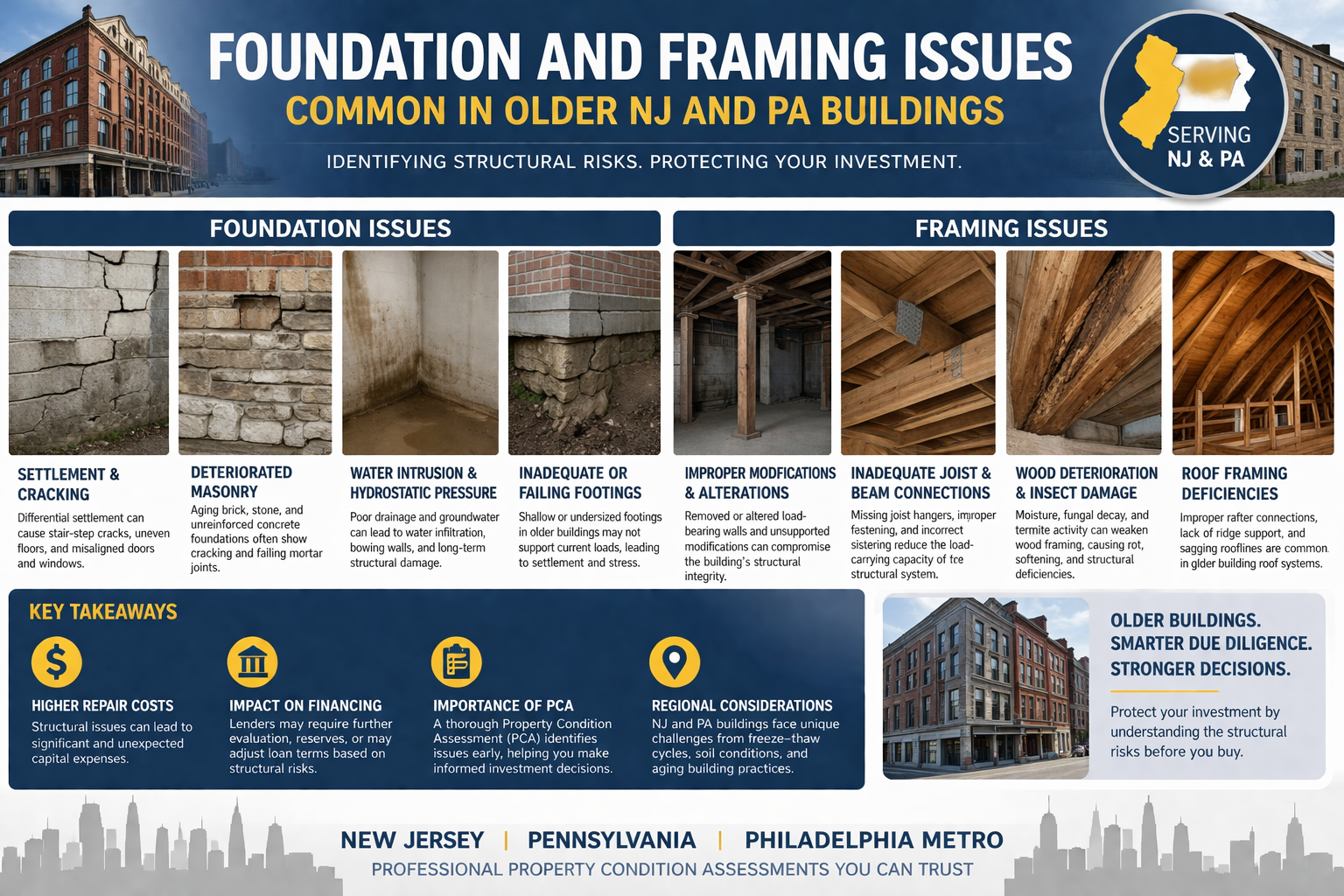
Common Foundation Problems
Settlement and Differential Movement
Settlement happens in almost every older building to some degree. What matters is whether it’s uniform and stable, or ongoing and uneven.
Differential settlement — where one part of the building sinks more than another — is the more serious concern. You’ll often see it expressed as:
- Diagonal cracks running from the corners of windows and doors
- Floors that slope noticeably toward one side
- Gaps opening up between walls and ceilings
- Doors and windows that stick or won’t close properly
In many cases, settlement has long since stabilized and the cracks are cosmetic. In others, it’s an active problem tied to soil conditions or drainage that will keep moving until it’s addressed.
Cracked and Deteriorated Masonry Foundations
Stone, brick, and unreinforced concrete foundations were standard in this region for most of the 19th and early 20th centuries. They’ve held up buildings for a long time — but they have limits.
What to watch for:
- Horizontal cracking in block or brick foundations, which often signals lateral pressure from soil and water — one of the more serious patterns we see
- Stair-step cracking through mortar joints, typically a sign of settlement or movement
- Spalling and mortar deterioration, which lets water in and accelerates the problem over time
A cracked masonry foundation isn’t automatically a deal-breaker, but it needs a structural engineer’s eyes on it before you can know what you’re dealing with.
Water Intrusion and Hydrostatic Pressure
Water is the enemy of every foundation, and older buildings rarely have adequate waterproofing by modern standards.
Poor grading, clogged drains, and downspouts that discharge right next to the building are the usual culprits. Over time, water builds up against the foundation wall, and hydrostatic pressure does real damage — bowing walls inward, forcing water through cracks, and saturating the soil around footings.
In basements and crawlspaces, chronic moisture leads to a cascade of secondary problems: efflorescence, mold, wood rot, and insect activity. By the time it’s visible, it’s usually been going on for years.
Inadequate Footings
Many older buildings were built with footings that were shallow, undersized, or simply not engineered for the loads they now carry. This was perfectly legal at the time — codes have changed significantly.
The problem surfaces when loads increase (a new roof, an added floor, heavy equipment) or when soil conditions shift. The result is ongoing settlement that doesn’t stop on its own.
Common Framing Problems
Load-Bearing Walls That Aren’t There Anymore
This is one of the most common issues we find in older commercial buildings, particularly those that have been renovated multiple times. Someone needed an open floor plan, so a wall came down. Whether a structural engineer was involved is another question entirely.
Removed or compromised load-bearing walls redistribute forces through the structure in ways the original framing wasn’t designed to handle. The effects can be subtle at first — a slight sag in the floor above, some cracking at connections — and more serious over time.
Joist and Beam Problems
Older wood framing systems predate modern metal connector hardware. Joists were often toenailed into place, and beams were supported by methods that don’t hold up the way modern joist hangers do.
What we commonly find:
- Joists with inadequate bearing at their ends
- Beams that have been notched or cut to accommodate plumbing or electrical runs — sometimes significantly weakening them
- Sistered joists added as repairs but installed incorrectly, providing little actual reinforcement
Wood Deterioration and Insect Damage
Termites are active throughout New Jersey and Pennsylvania. Subterranean termites in particular are common in the Philadelphia metro area and across South Jersey. In an older building that hasn’t had consistent pest management, the framing can be extensively damaged before anyone notices.
Wood rot from chronic moisture exposure is equally common and often found alongside insect damage. Soft, discolored, or visibly deteriorated framing members — especially at sill plates, rim joists, and anywhere near plumbing — are a consistent finding in this building stock.
Roof Framing
Older roof systems were often built using cut rafter methods rather than engineered trusses, and they frequently lack the ridge beams or collar ties that modern codes require. Over decades, this results in roof spread — the walls slowly being pushed outward by the weight of the roof.
Signs include sagging ridgelines, bowing exterior walls at the upper floors, and cracks at the tops of masonry walls. It’s a slow-moving problem, but it’s also one that’s expensive to correct properly.
What a PCA Actually Evaluates
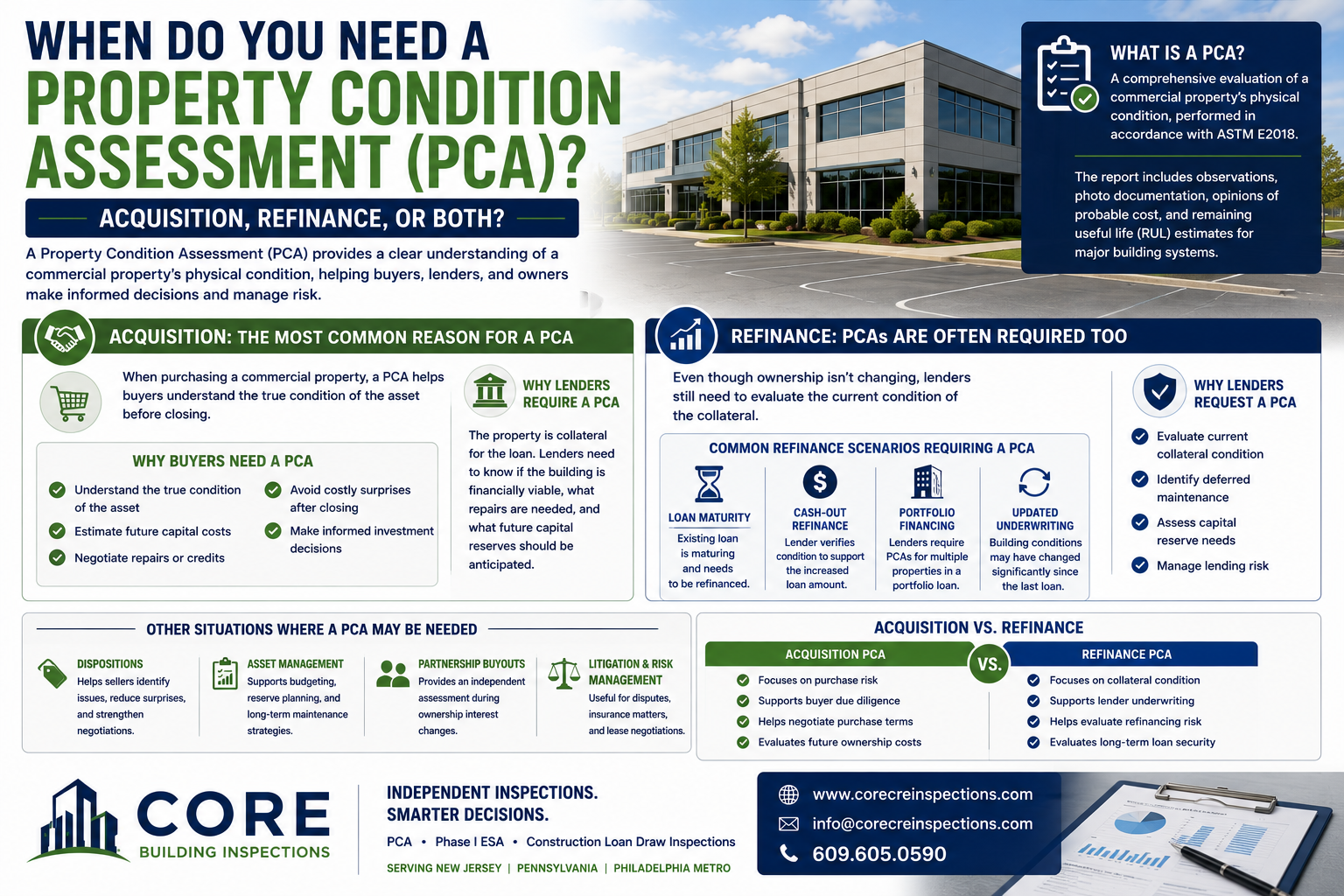
A Property Condition Assessment is a visual, non-invasive inspection conducted in accordance with ASTM E2018 standards. It’s not a structural engineering report — but it is designed to identify conditions that warrant one.
During a PCA, inspectors evaluate:
- Foundation walls, footings, and visible below-grade conditions
- Framing integrity throughout accessible areas
- Signs of settlement, movement, or differential deflection
- Evidence of moisture intrusion and drainage conditions
- Any modifications or alterations that may affect structural load paths
When we identify something that needs closer scrutiny, we say so — and we recommend the right follow-up, whether that’s a structural engineer, a waterproofing specialist, or a pest inspector.
Why It Matters Before You Close
Structural problems don’t get cheaper with time. What looks like a minor foundation crack at closing can turn into a six-figure remediation project two years later. Lenders are increasingly aware of this, and structural findings in a PCA can affect loan approval, escrow requirements, and deal terms.
More importantly, understanding what you’re buying allows you to price it correctly, negotiate appropriately, and plan for what comes next. That’s what due diligence is supposed to do.
Working in This Region
Core Building Inspections conducts ASTM-compliant Property Condition Assessments throughout New Jersey and the Philadelphia metro area. We know this building stock — the rowhouses, the industrial conversions, the mixed-use strips that line every main street in South Jersey. We’ve seen what these buildings do, and we know what to look for.
If you’re evaluating an older commercial property and need a PCA that gives you straight answers, contact us to schedule an assessment.