Houses of worship building inspections help buyers, lenders, boards, and owners understand the true condition of a religious property before a purchase, refinance, renovation, or major repair decision. A church, synagogue, mosque, temple, or similar facility may look sound during a walkthrough, but hidden cost often sits in the roof, structure, mechanical systems, accessibility issues, and life safety items. Religious buildings carry a combination of large assembly spaces, older construction, mixed-use areas, deferred capital spending, and public-facing occupancy that demands more than a residential-style checklist.
At Core Building Inspections, houses of worship building inspections are approached as real commercial due diligence. The goal is not to hand over a long list of minor flaws. The goal is to show decision-makers where risk is building, where deferred maintenance may affect the budget, and where a property may need additional review before money is committed. Our inspections are performed using a methodical, standards-driven approach aligned with ASTM, CCPIA, and ICC guidelines across the Philadelphia metro area and throughout PA, NJ, NY, and DE.
Religious buildings are unlike standard office, retail, or industrial properties. Many have large assembly spaces with tall ceilings, older sanctuaries, fellowship halls, classrooms, offices, kitchens, nurseries, and several connected additions built in different decades. That mix changes the inspection fundamentally.
A house of worship may carry years of careful use but uneven capital spending. Many congregations do a good job keeping the building active while deferring bigger repair work until it becomes urgent. That does not mean the property is poorly managed. It means the building often needs a closer look at long-term costs, not just what is visible in the lobby or sanctuary.
Use also matters. These properties can host weekly worship, weekday office work, childcare during services, food service, education, counseling, events, and community gatherings. A building that supports many functions puts more stress on parking, restrooms, HVAC zones, electrical loads, exits, and circulation paths than its outward appearance suggests. A standard commercial walkthrough often misses how those parts work together under real operating conditions.
Houses of worship building inspections should stay focused on the systems that affect safety, function, and future spending. Buyers want to know what they are taking on. Boards want to know what needs attention first. Lenders want a report that speaks clearly about risk, condition, and major building components.
Roofing is one of the biggest cost items in many religious properties, especially where the site includes a sanctuary roof with steep slopes or complex geometry, flat roof sections over classrooms and fellowship halls, low-slope roofs over offices, or older drainage layouts. Leaks in a house of worship do more than stain ceilings. They can damage interior finishes, affect air quality, harm framing, and create repair needs in spaces used by large groups. Our inspection evaluates roof type, membrane or shingle condition, drainage, flashings, penetrations, signs of prior repairs, and evidence of active or historical water intrusion. For more on how we evaluate commercial roofing, see our Commercial Roofing Inspection page.
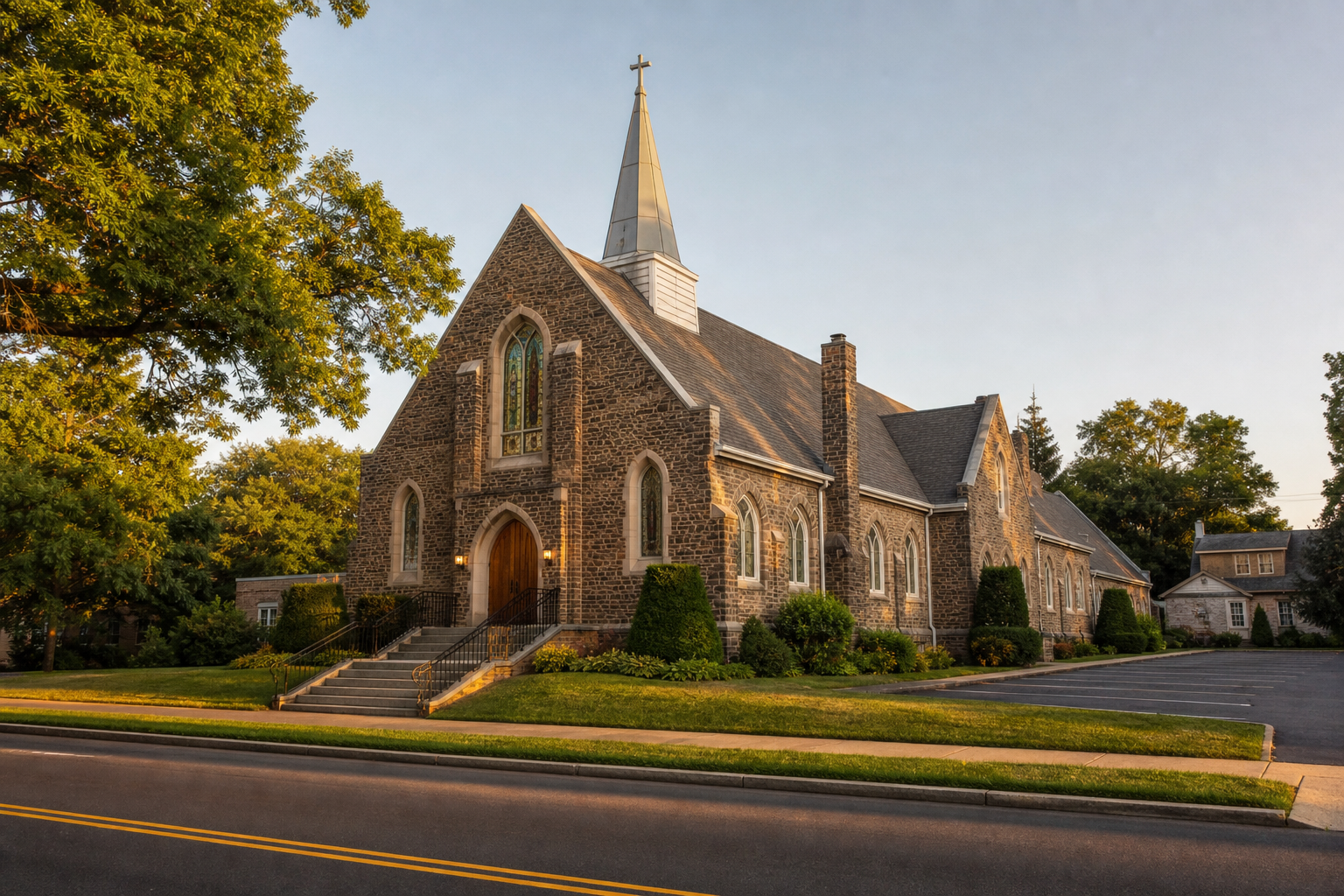
Older sanctuaries may have long spans, heavy roof framing, masonry bearing walls, bell towers, steeples, or additions tied into the main building in ways that deserve close visual review. Cracking, movement, moisture damage, and settlement are not small issues when the building is used by a congregation and the repair budget may already be tight. We evaluate foundations, structural framing, load-bearing walls, visible connections, and evidence of settlement or movement. In the Philadelphia metro area, older stone and brick churches, many dating to the 19th and early 20th centuries, carry specific structural patterns including deteriorated mortar joints, lintel displacement, and foundation movement from decades of soil interaction.
Houses of worship often have HVAC equipment that serves spaces with very different use patterns. A sanctuary may sit quiet most of the week, then fill with hundreds of people on weekends. Fellowship halls, classrooms, and offices may follow a different schedule entirely. That kind of stop-and-start demand can expose deferred maintenance, aging equipment, poor zoning, or uneven comfort that points to larger system issues. Boilers, furnaces, rooftop units, split systems, and unit heaters are all commonly found in religious properties, sometimes in combination across additions of different eras. We evaluate equipment type, apparent age, general condition, and any observable concerns.
Older religious facilities may have had sound systems, lighting upgrades, kitchens, office equipment, security systems, and added cooling installed over time. If those changes were layered onto an older electrical service without a long-term plan, the result may be overloaded panels, aging wiring, or equipment that no longer fits the building’s real use. Our inspection evaluates service entrance condition, main distribution, visible wiring and panels, and whether the electrical system appears adequate for the building’s current demands. Many older houses of worship have electrical systems that were originally designed for lighting and basic receptacle loads, not the modern audio-visual, HVAC, kitchen, and technology demands they now support.
Restrooms, kitchens, janitor spaces, water heaters, and drainage points in religious properties often see heavy intermittent use during services and events. In some buildings, a small leak, worn finish, or soft floor around these areas is the first indication that a larger maintenance issue has been developing in the background. We evaluate the main water service, distribution piping, restroom fixtures, water heating equipment, kitchen plumbing where present, and visible drain and waste piping. For properties with commercial kitchens or food preparation areas, plumbing demands are higher and the inspection scope reflects those requirements.
Life safety needs special attention in religious properties because they are public-facing assembly spaces classified under IBC Group A-3 (Assembly) when calculated occupancy reaches 50 or more. That classification triggers specific requirements for egress, sprinkler systems, fire alarms, emergency lighting, and occupancy posting that many congregations may not be fully aware of. Our inspection documents visible fire protection components, sprinkler system condition where present, fire alarm and detection systems, means of egress, exit signage, emergency lighting, stair conditions, and handrails. We note conditions that may warrant further review by the local fire marshal or a fire protection specialist.
Insurance carriers increasingly require documented inspection and maintenance records for houses of worship. Many church insurance policies include conditions related to building code compliance, and violations can result in claim denial or policy non-renewal. Our inspection reports provide the documented evidence that supports insurance compliance and risk management.
Accessibility observations matter in religious properties, especially in older buildings where entries, restrooms, seating access, ramps, parking, or path-of-travel conditions may not meet current ADA guidelines. While our inspection is not a formal ADA compliance audit, we document observable accessibility concerns that may affect daily use, future improvement planning, and the property’s suitability for its intended congregation. For properties subject to ADA Title III (places of public accommodation), accessibility findings can influence renovation scope, budgeting, and prioritization. For a more detailed evaluation, see our Accessibility (ADA) Inspections service.
Parking lots, sidewalks, curbs, site lighting, drainage, retaining walls, and exterior stairs can become major expense items at religious properties. They also affect how safely people move through the property before and after services, events, and meetings. Many houses of worship have parking and site infrastructure that has been expanded or modified over decades without consistent capital investment. Our inspection evaluates site conditions with attention to the circulation patterns, pedestrian safety, and drainage demands specific to assembly-use properties.
Not every house of worship is the same, and the inspection should reflect the specific property being evaluated.
Churches and Cathedrals: From small neighborhood churches to large multi-building campuses with sanctuaries, fellowship halls, classrooms, offices, gymnasiums, and support buildings. Older churches in the Philadelphia metro area frequently feature stone or brick masonry construction, slate or metal roofing, bell towers or steeples, and additions spanning multiple decades.
Synagogues and Jewish Community Centers: Often combine worship space with education, social, and community functions. Many include commercial kitchens, event spaces, and childcare facilities that add complexity to the inspection.
Mosques and Islamic Centers: May include prayer halls with specific orientation requirements, ablution areas with specialized plumbing, educational spaces, and community gathering areas.
Temples, Gurdwaras, and Other Religious Facilities: Each carries its own combination of worship space, community use, kitchen and food service areas, and support functions. The inspection scope adapts to the specific building and its use.
Multi-Building Campuses: Religious campuses with multiple structures require evaluation of each building as well as shared site infrastructure, utilities, and connections between buildings.
Religious properties tend to repeat recognizable problem patterns based on building age, construction type, and maintenance history.
Deferred roofing maintenance is one of the most common and most expensive findings. Complex roof geometries, multiple roof sections from different additions, and limited capital budgets often result in layered repairs, aging membranes, and active water intrusion that has been managed rather than resolved.
Structural movement in older masonry is common in pre-war stone and brick churches. Deteriorated mortar joints, lintel displacement, settling foundations, and cracking at wall intersections and around window and door openings are frequent findings.
Aging mechanical systems with uneven maintenance. Boilers, furnaces, and HVAC equipment in religious properties often have extended service lives well beyond typical commercial expectations because replacement is deferred until failure. Equipment may be operational but approaching or past the end of its expected useful life.
Electrical systems outgrown by modern use. Sound systems, projectors, kitchen appliances, HVAC additions, security equipment, and office technology layered onto older electrical service create capacity and safety concerns that may not be visible during a walkthrough.
Life safety gaps in older buildings that predate current code requirements. Missing or non-functional emergency lighting, inadequate exit signage, blocked egress paths, and fire protection systems with unknown service status are common findings in older religious facilities.
Site deterioration including cracked parking lots, failed sidewalks, poor drainage, and deteriorated exterior stairs. These conditions create trip-and-fall liability and represent significant capital expense when they reach the point of full replacement.
The first step is scoping the property. A small single-building church needs a different level of review than a multi-building campus with classrooms, offices, fellowship space, kitchens, and support buildings. The scope matches the property, the age of the site, and the reason the inspection is being ordered.
Before the site visit, we review available background information and identify areas that may need extra attention. During the field visit, the building is inspected system by system, with focus on visible condition, deferred maintenance, safety concerns, and the major systems that drive ownership cost. Where a condition points beyond the normal inspection scope, that is called out clearly so the client knows whether a roofer, structural engineer, electrician, environmental consultant, or another specialist should step in.
After the visit, the report translates field observations into plain language. A useful report separates urgent items from longer-range capital needs and is organized so that a board, buyer, lender, or attorney can follow it without technical translation. That clarity is where many weaker providers fall short.
A strong inspection does more than point out defects. It helps the people making the decision understand what comes next. If the property is being purchased, the report helps the buyer sort cosmetic issues from material concerns. Roof age, water entry, structural movement, aging HVAC, electrical limitations, and deferred pavement work can all shape price negotiations and post-closing budgets.
If the property is already owned, the same inspection helps a board or facility team set repair priorities. Some items need prompt action because they affect safety or active deterioration. Others belong in a short-term or long-term capital plan. That kind of clarity is often more useful to a congregation than a report full of noise.
For properties where granular cost estimates are needed, our Cost to Cure Reporting service provides detailed financial analysis tied to specific repair and replacement items.
A houses of worship building inspection can be performed as a standalone service or as part of a broader Property Condition Assessment conducted in general conformance with ASTM E2018. A standalone inspection provides a focused commercial evaluation of visible conditions. A PCA is more formal and may include capital needs tables, remaining useful life analysis, and opinions of probable cost tied to lender requirements.
For clients exploring related building types, this page also connects to our Special Purpose Property Inspections offering, since many religious buildings fall into that broader category of use-specific commercial real estate.
Our houses of worship building inspection clients include buyers, lenders, congregations, trustees, nonprofit boards, owner-representatives, property managers, attorneys, and denominational organizations. Reports are structured to support acquisition due diligence, loan underwriting, capital planning, renovation scoping, insurance documentation, and leadership transition reviews.
Religious properties can carry deep emotional value, but the building still has to be evaluated as a physical asset with real repair cost, system age, and long-term risk. Core Building Inspections approaches that work with a practical, commercial lens. The report is meant to help people make a sound decision.
We provide houses of worship building inspections throughout the Philadelphia metropolitan area, all of New Jersey, New Castle County in Delaware, and select markets in New York. This regional footprint covers a diverse building stock of religious properties spanning centuries of construction, from colonial-era stone churches and 19th-century urban parishes to mid-century suburban campuses and modern worship centers.
For more on the industry standard guiding commercial PCAs, see ASTM E2018. Industry standards from CCPIA help frame a consistent, standards-based approach to commercial property inspection work.



Certified under nationally recognized commercial inspection standards to ensure consistency, accuracy, and professional accountability.

CCPIA Certified
Certified under nationally recognized commercial inspection standards to ensure consistency, accuracy, and professional accountability.

ICC Certified
Ongoing education and training aligned with current safety practices, codes, and inspection methodologies.

ASTM Member
Inspections performed in general conformance with ASTM standards, supporting due diligence and lender requirements.

Years of Experience
Extensive field experience inspecting diverse commercial properties across multiple asset types and markets.

Highly Trained
Continuous training and practical expertise focused on risk identification, system performance, and long-term planning.

 David129 days ago
Trustindex verifies that the original source of the review is Google.
I rely heavily on accurate due diligence and trusted professionals when evaluating acquisitions. Core Building Inspections exceeded my expectations at every stage of the process. Their level of professionalism, technical expertise, and attention to detail was exceptional. The inspection report was comprehensive, well-organized, and provided valuable insights that helped me assess risk and make informed decisions with confidence. What truly sets Core Building Inspections apart is their ability to communicate complex building conditions in a clear, practical manner. Their responsiveness and commitment to client service reflect a deep understanding of the commercial real estate industry. I would not hesitate to use their services again and highly recommend them to investors, lenders, and property owners seeking a first-class commercial building inspection firm. Chris Nocera131 days agoAs a commercial real estate investor, I’ve worked with many inspection companies over the years, and this team stands out. Their inspection was thorough, professional, and delivered in a way that helped me make informed investment decisions with confidence. The report was detailed, easy to understand, and completed on schedule. Their responsiveness and attention to detail were impressive from start to finish. I would highly recommend their services to any investor, buyer, or property owner in need of a high-quality commercial building inspection.
 Jordan Patruskey133 days agoI’ve worked with a number of inspection firms over the years, and Core Building Inspections is one of the best. Their team was professional, responsive, and extremely thorough throughout the process. The report was clear, detailed, and gave me the information I needed to move forward with confidence. If you’re involved in commercial real estate and need a dependable inspection company, I highly recommend Core Building Inspections.
Yes. The core systems are similar, but religious properties often include large assembly spaces, classrooms, kitchens, offices, and older additions that change the risk picture. A good inspector adjusts the review to fit how the property is actually used, not just its square footage.
Deferred roofing maintenance, structural movement in older masonry, aging HVAC equipment operating past expected useful life, electrical systems outgrown by modern use, life safety gaps in older buildings, and deteriorated site conditions are the most common findings.
Many church insurance policies require documented inspection and maintenance records as conditions of coverage. Our reports provide dated, photographic documentation of building condition that supports insurance compliance, risk management, and claim substantiation.
Yes. A professional inspection report with documented conditions, photographs, and prioritized findings provides the objective evidence that grant agencies, denominational funding bodies, and capital campaign committees often require when evaluating facility improvement requests.
In many cases, yes. Older structures, towers, mixed roof types, and several connected buildings add complexity. The inspection should be scoped around the real property, not forced into a one-size-fits-all format.