HVAC systems are the single largest operating expense in most commercial buildings, and they are among the most capital-intensive systems to repair or replace. A failing rooftop unit, an aging boiler, or a neglected air handling system does not just create tenant discomfort. It drives energy waste, accelerates related building deterioration, and exposes owners to unplanned six-figure capital outlays. A commercial HVAC inspection gives buyers, owners, and lenders a clear evaluation of system condition, remaining useful life, and near-term capital exposure. Core Building Inspections performs commercial HVAC inspections throughout the Philadelphia metro area and across PA, NJ, NY, and DE.
Our inspections follow a systematic, standards-referenced approach aligned with CCPIA, ICC, and ASTM guidelines. We evaluate heating, cooling, ventilation, and distribution systems, including rooftop units, split systems, boilers, chillers, air handlers, exhaust systems, ductwork, controls, and associated mechanical components. Each inspection is scoped to the property type, system configuration, building age, and purpose of the evaluation.
HVAC systems in commercial buildings are fundamentally different from residential heating and cooling. They operate at larger scale, serve more complex distribution networks, manage greater airflow volumes, and carry significantly higher replacement costs. A commercial property may have multiple rooftop packaged units, central chiller plants, boiler systems, variable air volume terminals, dedicated exhaust and ventilation systems, and building automation controls coordinating it all. The failure modes are different, the energy implications are larger, and the capital costs of deferred maintenance compound faster.
Commercial HVAC inspection identifies aging equipment, inadequate maintenance, operational deficiencies, and conditions that shorten system life or increase operating costs. For buyers, it quantifies the cost of bringing mechanical systems to an acceptable standard and informs the post-closing capital budget. For owners, it supports maintenance planning and helps prioritize replacements before failures disrupt tenants or operations. For lenders, it documents mechanical system condition at the time of financing and reduces risk exposure tied to the building’s most expensive operating system.
ANSI/ASHRAE/ACCA Standard 180-2018, the industry standard for inspection and maintenance of commercial building HVAC systems, establishes condition-based inspection frequencies by equipment type. The standard requires a documented maintenance program with scheduled inspection and maintenance tasks at monthly, quarterly, semi-annual, annual, and multi-year intervals depending on the equipment category and observed condition.
At minimum, commercial HVAC systems should receive professional inspection at least annually. Seasonal inspections, typically in spring before cooling season and fall before heating season, are standard practice for most commercial buildings. Equipment in deteriorated condition or serving critical operations may require quarterly or monthly attention. Beyond scheduled maintenance, HVAC systems should be evaluated at every property transaction, before any major renovation or change of use, and after any significant equipment failure, flooding event, or storm damage.
For properties in the Philadelphia metro area and across PA, NJ, and DE, the full four-season climate cycle, with summer cooling demands, winter heating loads, and seasonal transitions, makes adherence to a regular inspection schedule especially important. Our commercial HVAC inspections are designed to fit within a proactive evaluation cadence, whether scheduled as part of a maintenance program or triggered by a specific transaction or event.
The most important distinction in a commercial HVAC inspection is not what is inspected but who is performing the inspection and what their incentives are. An HVAC contractor who performs inspections also sells repairs, replacements, and service contracts. Their assessment is not independent, and their business model creates an inherent financial interest in recommending more work, not less.
Core Building Inspections is not an HVAC contractor. We do not sell mechanical repairs, equipment replacements, refrigerant services, or maintenance contracts. Our only deliverable is an objective, documented evaluation of HVAC system condition. This independence matters most in three scenarios: pre-purchase due diligence, where the buyer needs an unbiased condition opinion before committing capital; dispute and insurance situations, where all parties need a neutral technical assessment; and capital planning, where the owner needs to know what to budget for over the next one to five years without the influence of a contractor’s sales pipeline.
As CCPIA, ICC, and ASTM-credentialed inspectors, we bring professional accountability and standards-driven methodology without the conflict of interest that arises when the inspector who identifies deficiencies is also the contractor who profits from correcting them.
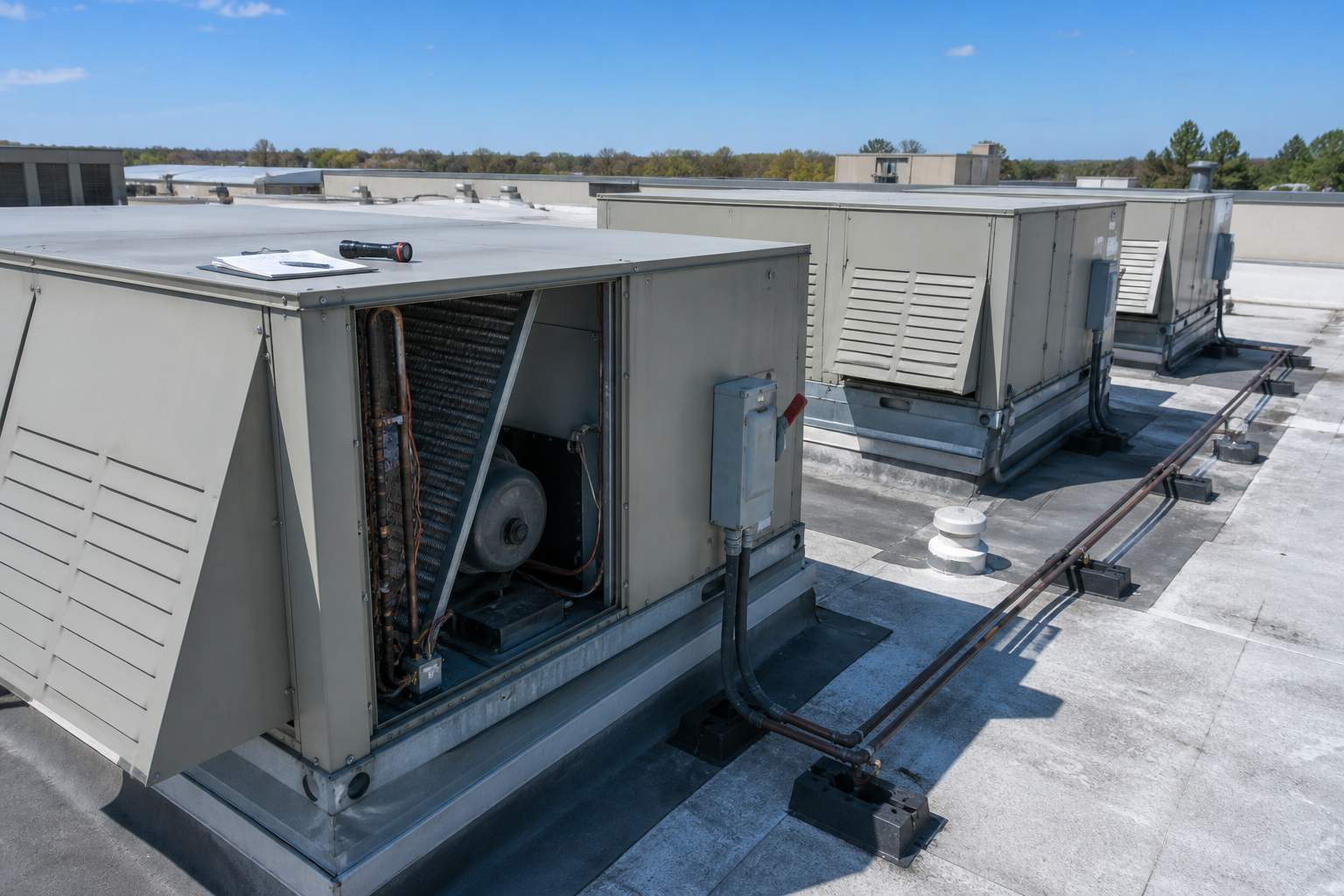
Rooftop packaged units are the most common HVAC configuration in commercial buildings, particularly in retail, office, and industrial properties. We evaluate each accessible unit for physical condition, age, cabinet integrity, condenser and evaporator coil condition, blower assembly, electrical disconnect, refrigerant line condition, and curb and roof penetration integrity. Evidence of corrosion, refrigerant leaks, failed components, and deferred maintenance is documented with photographs and unit identification.
Split system configurations with separate indoor and outdoor components are inspected at both locations. We evaluate condenser units for physical condition, coil cleanliness, refrigerant line insulation, electrical connections, and mounting. Indoor air handlers and fan coil units are evaluated for condition, filter access, condensate management, and ductwork connections.
Commercial boiler systems, including hot water and steam configurations, are evaluated for physical condition, age, evidence of leaks or corrosion, flue and venting condition, piping and valve condition, expansion tank integrity, and control system functionality. We document boiler nameplate data, operating pressure, and any visible safety concerns. Boiler rooms are assessed for code-compliant clearances, ventilation, and general housekeeping.
For properties with central chiller plants, we evaluate chiller condition, age, refrigerant type, associated pumps, cooling towers, piping, and controls. Cooling towers are inspected for structural condition, basin integrity, fill media, drift eliminators, and evidence of biological growth or scale buildup. Chiller and cooling tower replacement is among the most expensive HVAC capital expenditures, and early identification of deterioration supports informed capital planning.
Central air handling units (AHUs) are evaluated for physical condition, filter condition and access, coil condition, blower assembly, damper operation, and ductwork connections. Dedicated ventilation and exhaust systems, including kitchen hoods, restroom exhaust, parking garage ventilation, and general building exhaust, are inspected for operation, condition, and code-compliant configuration.
Accessible ductwork is evaluated for physical condition, insulation integrity, support and hanging methods, evidence of air leakage, and visible contamination. Distribution components including diffusers, registers, VAV boxes, and terminal units are observed where accessible. Ductwork condition affects energy efficiency, indoor air quality, and tenant comfort.
Building automation systems (BAS), programmable thermostats, and standalone controls are observed for general operation and condition. While detailed controls commissioning is outside the scope of a visual inspection, we document the type and age of control systems, note any obvious operational issues, and identify when controls upgrades or recommissioning should be considered.
Condensate drain lines, pans, and pumps are inspected for proper drainage, evidence of overflow or blockage, and water damage to surrounding building components. Condensate failures are a leading cause of water damage and mold growth in commercial buildings and are frequently overlooked during routine maintenance.
Commercial HVAC systems vary widely based on building size, age, use, and climate zone. Our inspectors are experienced with all major commercial HVAC configurations:
Each system type has different failure modes, maintenance requirements, expected service life, and capital replacement costs. Our inspection approach is adapted to the specific mechanical infrastructure installed in your property.
Commercial HVAC deficiencies follow predictable patterns based on equipment age, maintenance history, and operating conditions. Common findings include:
Identifying these conditions early allows property owners and buyers to plan replacements, negotiate pricing, and avoid costly emergency failures that disrupt building operations.
HVAC systems are vulnerable to damage from severe weather, flooding, power surges, and extended periods of disuse. Post-event HVAC inspections identify flood damage to mechanical rooms and ground-level equipment, storm damage to rooftop units and condensers, power surge effects on controls and compressors, freeze damage to hydronic piping, coils, and cooling towers, and accelerated deterioration from deferred seasonal maintenance.
For properties across the Philadelphia metro area, South Jersey, and the Delaware Valley, the full range of seasonal exposure, from summer heat and humidity to winter freeze-thaw cycles, nor’easters, and ice storms, makes post-event and seasonal HVAC evaluation a practical necessity. Timely documentation also supports insurance claims and loss recovery.
Our standard commercial HVAC inspection is a visual, non-invasive evaluation aligned with CCPIA commercial standards of practice. In some cases, the findings of a visual inspection may warrant additional diagnostic testing:
Infrared Thermography: Infrared scanning can identify temperature anomalies in ductwork, insulation failures, and areas of air leakage that are not visible during a standard inspection. For hydronic systems, thermography can detect blocked or underperforming heating and cooling zones.
Refrigerant Analysis and Leak Detection: When visual evidence suggests refrigerant loss, specialized leak detection and refrigerant analysis can pinpoint the source and quantify the issue. This is particularly important for systems using phased-out refrigerants such as R-22, where repair economics differ significantly from current-production systems.
Indoor Air Quality Testing: For buildings with occupant comfort complaints, odor issues, or suspected ventilation deficiencies, indoor air quality testing can measure CO2 levels, particulate counts, temperature and humidity distribution, and airflow rates to identify root causes.
Controls Commissioning and Functional Testing: For buildings with building automation systems, functional performance testing can verify that sequences of operation, setpoints, and scheduling are performing as designed, an issue that visual inspection alone cannot fully assess.
These diagnostic methods are recommended based on the specific findings of the visual evaluation and the purpose of the inspection. Our role is to identify when additional testing adds value and to clearly communicate that recommendation.
HVAC replacement is typically the single largest recurring capital expenditure in commercial property ownership. A commercial rooftop unit may cost $15,000 to $50,000 or more to replace. A central chiller or boiler plant replacement can run into the hundreds of thousands. A well-timed commercial HVAC inspection supports capital planning by identifying where each major mechanical component stands in its lifecycle, what maintenance or repairs can extend service life, and when full replacement should be budgeted.
Our inspection reports provide the observational data needed to support capital reserve planning, insurance discussions, and long-term ownership strategy. For properties where granular cost estimates are needed, our Cost to Cure Reporting service provides detailed financial analysis tied to specific HVAC repair and replacement items.
Mechanical systems are a critical component of every Property Condition Assessment. Our commercial HVAC inspection can be performed as a standalone service or as part of a broader PCA conducted in general conformance with ASTM E2018. When performed within a PCA, the HVAC evaluation contributes to the overall capital needs table, remaining useful life analysis, and opinions of probable cost.
For properties where the HVAC system is the primary concern, a standalone commercial HVAC inspection provides focused, detailed documentation without the full scope and cost of a complete PCA.
Our commercial HVAC inspection clients include commercial real estate buyers, investors, property managers, asset managers, lenders, attorneys, and building owners. Reports are structured to support acquisition due diligence, loan underwriting, capital planning, and ongoing portfolio management.
A small amount of preparation shortens inspection time and improves report quality. Before your scheduled inspection, gather any available HVAC documentation: original equipment specifications, warranty documents, maintenance records and service logs, prior inspection reports, and any known mechanical issues or tenant comfort complaints. Ensure safe access to all mechanical rooms, rooftop equipment, boiler rooms, and chiller plants.
If specific areas of concern exist, such as units that have been de-energized, recurring comfort complaints in specific zones, unusual noises or odors, or recent equipment work, communicate those to the inspector in advance. This context allows the inspection to focus additional attention on known problem areas while still providing a complete evaluation of the full mechanical system.
We provide commercial HVAC inspections throughout the Philadelphia metropolitan area, all of New Jersey, New Castle County in Delaware, and select markets in New York. This regional footprint supports buyers, owners, and lenders working across the tri-state area and beyond.



Certified under nationally recognized commercial inspection standards to ensure consistency, accuracy, and professional accountability.

CCPIA Certified
Certified under nationally recognized commercial inspection standards to ensure consistency, accuracy, and professional accountability.

ICC Certified
Ongoing education and training aligned with current safety practices, codes, and inspection methodologies.
ASTM Member
Inspections performed in general conformance with ASTM standards, supporting due diligence and lender requirements.

Years of Experience
Extensive field experience inspecting diverse commercial properties across multiple asset types and markets.

Highly Trained
Continuous training and practical expertise focused on risk identification, system performance, and long-term planning.

 David129 days ago
Trustindex verifies that the original source of the review is Google.
I rely heavily on accurate due diligence and trusted professionals when evaluating acquisitions. Core Building Inspections exceeded my expectations at every stage of the process. Their level of professionalism, technical expertise, and attention to detail was exceptional. The inspection report was comprehensive, well-organized, and provided valuable insights that helped me assess risk and make informed decisions with confidence. What truly sets Core Building Inspections apart is their ability to communicate complex building conditions in a clear, practical manner. Their responsiveness and commitment to client service reflect a deep understanding of the commercial real estate industry. I would not hesitate to use their services again and highly recommend them to investors, lenders, and property owners seeking a first-class commercial building inspection firm. Chris Nocera131 days agoAs a commercial real estate investor, I’ve worked with many inspection companies over the years, and this team stands out. Their inspection was thorough, professional, and delivered in a way that helped me make informed investment decisions with confidence. The report was detailed, easy to understand, and completed on schedule. Their responsiveness and attention to detail were impressive from start to finish. I would highly recommend their services to any investor, buyer, or property owner in need of a high-quality commercial building inspection.
 Jordan Patruskey133 days agoI’ve worked with a number of inspection firms over the years, and Core Building Inspections is one of the best. Their team was professional, responsive, and extremely thorough throughout the process. The report was clear, detailed, and gave me the information I needed to move forward with confidence. If you’re involved in commercial real estate and need a dependable inspection company, I highly recommend Core Building Inspections.
Useful life varies by equipment type and maintenance history. Packaged rooftop units typically last 15 to 20 years. Commercial boilers may last 20 to 35 years. Chillers range from 20 to 30 years. Cooling towers typically last 15 to 25 years. These are general ranges, and actual condition depends heavily on maintenance, operating environment, and usage patterns. Our inspection assesses where each component stands relative to its expected lifecycle.
An independent inspector has no financial interest in selling repairs, replacements, or service contracts. Core Building Inspections is not an HVAC contractor. We do not perform mechanical work. Our only deliverable is an objective, documented condition assessment, which means our findings are unbiased and defensible for negotiations, insurance matters, and capital planning.
Commercial HVAC systems are larger, more complex, and more capital-intensive than residential systems. They may include three-phase power, multiple equipment types serving different zones, central plant configurations, building automation controls, and dedicated ventilation systems. Our inspection methodology is adapted to the scale and complexity of commercial mechanical infrastructure.
The inspection identifies where each major mechanical component stands in its lifecycle, what maintenance can extend service life, and when replacement should be budgeted. HVAC replacement is typically the largest recurring capital expenditure in commercial property ownership, and our reports provide the data needed for informed reserve planning and ownership strategy.
Yes. Our reports include date-stamped photographs, equipment-specific documentation, and condition narratives that support insurance submissions and loss documentation. Post-event inspections after storm damage, flooding, or major equipment failures are a common use case.