
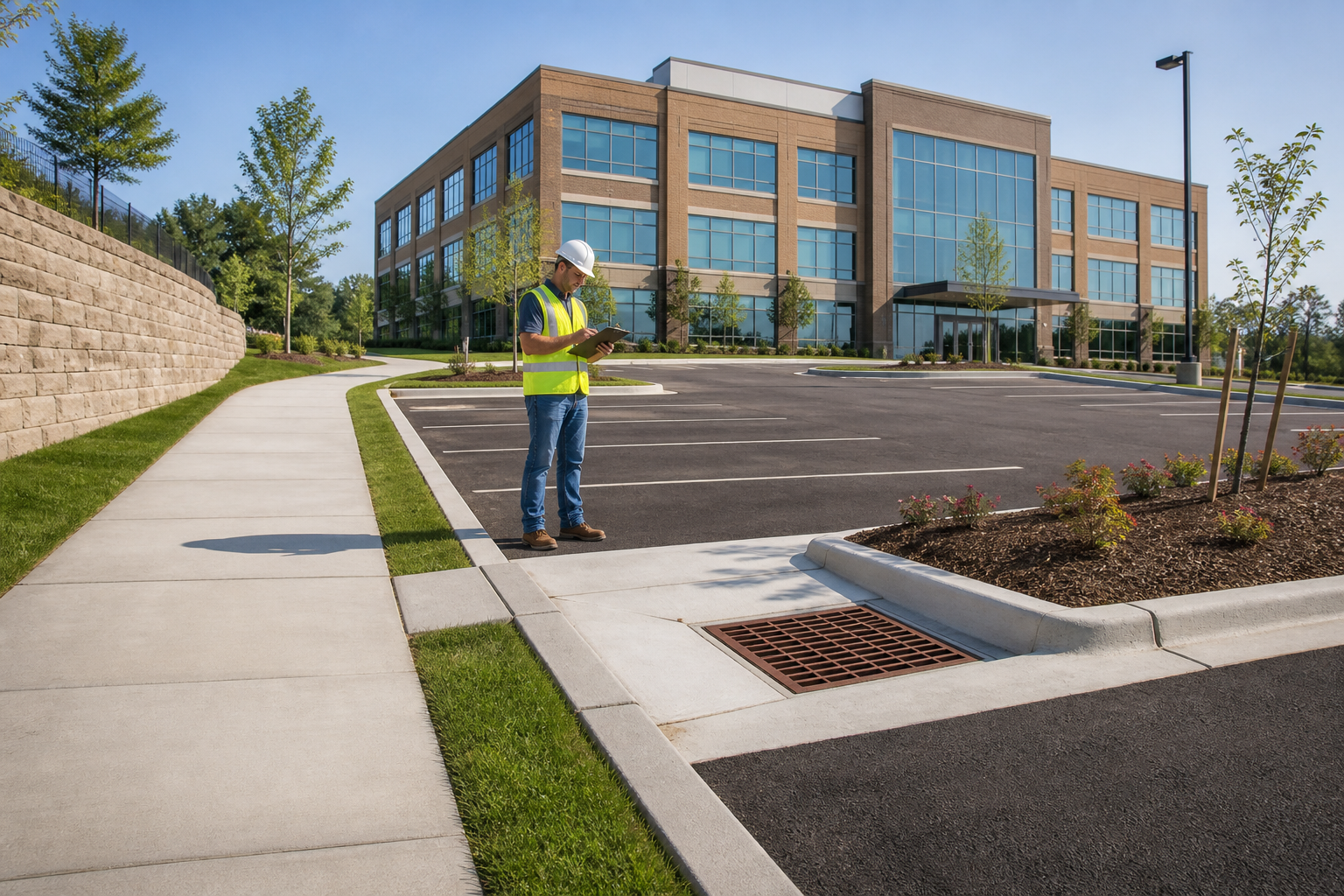
Site improvements represent a significant portion of a commercial property’s value, maintenance burden, and liability exposure. A commercial site improvements inspection evaluates the condition of paving, parking areas, curbing, sidewalks, stormwater drainage, retaining walls, fencing, site lighting, landscaping, and related exterior improvements to identify material deficiencies, safety hazards, ADA accessibility concerns, and deferred maintenance that affect property use, value, and capital planning. Core Building Inspections performs commercial site improvements inspections throughout the Philadelphia metro area and across PA, NJ, NY, and DE.
Our inspections follow a standards-driven methodology aligned with ASTM E2018, CCPIA ComSOP, and ICC guidelines. We evaluate all major site components, documenting surface condition, drainage performance, accessibility, structural integrity, and maintenance level. Each inspection is scoped to the property type, site size, and purpose of the evaluation.
Whether you are acquiring a commercial property, planning capital improvements, evaluating site condition after a severe weather event, or assessing site improvements as part of a broader due diligence effort, our commercial site improvements inspection delivers the documentation and insight you need to make confident, informed decisions.
Site improvements on commercial properties are fundamentally different from residential in scale, regulatory requirements, traffic loading, and capital exposure. Commercial parking lots, drive aisles, sidewalks, and drainage systems serve hundreds or thousands of users daily, bear heavy vehicle loads, and are subject to ADA accessibility mandates, local stormwater management regulations, and municipal maintenance codes. Deteriorating site conditions create trip-and-fall liability, impede accessibility, reduce curb appeal, and accelerate damage to adjacent building systems when drainage fails.
Pavement alone is one of the largest deferred maintenance items in commercial real estate. Asphalt parking lots have a typical expected useful life of 20 to 25 years, and concrete flatwork 40 to 50 years, but actual performance depends heavily on installation quality, drainage, traffic loading, and maintenance history. A commercial site improvements inspection identifies current condition, active deficiencies, and anticipated capital needs before they escalate into costly full-depth reconstruction, regulatory penalties, or liability claims.
For buyers, it informs the purchase price and post-closing site repair budget. For owners and asset managers, it supports capital reserve planning, maintenance prioritization, and portfolio benchmarking. For lenders, it documents site condition at the time of financing and reduces risk exposure from concealed deferred maintenance.
We evaluate the condition of asphalt, concrete, and other paved surfaces throughout parking lots, drive aisles, fire lanes, and loading areas. Observations include cracking patterns (alligator, longitudinal, transverse, block), rutting, potholes, surface deterioration, patch history, seal coat condition, and evidence of base failure. Cracking patterns are diagnostic: alligator cracking indicates structural base failure, while longitudinal and transverse cracking may indicate thermal contraction or joint-related issues. Each deficiency type has different repair implications and cost profiles.
Parking lot striping, directional markings, fire lane markings, and accessible space designations are documented for condition and visibility. Faded or missing striping affects traffic flow, safety, and ADA compliance.
Concrete, granite, and asphalt curbing is evaluated for displacement, cracking, spalling, heaving, and evidence of vehicle impact damage. Curbing serves both drainage and traffic management functions, and deteriorated curbing compromises both. Wheel stops are inspected for condition, anchoring, and proper placement, especially in accessible parking spaces where they can create tripping hazards.
Sidewalks, plazas, patios, loading dock approaches, equipment pads, ramps, and other concrete or paver flatwork are inspected for cracking, settlement, heaving, spalling, trip hazards, and drainage issues. Vertical displacement at joints and cracks exceeding a quarter inch creates ADA trip hazard concerns and slip-and-fall liability. We document specific locations and measurements where significant displacement is observed.
Site drainage is critical to both pavement longevity and building protection. We evaluate site grading, surface drainage patterns, catch basins, storm inlets, area drains, swales, retention and detention basins, and discharge points. Observations include evidence of ponding, erosion, blocked or deteriorated drainage structures, and drainage directed toward building foundations. Poor site drainage is one of the most common and consequential deficiencies in commercial real estate, accelerating pavement failure, causing foundation issues, and contributing to moisture intrusion in the building envelope.
Retaining walls, screen walls, decorative walls, and other site wall structures are inspected for structural integrity, material condition, drainage provisions, and evidence of movement or failure. Observations include leaning, bulging, cracking, mortar deterioration, displacement, weep hole condition, and evidence of hydrostatic pressure. Retaining wall failure is a significant safety and capital concern, and early identification of distress signs supports timely intervention.
Perimeter fencing, security gates, bollards, guard rails, and traffic barriers are evaluated for material condition, structural integrity, hardware operation, and overall effectiveness. Observations include corrosion, leaning, damaged sections, non-functional gates, and missing components. Fencing condition directly affects property security, liability exposure, and tenant satisfaction.
Exterior lighting including parking lot pole lights, building-mounted fixtures, walkway lights, and security lighting is inspected for fixture condition, pole integrity, visible wiring, and overall coverage. Damaged, non-functional, or inadequate lighting creates safety hazards, increases liability, and affects tenant and visitor perception. Lighting infrastructure, particularly pole bases and wiring, is a capital expenditure item with a defined replacement cycle.
Landscaping is evaluated for overall maintenance level, condition of trees, shrubs, and ground cover, and any conditions where vegetation adversely affects building or site systems. Common concerns include tree roots lifting sidewalks or damaging underground utilities, overgrown vegetation blocking drainage structures or obscuring signage, dead or dying plantings affecting curb appeal, and landscape grading that directs water toward foundations. Irrigation systems are inspected for visible condition, coverage, and evidence of leaks or non-functional zones where observable.
Loading docks, service drives, dumpster enclosures, and waste storage areas are inspected for pavement condition, structural integrity, drainage, bumper and leveler condition, and overall maintenance level. Loading areas experience concentrated heavy vehicle traffic and are among the first site areas to show pavement distress.
Site signage including monument signs, directional signs, tenant identification, and regulatory signage is documented for condition and legibility. Site amenities such as benches, trash receptacles, bike racks, and recreational facilities are noted for condition where they represent material property components.
Visible site utilities including water, sewer, gas, electrical, and telecommunications infrastructure are observed at the site level. Observations include manhole and cleanout condition, visible utility damage, and evidence of utility-related settlement or disturbance. Underground utility condition is outside the scope of a visual inspection but surface indicators of subsurface issues are documented.
ADA compliance at the site level is a significant concern for any commercial property that serves the public. Our site improvements inspection includes visual observations of accessible parking spaces, van-accessible spaces, access aisles, signage, accessible routes from parking to building entrances, curb ramps, and surface conditions along accessible paths. These observations are not a substitute for a full ADA compliance audit but establish a documented baseline of observable accessibility conditions.
Common site-level ADA observations include insufficient accessible parking count for total lot capacity, missing or non-compliant signage, access aisles that are too narrow or obstructed, slopes exceeding maximum grade on accessible routes, surface deterioration creating trip hazards along accessible paths, and curb ramps that are missing, damaged, or improperly graded. For properties where significant accessibility gaps are identified, we recommend a specialist ADA survey to evaluate full compliance.
Commercial site improvement deficiencies follow predictable patterns based on site age, traffic volume, climate exposure, and maintenance history. Common findings include:
Identifying these conditions early allows property owners and buyers to plan repairs, negotiate pricing, and avoid costly emergency reconstruction.
For properties in the Philadelphia metro area and across PA, NJ, and DE, seasonal conditions significantly influence site improvement performance. Winter freeze-thaw cycles are the primary driver of asphalt and concrete deterioration in the region. Water infiltrates cracks and joints, freezes, expands, and progressively widens the damage with each cycle. Spring reveals the cumulative impact of winter damage: potholes, heaved sidewalks, and failed curbing that developed or worsened during the cold months.
Summer heat softens asphalt surfaces and accelerates rutting under heavy traffic loads. Severe thunderstorms and nor’easters test drainage systems and expose grading deficiencies. Salt and de-icing chemical application, while necessary for winter safety, accelerates surface deterioration and corrosion of metal site components over time.
Our site improvements inspections are calibrated to the regional climate and seasonal exposure these properties face. Post-winter and post-storm inspections are particularly valuable for identifying damage before it compounds.
Our standard commercial site improvements inspection is a visual, non-invasive evaluation. In some cases, findings may warrant additional investigation to fully characterize site conditions. We identify when these methods may add value and communicate the recommendation clearly:
Pavement Coring and Testing: When the extent of base failure needs to be quantified, pavement core samples can determine asphalt thickness, base material condition, and subgrade characteristics. This data supports accurate repair scoping: mill-and-overlay versus full-depth reconstruction.
Ground-Penetrating Radar (GPR): GPR can detect voids beneath pavement, locate underground utilities, and identify areas of base failure without destructive investigation. This is especially useful for large parking areas where visual cracking patterns suggest widespread subsurface issues.
Geotechnical Investigation: When retaining wall movement, settlement patterns, or drainage problems suggest subsurface soil conditions are contributing to site distress, geotechnical borings and analysis provide the data needed to design effective repairs.
Topographic and Drainage Survey: For properties with complex or chronic drainage problems, a licensed surveyor can produce a detailed topographic map and drainage analysis that identifies low points, flow paths, and grading corrections needed to resolve ponding and erosion.
These diagnostic methods are not part of every site improvements inspection. They are recommended based on the specific findings of the visual evaluation and the purpose of the inspection. Our role is to identify when additional testing adds value and to clearly communicate that recommendation.
Site improvements represent a major and recurring capital expenditure category for commercial property owners. Asphalt parking lot mill-and-overlay, full-depth reconstruction, concrete flatwork replacement, curbing repairs, drainage system rehabilitation, retaining wall stabilization, site lighting upgrades, and re-striping programs are predictable capital items that must be budgeted on defined cycles.
A commercial site improvements inspection provides the condition data needed to prioritize these expenditures, phase improvements over a multi-year horizon, and avoid reactive spending on emergency repairs. Proactive pavement management, where seal coating and crack filling are performed on schedule, can extend asphalt life significantly and reduce total lifecycle cost compared to deferred maintenance followed by full reconstruction.
Our inspection reports support capital reserve planning, operating budget development, and long-term ownership strategy. For properties where granular cost estimates are needed, our Cost to Cure Reporting service provides detailed financial analysis tied to specific site repair and replacement items.
Site improvements are a required component of every Property Condition Assessment performed in general conformance with ASTM E2018. Section 8.4.1 of the standard specifically addresses observation of site elements, including topography, stormwater drainage, ingress and egress, paving, curbing, parking, flatwork, landscaping, appurtenances, and recreational facilities.
Our commercial site improvements inspection can be performed as a standalone service or as an integrated component of a full PCA. When performed within a PCA, site observations contribute to the overall capital needs table, remaining useful life analysis, and opinions of probable cost. For properties where site condition is the primary concern, such as pre-paving bid evaluations, post-winter damage assessments, or parking lot management programs, a standalone site improvements inspection provides focused documentation without the full scope and cost of a complete PCA.
Our commercial site improvements inspection clients include commercial real estate buyers, investors, property managers, asset managers, lenders, attorneys, and building owners. Reports are structured to support acquisition due diligence, loan underwriting, capital planning, pavement management programs, and ongoing portfolio management.
A small amount of preparation shortens inspection time and improves report quality. Before your scheduled inspection, gather any available site-related documentation: original site plans, paving specifications, drainage plans, prior inspection or pavement condition reports, seal coating and repair history, retaining wall engineering, and any known drainage or settlement issues. Ensure the inspector has access to all site areas, including gated parking areas, service drives, loading docks, and restricted zones.
If specific areas of concern exist, such as chronic ponding, recent pavement failures, retaining wall movement, or known drainage complaints, communicate those to the inspector in advance. This context allows the inspection to focus additional attention on known problem areas while still providing a complete evaluation of all accessible site improvements.
For multi-parcel properties or campus settings, provide a site map identifying lot boundaries, building numbers, and any areas with access restrictions or active construction.
We provide commercial site improvements inspections throughout the Philadelphia metropolitan area, all of New Jersey, New Castle County in Delaware, and select markets in New York. This regional footprint supports buyers, owners, and lenders working across the tri-state area and beyond.
For more on the industry standard guiding commercial PCAs, see ASTM E2018.



Certified under nationally recognized commercial inspection standards to ensure consistency, accuracy, and professional accountability.

CCPIA Certified
Certified under nationally recognized commercial inspection standards to ensure consistency, accuracy, and professional accountability.

ICC Certified
Ongoing education and training aligned with current safety practices, codes, and inspection methodologies.

ASTM Member
Inspections performed in general conformance with ASTM standards, supporting due diligence and lender requirements.

Years of Experience
Extensive field experience inspecting diverse commercial properties across multiple asset types and markets.

Highly Trained
Continuous training and practical expertise focused on risk identification, system performance, and long-term planning.

 David129 days ago
Trustindex verifies that the original source of the review is Google.
I rely heavily on accurate due diligence and trusted professionals when evaluating acquisitions. Core Building Inspections exceeded my expectations at every stage of the process. Their level of professionalism, technical expertise, and attention to detail was exceptional. The inspection report was comprehensive, well-organized, and provided valuable insights that helped me assess risk and make informed decisions with confidence. What truly sets Core Building Inspections apart is their ability to communicate complex building conditions in a clear, practical manner. Their responsiveness and commitment to client service reflect a deep understanding of the commercial real estate industry. I would not hesitate to use their services again and highly recommend them to investors, lenders, and property owners seeking a first-class commercial building inspection firm. Chris Nocera131 days agoAs a commercial real estate investor, I’ve worked with many inspection companies over the years, and this team stands out. Their inspection was thorough, professional, and delivered in a way that helped me make informed investment decisions with confidence. The report was detailed, easy to understand, and completed on schedule. Their responsiveness and attention to detail were impressive from start to finish. I would highly recommend their services to any investor, buyer, or property owner in need of a high-quality commercial building inspection.
 Jordan Patruskey133 days agoI’ve worked with a number of inspection firms over the years, and Core Building Inspections is one of the best. Their team was professional, responsive, and extremely thorough throughout the process. The report was clear, detailed, and gave me the information I needed to move forward with confidence. If you’re involved in commercial real estate and need a dependable inspection company, I highly recommend Core Building Inspections.
No. A pavement condition survey focuses exclusively on paved surfaces. A commercial site improvements inspection evaluates the full range of exterior site components, including paving, drainage, retaining walls, lighting, fencing, landscaping, and accessibility. Pavement is a major component, but the scope is broader.
At minimum, site improvements should be inspected as part of regular property condition assessments, typically every three to five years or at each transaction event. Pavement-intensive properties benefit from annual visual assessments, especially after winter, to catch freeze-thaw damage before it compounds. Post-storm inspections should follow any significant weather event.
Our visual inspection identifies cracking patterns, surface condition, and drainage issues that indicate the severity of pavement distress. Alligator cracking, for example, typically indicates base failure requiring reconstruction rather than overlay. When pavement condition suggests the repair approach is unclear, we recommend pavement coring to confirm base and subgrade conditions before committing to a repair scope.
An independent inspector has no financial interest in selling paving, seal coating, drainage, or landscaping work. Core Building Inspections is not a paving contractor or site work company. Our only deliverable is an objective, documented condition assessment, which means our findings are unbiased and defensible for acquisitions, financing, and capital planning.
Our inspection includes visual observations of accessible parking spaces, access aisles, signage, accessible routes, curb ramps, and surface conditions along accessible paths. These are baseline observations, not a full ADA compliance audit. When significant accessibility gaps are identified, we recommend a specialist ADA survey.