Roofing is one of the highest-cost systems in any commercial property, and roof failure is one of the most common sources of building damage, deferred maintenance, and unexpected capital expenditure. A commercial roofing inspection provides buyers, owners, and lenders with a clear evaluation of roof system condition, remaining useful life, and near-term risk. Core Building Inspections performs commercial roofing inspections throughout the Philadelphia metro area and across PA, NJ, NY, and DE.
Our inspections are performed using a methodical, standards-driven approach aligned with ASTM, CCPIA, and ICC guidelines. We evaluate all major commercial roof types, including flat, low-slope, and pitched systems, membrane assemblies, metal roofing, modified bitumen, built-up roofing (BUR), and single-ply systems such as TPO, EPDM, and PVC. Each inspection is scoped to the property type, roof age, and purpose of the evaluation.
Whether you are acquiring a commercial property, planning capital improvements, or evaluating roof condition as part of a broader due diligence effort, our commercial roofing inspection delivers the documentation and insight you need to make confident, informed decisions.
Roof systems on commercial buildings are fundamentally different from residential roofing. They are larger, more complex, and more expensive to repair or replace. A commercial roof failure does not just damage the roof itself. It damages ceilings, insulation, electrical systems, inventory, equipment, and occupied space. Water intrusion from a compromised roof is one of the most destructive and costly issues in commercial property ownership.
Commercial roofing inspection identifies current condition, active deficiencies, and anticipated capital needs before they become emergencies. For buyers, it informs the purchase price and post-closing budget. For owners, it supports maintenance planning and extends the service life of the existing system. For lenders, it reduces risk exposure by documenting roof condition at the time of financing.
The National Roofing Contractors Association (NRCA) recommends that commercial roofs be inspected at least twice per year, once in spring and once in fall, plus after any major weather event. The spring inspection identifies damage from winter freeze-thaw cycles, ice loading, and thermal shock. The fall inspection prepares the roof for winter by verifying drainage, confirming flashing integrity, and clearing debris from drains, scuppers, and gutters.
Beyond the biannual baseline, post-event inspections should follow any hail, high winds, severe thunderstorms, or rooftop equipment work by non-roofing trades. Buildings with older membranes, high rooftop foot traffic, or critical operations may benefit from quarterly inspections. Most commercial roofing manufacturers reference biannual inspection as the minimum cadence required to maintain warranty coverage, and failure to document regular inspections can jeopardize warranty claims.
For properties in the Philadelphia metro area and across PA, NJ, and DE, seasonal exposure to freeze-thaw cycling, nor’easters, and summer storm activity makes adherence to this schedule especially important. Our commercial roofing inspections are designed to fit within a proactive maintenance cadence, whether scheduled as part of a biannual program or triggered by a specific event.
The most important distinction in a commercial roofing inspection is not what is inspected but who is performing the inspection and what their incentives are. A roofing contractor who performs inspections also sells repair and replacement work. Their assessment is not independent, and their business model creates an inherent financial interest in recommending more work, not less.
Core Building Inspections is not a roofing contractor. We do not sell roofing repairs, replacements, coatings, or maintenance contracts. Our only deliverable is an objective, documented evaluation of roof condition. This independence matters most in three scenarios: pre-purchase due diligence, where the buyer needs an unbiased condition opinion before committing capital; insurance claims and disputes, where the carrier and owner both need a neutral technical assessment; and capital planning, where the owner needs to know whether to budget for targeted repair, restoration, or full replacement over the next one to five years.
As CCPIA, ICC, and ASTM-credentialed inspectors, we bring the same professional accountability and standards-driven methodology that independent building enclosure consultants provide, without the conflict of interest that arises when the inspector who recommends work is also the contractor who performs it.
Roof Membrane and Surface Condition
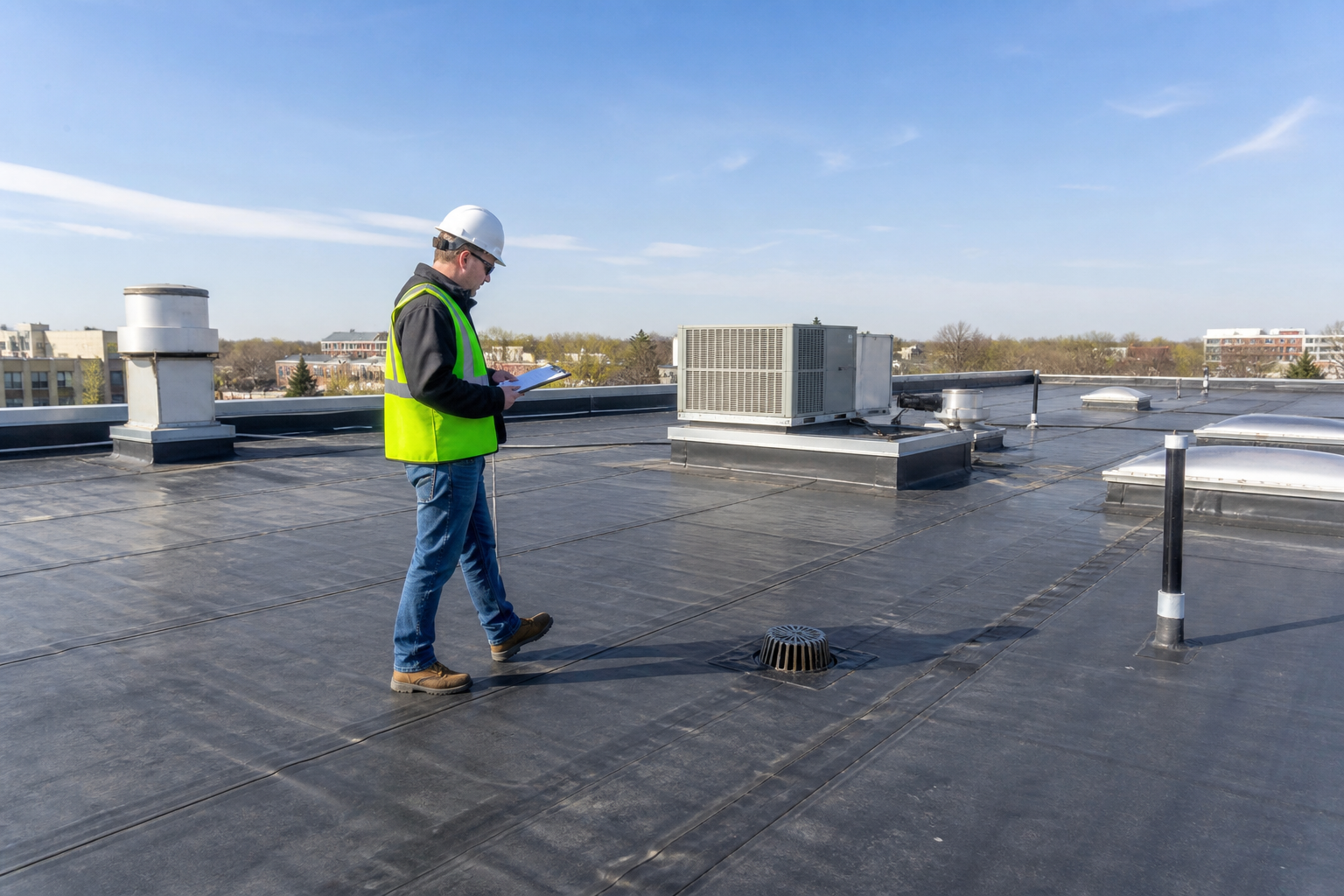
We evaluate the primary roof covering, whether single-ply membrane (TPO, EPDM, PVC), modified bitumen, built-up roofing (BUR), metal panels, or coating systems. Surface wear, UV degradation, blistering, splitting, punctures, and areas of ponding water are documented with photographs and location references.
Flashings and Penetrations
Flashings at parapets, curbs, walls, and roof-to-wall transitions are inspected for separation, deterioration, and sealant failure. Roof penetrations, including pipe boots, conduit entries, vent stacks, and mechanical curbs, are common failure points and are evaluated individually.
Drainage Systems
Roof drainage is critical to performance and longevity. We inspect internal drains, scuppers, gutters, downspouts, and overflow systems for blockages, deterioration, and improper grading. Ponding water and evidence of chronic drainage issues are documented.
Rooftop Equipment and Supports
HVAC units, exhaust fans, satellite dishes, conduit runs, and other rooftop-mounted equipment create penetration points and load concentrations. We document equipment supports, curbing condition, and any evidence that equipment installation or maintenance has damaged the roof membrane.
Parapet Walls and Coping
Parapet walls define the roof perimeter on most commercial buildings. We evaluate parapet condition, coping cap attachment, mortar joint integrity, and cap flashing. Deteriorating parapets are a leading source of water intrusion at the roof edge.
Insulation and Deck Observations
Where observable, we note evidence of wet or compressed insulation, visible deck deterioration, and areas where insulation performance may be compromised. Infrared thermography for moisture mapping is outside our standard visual scope but can be recommended when warranted.
Interior Evidence of Roof Leaks
A commercial roofing inspection is not limited to the rooftop. We document interior evidence of active or historical roof leaks, including ceiling staining, damaged finishes, mold growth, and structural damage beneath the roof assembly. Interior observations often reveal conditions not visible from the roof surface alone.
Commercial roofing systems vary widely based on building age, use, and design. Our inspectors are experienced with all major commercial roof types:
Each system has different failure modes, maintenance requirements, and expected service life. Our inspection approach is adapted to the specific system installed on your property.
Commercial roofing deficiencies follow predictable patterns based on roof age, system type, and maintenance history. Common findings include:
Identifying these conditions early allows property owners and buyers to plan repairs, negotiate pricing, and avoid costly emergency replacements.
Severe weather events, including hail, high winds, heavy rain, and nor’easters, can cause damage that is not immediately visible from the ground or from inside the building. Post-storm commercial roofing inspections identify wind uplift damage at perimeters and corners, hail impact on membranes and flashings, displaced coping and edge metal, punctures from windborne debris, and accelerated drainage failures from storm loading.
Timely post-storm documentation is critical for insurance claims. Many commercial property insurance carriers impose reporting windows of 30 to 60 days, and failure to inspect and document damage promptly can jeopardize claim eligibility. Our post-storm inspection reports include date-stamped photographs, location-specific deficiency descriptions, and condition narratives structured to support insurance submissions and loss documentation.
For properties across the Philadelphia metro area, South Jersey, and the Delaware Valley, storm exposure from seasonal nor’easters, summer thunderstorms, and occasional hail events makes post-storm inspection a practical necessity, not an optional precaution.
Most commercial roofing manufacturer warranties require documented biannual inspections as a condition of coverage. Failure to maintain an inspection record, or failure to address identified deficiencies promptly, can void warranty protection entirely. Common warranty-voiding actions include unauthorized roof penetrations by non-roofing trades, repairs performed by unauthorized contractors, dragging equipment across the membrane, and neglecting small defects that escalate into system-wide failures.
Our commercial roofing inspection reports provide the dated, photographic documentation needed to demonstrate warranty compliance. Each report creates a defensible record of roof condition at the time of inspection, supporting both warranty claims and ongoing maintenance accountability. For building owners and property managers maintaining roofing warranties across multiple properties, our inspection reports integrate directly into portfolio-level documentation programs.
Our standard commercial roofing inspection is a visual, non-invasive evaluation. In some cases, the findings of a visual inspection may warrant additional diagnostic testing to fully characterize roof condition. We identify when these additional methods may be beneficial and can coordinate the appropriate specialized services:
Infrared (Thermographic) Moisture Surveys: Infrared scanning detects trapped moisture within the roof assembly that is not visible from the surface. Wet insulation retains heat differently than dry insulation, and thermographic imaging identifies these temperature differentials. Infrared surveys are particularly valuable for pre-purchase due diligence, warranty disputes, and large-scale capital planning where the extent of concealed moisture damage needs to be quantified before committing to a repair or replacement scope.
Core Sampling: Core sampling is a destructive diagnostic method in which a small cylindrical section of the roof assembly is removed and examined layer by layer. It provides definitive information about membrane thickness, insulation condition, inter-ply adhesion, and moisture content at specific locations. Core samples confirm what infrared surveys suggest and are frequently recommended when the visual inspection and infrared results indicate areas of concern.
Drone and Aerial Imaging: For large or complex roof systems, drone-based photography and imaging can supplement the ground-level and rooftop walkover by providing overhead perspective on drainage patterns, large-area membrane condition, and areas that may be difficult to access safely on foot.
These diagnostic methods are not part of every commercial roofing inspection. They are recommended based on the specific findings of the visual evaluation, the age and condition of the roof system, and the purpose of the inspection. Our role is to identify when additional testing adds value and to clearly communicate that recommendation.
Roof replacement is typically one of the largest single capital expenditures a commercial property owner will face. A well-timed commercial roofing inspection supports capital planning by identifying where the roof system stands in its lifecycle, what maintenance or repairs can extend its service life, and when full replacement should be budgeted.
Our inspection reports provide the observational data needed to support capital reserve planning, insurance discussions, and long-term ownership strategy. For properties where granular cost estimates are needed, our Cost to Cure Reporting service provides detailed financial analysis tied to specific roof repair and replacement items.
Roofing is a critical component of every Property Condition Assessment. Our commercial roofing inspection can be performed as a standalone service or as part of a broader PCA conducted in general conformance with ASTM E2018. When performed within a PCA, the roofing evaluation contributes to the overall capital needs table, remaining useful life analysis, and opinions of probable cost.
For properties where the roof is the primary concern, a standalone commercial roofing inspection provides focused, detailed documentation without the full scope and cost of a complete PCA.
Our commercial roofing inspection clients include commercial real estate buyers, investors, property managers, asset managers, lenders, attorneys, and building owners. Reports are structured to support acquisition due diligence, loan underwriting, capital planning, and ongoing portfolio management.
A small amount of preparation shortens inspection time and improves report quality. Before your scheduled inspection, gather any available roof-related documentation: original installation records, warranty documents, prior inspection reports, maintenance and repair history, and any known leak or damage records. Ensure safe roof access is available, including interior access to mechanical rooms and top-floor spaces where evidence of leaks may be visible.
If specific areas of concern exist, such as recurring leaks, ponding water visible after rain, or recent rooftop equipment work, communicate those to the inspector in advance. This context allows the inspection to focus additional attention on known problem areas while still providing a complete evaluation of the full roof system.
We provide commercial roofing inspections throughout the Philadelphia metropolitan area, all of New Jersey, New Castle County in Delaware, and select markets in New York. This regional footprint supports buyers, owners, and lenders working across the tri-state area and beyond.
For more on the industry standard guiding commercial PCAs, see ASTM E2018.

Certified under nationally recognized commercial inspection standards to ensure consistency, accuracy, and professional accountability.

CCPIA Certified
Certified under nationally recognized commercial inspection standards to ensure consistency, accuracy, and professional accountability.
ICC Certified
Ongoing education and training aligned with current safety practices, codes, and inspection methodologies.
ASTM Member
Inspections performed in general conformance with ASTM standards, supporting due diligence and lender requirements.
Years of Experience
Extensive field experience inspecting diverse commercial properties across multiple asset types and markets.

Highly Trained
Continuous training and practical expertise focused on risk identification, system performance, and long-term planning.

 David129 days ago
Trustindex verifies that the original source of the review is Google.
I rely heavily on accurate due diligence and trusted professionals when evaluating acquisitions. Core Building Inspections exceeded my expectations at every stage of the process. Their level of professionalism, technical expertise, and attention to detail was exceptional. The inspection report was comprehensive, well-organized, and provided valuable insights that helped me assess risk and make informed decisions with confidence. What truly sets Core Building Inspections apart is their ability to communicate complex building conditions in a clear, practical manner. Their responsiveness and commitment to client service reflect a deep understanding of the commercial real estate industry. I would not hesitate to use their services again and highly recommend them to investors, lenders, and property owners seeking a first-class commercial building inspection firm. Chris Nocera131 days agoAs a commercial real estate investor, I’ve worked with many inspection companies over the years, and this team stands out. Their inspection was thorough, professional, and delivered in a way that helped me make informed investment decisions with confidence. The report was detailed, easy to understand, and completed on schedule. Their responsiveness and attention to detail were impressive from start to finish. I would highly recommend their services to any investor, buyer, or property owner in need of a high-quality commercial building inspection.
 Jordan Patruskey133 days agoI’ve worked with a number of inspection firms over the years, and Core Building Inspections is one of the best. Their team was professional, responsive, and extremely thorough throughout the process. The report was clear, detailed, and gave me the information I needed to move forward with confidence. If you’re involved in commercial real estate and need a dependable inspection company, I highly recommend Core Building Inspections.
The NRCA recommends at least twice per year, in spring and fall, plus after any major weather event such as hail, high winds, or heavy storms. Most manufacturer warranties require documented biannual inspections to maintain coverage. Older roofs and buildings with high rooftop traffic may benefit from quarterly inspections.
An independent inspector has no financial interest in selling repairs or replacements. Core Building Inspections is not a roofing contractor. We do not perform roof work. Our only deliverable is an objective, documented condition assessment, which means our findings are unbiased and defensible for negotiations, insurance claims, and capital planning.
Yes. Post-storm inspections are a common use case. Our reports include date-stamped photographs, location-specific documentation, and condition narratives structured to support insurance submissions within carrier reporting windows.
Yes. Most manufacturer warranties require documented biannual inspections as a condition of coverage. Our reports provide the dated, photographic inspection records needed to demonstrate compliance and support warranty claims if deficiencies arise.
Our standard inspection is visual and non-invasive. When findings suggest concealed moisture or conditions that warrant deeper investigation, we recommend infrared thermographic surveys, core sampling, or other diagnostic methods and can coordinate those specialized services.