Commercial plumbing systems are fundamentally different from residential plumbing. They serve larger buildings, handle higher water demand, use different pipe materials and configurations, and incorporate components rarely found in homes, including backflow prevention assemblies, grease interceptors, ejector pumps, commercial water heaters, and complex drain, waste, and vent (DWV) networks. A plumbing failure in a commercial building does not just inconvenience one household. It can flood occupied space, damage inventory and equipment, displace tenants, trigger health code violations, and create liability exposure for owners and operators.
Commercial plumbing inspection identifies current condition, active deficiencies, and anticipated capital needs before they become emergencies. For buyers, it reveals the hidden cost of aging infrastructure that is not visible during a walkthrough. For owners, it supports maintenance planning and helps avoid the kind of catastrophic failures that result in emergency repairs at premium cost. For lenders, it documents plumbing condition at the time of financing and reduces risk exposure.
The most expensive plumbing problems in commercial buildings are almost always the ones that were not identified before closing.
A residential plumbing inspection typically evaluates a single water heater, a handful of fixtures, and a simple supply and waste system. Commercial plumbing inspections are broader in scope, more complex in what they evaluate, and more consequential in what they find.
Commercial plumbing inspections address higher water demand and larger distribution systems, multiple water heating appliances or systems, backflow prevention assemblies required by code, grease interceptors and specialty drainage for food service occupancies, ejector pumps and lift stations for below-grade drainage, multi-tenant and multi-building distribution, fuel supply and gas distribution systems, and fixtures that must meet ADA and commercial code requirements. The financial implications of plumbing findings in a commercial building are correspondingly larger, and the inspection must be oriented toward risk assessment, capital planning, and transaction support, not just a pass-fail checklist.
We evaluate the main water service entry, service line material, and main shut-off valve. The water distribution system is inspected for pipe material identification, visible corrosion, support and attachment, evidence of leaks or prior repairs, and general condition. We observe functional water flow at representative fixtures to assess system performance. Pipe materials commonly encountered in commercial buildings include copper, galvanized steel, PEX, CPVC, and in older buildings, lead service lines or polybutylene, both of which carry significant replacement implications.
The DWV system carries wastewater from fixtures and equipment to the building sewer connection. We inspect accessible drain piping, waste lines, vent stacks, and cleanouts for visible deterioration, improper slope, evidence of blockage, and signs of prior repair. Floor drains in mechanical rooms, kitchens, and restrooms are evaluated for trap seal and functional drainage. We determine whether the property connects to a public sanitary sewer or private septic system and note any observable conditions that may warrant further investigation.
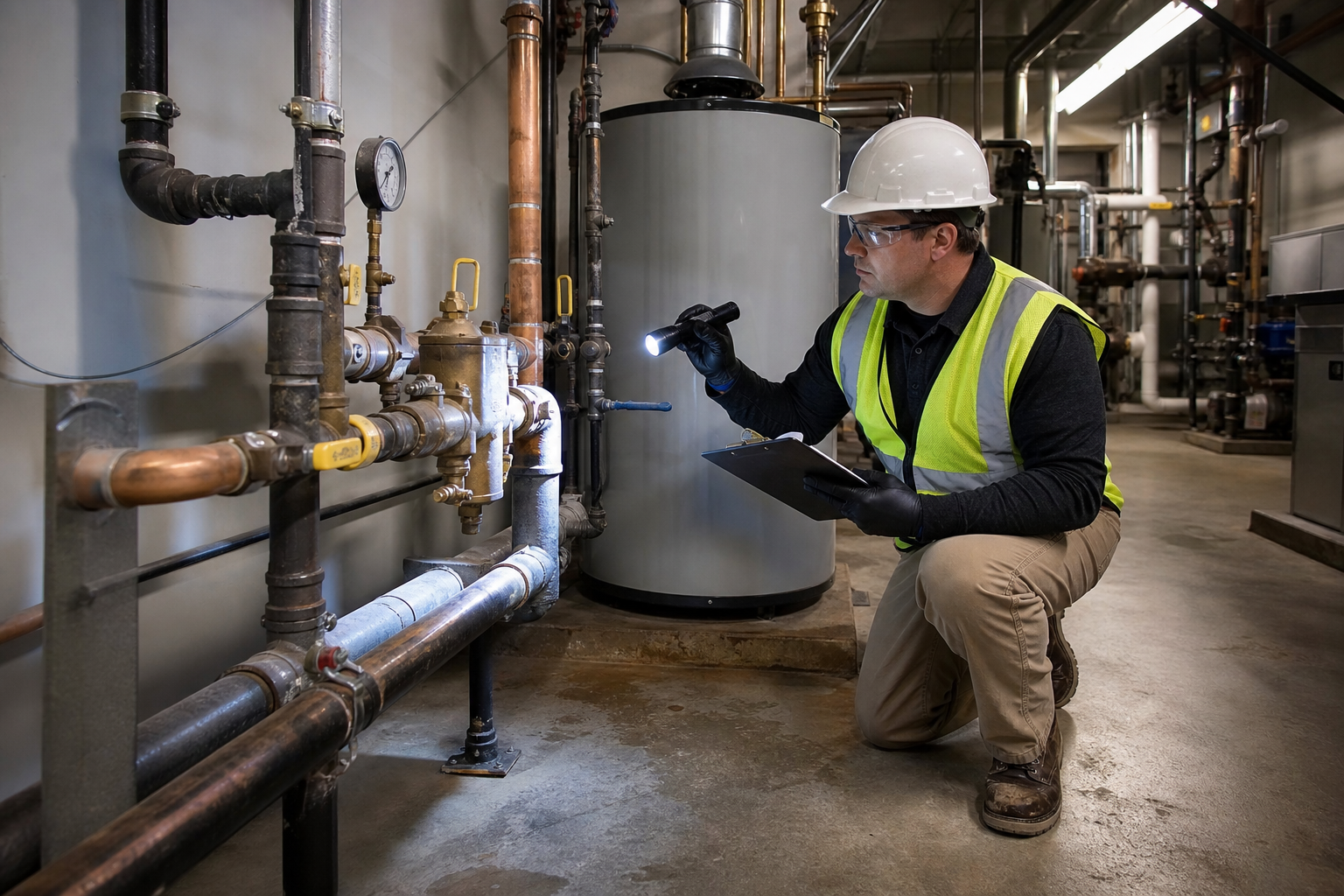
Commercial water heaters are inspected for type, apparent age, general condition, combustion air, venting, connections, energy source, and the presence or absence of temperature and pressure relief valves. Commercial properties frequently use tank-style heaters, tankless systems, boiler-fed domestic hot water, or combinations depending on occupancy demand. We document equipment condition, capacity relative to the building, and any observable concerns that may affect serviceability or remaining useful life.
Backflow prevention devices protect the potable water supply from contamination caused by backflow or back-siphonage. Most commercial properties are required by code to have backflow prevention assemblies on the main water supply. We verify the presence of backflow prevention, document assembly type and observable condition, and note whether the system appears to be maintained. Annual testing and certification of backflow assemblies is typically required by local water authorities, and non-compliant properties may face fines, water service interruption, or both.
Where the property is served by natural gas, propane, or other fuel systems, we inspect the main gas meter, main shut-off valve, and visible portions of the fuel distribution piping. Shut-off valves at individual appliances and equipment are verified where accessible. Evidence of corrosion, improper support, damaged piping, and missing drip legs or sediment traps is documented.
A representative number of plumbing fixtures are evaluated for operation, mounting, water flow, and functional drainage. Restrooms are inspected for fixture condition, accessibility concerns, and evidence of chronic leaks or moisture damage. In multi-tenant properties, fixture condition across different tenant spaces often varies significantly and can indicate differences in maintenance history.
Properties with food service occupancy require grease interceptors or grease traps to prevent fats, oils, and grease (FOG) from entering the sanitary sewer system. We document the presence, type, observable condition, and apparent maintenance status of grease interceptors. Non-compliant grease systems can expose property owners to municipal enforcement, fines, and sewer backup liability. For properties with industrial occupancy, sand-oil interceptors and oil-water separators are evaluated where accessible.
Commercial buildings with below-grade spaces, including basements, lower-level restrooms, and mechanical rooms, frequently rely on ejector pumps or lift stations to move wastewater to the building sewer. We document the presence, type, and observable condition of ejector pump systems and note any evidence of failure, overflow, or deferred maintenance.
Pipe material identification is one of the most important outcomes of a commercial plumbing inspection. The material, age, and condition of supply and waste piping directly affect remaining useful life, maintenance cost, and capital replacement timing.
Galvanized Steel: Common in buildings constructed before the 1970s. Galvanized supply lines corrode from the inside, gradually restricting flow and reducing water pressure. Internal buildup of mineral deposits can reduce effective pipe diameter by 50% or more in aging systems, eventually requiring full replacement.
Cast Iron: The standard waste pipe material in older commercial buildings. Cast iron has a typical service life of 50 to 75 years, after which it becomes brittle, develops cracks, and is susceptible to joint failure. Buildings from the 1950s through 1970s are frequently approaching or past the end of expected service life for cast iron DWV piping.
Copper: A durable supply line material with a long service life, but susceptible to pinhole leaks from aggressive water chemistry, particularly in areas with low pH or high chloride content.
Polybutylene: Used in some commercial and multifamily buildings from the late 1970s through the mid-1990s. Polybutylene is known for premature failure and is generally considered a material deficiency that warrants replacement planning.
PEX and CPVC: Modern supply line materials with good performance records. PEX is increasingly common in renovated commercial properties. CPVC is used in both supply and some industrial applications.
Our inspection identifies the pipe materials present in the building and documents any observable conditions, such as corrosion, scale buildup, active leaks, or prior repairs, that indicate the system is approaching the end of its useful life.
Commercial plumbing deficiencies follow predictable patterns based on building age, pipe material, occupancy type, and maintenance history. Common findings include:
Identifying these conditions during a plumbing inspection allows property owners and buyers to plan repairs, negotiate pricing, and budget for capital replacement before small deficiencies escalate into system-wide failures.
Our standard commercial plumbing inspection is a visual, non-invasive evaluation of accessible components. In some cases, the findings of a visual inspection may warrant additional diagnostic testing to fully characterize plumbing condition. We identify when these additional methods may be beneficial:
Sewer Scope (Video Camera Inspection): A sewer scope uses a camera on a flexible cable to inspect the interior of underground sewer lines. It is the most reliable method for identifying root intrusion, pipe cracks, joint offsets, bellies, corrosion, and blockages in piping that cannot be evaluated visually. Sewer scope inspection is particularly valuable for older properties, properties with mature trees near sewer lines, properties with a history of drainage problems, and any acquisition where sewer replacement could represent a significant capital expense.
Hydrostatic Testing: For properties where foundation movement or slab settlement may have damaged under-slab plumbing, hydrostatic testing pressurizes the drain system to identify leaks beneath the slab. This is especially relevant for buildings in areas with expansive soils or visible foundation settlement.
Thermal Imaging: Infrared thermography can detect hidden moisture from concealed plumbing leaks within walls, ceilings, and floors. Thermal imaging is non-invasive and can identify active leaks that have not yet produced visible damage.
These diagnostic methods are not part of every commercial plumbing inspection. They are recommended based on the specific findings of the visual evaluation, the age and condition of the plumbing system, and the purpose of the inspection. Our role is to identify when additional testing adds value and to clearly communicate that recommendation.
Plumbing replacement, particularly full re-piping of supply or waste systems, is one of the most disruptive and expensive capital projects a commercial property owner will face. Unlike a roof, which can be replaced from the exterior, plumbing replacement often requires interior demolition, tenant displacement, and extended construction timelines.
A well-timed commercial plumbing inspection supports capital planning by identifying where the plumbing system stands in its lifecycle, what maintenance or targeted repairs can extend its service life, and when full replacement should be anticipated. Our inspection reports provide the observational data needed to support capital reserve planning, insurance discussions, and long-term ownership strategy. For properties where granular cost estimates are needed, our Cost to Cure Reporting service provides detailed financial analysis tied to specific plumbing repair and replacement items.
lumbing is a critical component of every Property Condition Assessment. Our commercial plumbing inspection can be performed as a standalone service or as part of a broader PCA conducted in general conformance with ASTM E2018. When performed within a PCA, the plumbing evaluation contributes to the overall capital needs table, remaining useful life analysis, and opinions of probable cost.
A standard PCA evaluates accessible plumbing components but does not include subsurface utility inspection, sewer scope, or specialized plumbing testing. When our visual inspection identifies conditions that suggest concealed plumbing problems, we recommend the appropriate additional investigation so that the buyer, owner, or lender has a complete picture of plumbing risk.
Our commercial plumbing inspection clients include commercial real estate buyers, investors, property managers, asset managers, lenders, attorneys, and building owners. Reports are structured to support acquisition due diligence, loan underwriting, capital planning, and ongoing portfolio management. For food service properties, multifamily buildings, and industrial facilities where plumbing demands are higher and more complex, our inspection scope reflects those additional requirements.
We provide commercial plumbing inspections throughout the Philadelphia metropolitan area, all of New Jersey, New Castle County in Delaware, and select markets in New York. This regional footprint supports buyers, owners, and lenders working across the tri-state area and beyond.
For more on the industry standard guiding commercial PCAs, see ASTM E2018.


Certified under nationally recognized commercial inspection standards to ensure consistency, accuracy, and professional accountability.

CCPIA Certified
Certified under nationally recognized commercial inspection standards to ensure consistency, accuracy, and professional accountability.

ICC Certified
Ongoing education and training aligned with current safety practices, codes, and inspection methodologies.
ASTM Member
Inspections performed in general conformance with ASTM standards, supporting due diligence and lender requirements.

Years of Experience
Extensive field experience inspecting diverse commercial properties across multiple asset types and markets.

Highly Trained
Continuous training and practical expertise focused on risk identification, system performance, and long-term planning.

 David129 days ago
Trustindex verifies that the original source of the review is Google.
I rely heavily on accurate due diligence and trusted professionals when evaluating acquisitions. Core Building Inspections exceeded my expectations at every stage of the process. Their level of professionalism, technical expertise, and attention to detail was exceptional. The inspection report was comprehensive, well-organized, and provided valuable insights that helped me assess risk and make informed decisions with confidence. What truly sets Core Building Inspections apart is their ability to communicate complex building conditions in a clear, practical manner. Their responsiveness and commitment to client service reflect a deep understanding of the commercial real estate industry. I would not hesitate to use their services again and highly recommend them to investors, lenders, and property owners seeking a first-class commercial building inspection firm. Chris Nocera131 days agoAs a commercial real estate investor, I’ve worked with many inspection companies over the years, and this team stands out. Their inspection was thorough, professional, and delivered in a way that helped me make informed investment decisions with confidence. The report was detailed, easy to understand, and completed on schedule. Their responsiveness and attention to detail were impressive from start to finish. I would highly recommend their services to any investor, buyer, or property owner in need of a high-quality commercial building inspection.
 Jordan Patruskey133 days agoI’ve worked with a number of inspection firms over the years, and Core Building Inspections is one of the best. Their team was professional, responsive, and extremely thorough throughout the process. The report was clear, detailed, and gave me the information I needed to move forward with confidence. If you’re involved in commercial real estate and need a dependable inspection company, I highly recommend Core Building Inspections.
Galvanized steel supply lines and cast iron waste piping are the most common concerns in older buildings. Galvanized lines corrode internally and restrict flow over time. Cast iron becomes brittle and cracks after 50 to 75 years of service. Polybutylene, used in some buildings from the late 1970s through mid-1990s, is also a known deficiency that warrants replacement planning.
Our standard inspection is visual and non-invasive. When findings suggest concealed sewer problems, such as chronic slow drainage, evidence of prior sewer repairs, or building age and pipe materials that indicate elevated risk, we recommend a sewer scope (video camera inspection) and can coordinate that specialized service.
We verify the presence of backflow prevention assemblies and document their type and observable condition. Annual testing and certification is typically required by local water authorities, and we note whether the system appears to be maintained. Non-compliant properties may face fines or water service interruption.
Yes. Food service properties have additional plumbing requirements, including grease interceptors, high-volume drainage, and FOG (fats, oils, and grease) compliance. Our inspection scope for food service properties addresses these components and documents compliance status.
Yes. Plumbing deficiencies, particularly aging pipe materials and deferred maintenance, frequently support purchase price adjustments, repair credits, or escrow holdbacks. Our reports provide the documented evidence needed to quantify plumbing risk in a transaction.