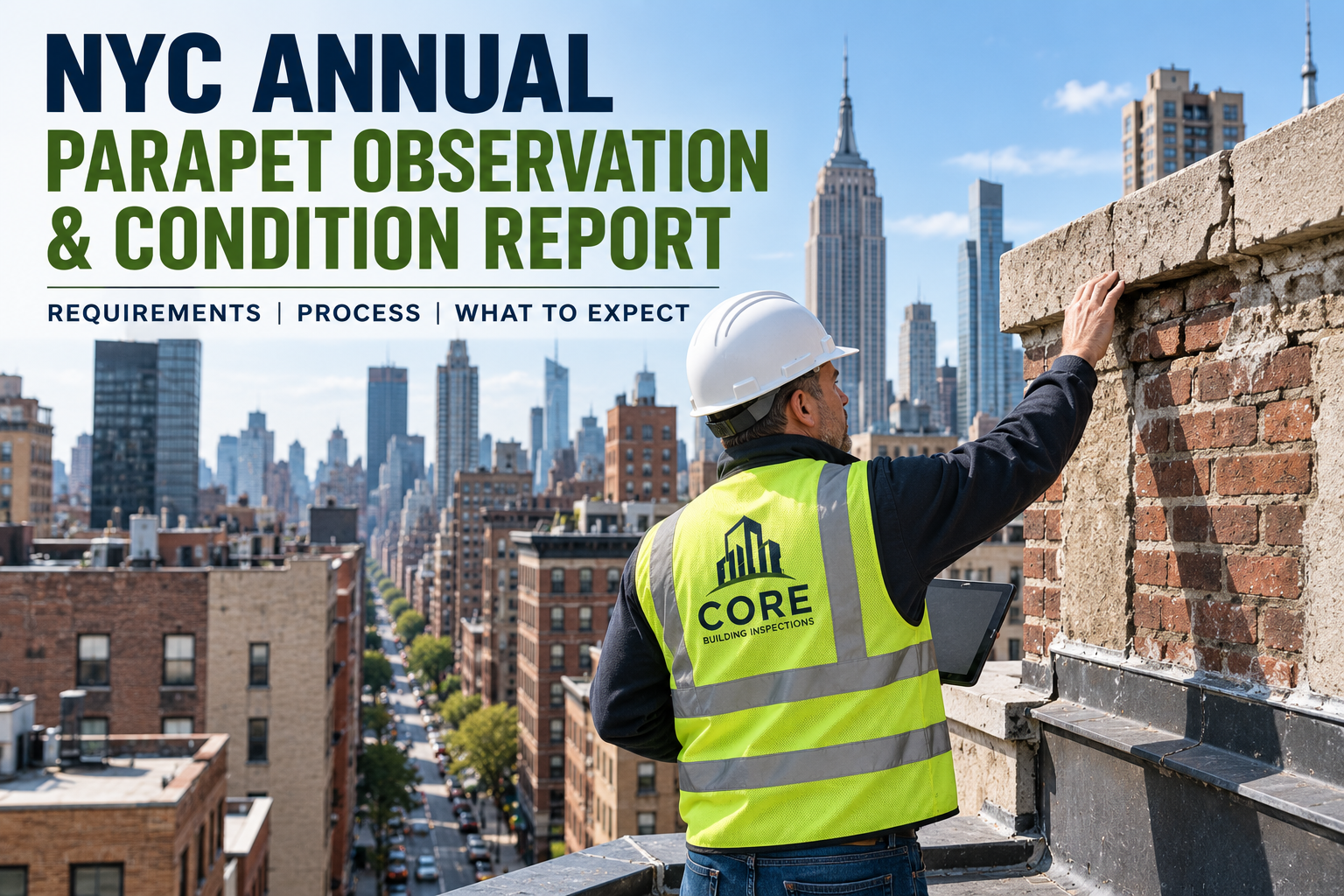
A few deteriorated mortar joints on top of a commercial building may not look particularly serious. Neither may a cracked coping stone, several spalled bricks, or an old patch repair.
But a parapet is different from most other masonry walls.
It sits at the uppermost edge of the building, is exposed to weather from multiple directions, and often stands directly above a sidewalk. Conditions that would be routine masonry maintenance elsewhere take on greater significance several stories above pedestrians.
That is why New York City requires qualifying parapets fronting a public right-of-way to be observed every year.
The NYC Annual Parapet Observation Requirement in Brief
Under Department of Buildings rule 1 RCNY §103-15, annual parapet observations began January 1, 2024.
- Applies to: buildings with parapets fronting a public right-of-way, regardless of height. Detached one- and two-family homes are exempt.
- Scope: a close-up observation of the entire parapet, including plumbness, deterioration, and the stability of attached railings, signs, and other appurtenances.
- Records: reports are not filed with DOB. Owners keep them for at least six years and produce them on request.
- Unsafe conditions: the observer must notify DOB immediately, the owner must install public protection, and the condition must be corrected within 90 days.
The requirement is the easy part to understand. The more useful question for an owner is what the inspector is actually looking for.
The answer goes well beyond whether the wall is still standing. A good NYC parapet inspection identifies the early signs of deterioration that can eventually lead to movement, instability, and falling masonry.
Parapet Problems Often Start With Water
Many masonry problems begin with something simple: water gets into the wall.
A properly maintained parapet limits water infiltration and directs moisture away from the masonry. That protection comes from coping stones or metal coping, mortar joints, sealants, through-wall flashing, and roof-to-wall transitions.
As these materials age, openings develop. A failed coping joint lets water into the top of the wall. Deteriorated mortar joints let moisture through the face. Failed flashing lets moisture migrate into areas that were meant to stay dry.
Once water enters the assembly, deterioration accelerates. In New York City’s climate, that moisture eventually meets another problem.
Freeze-Thaw Cycles Turn Small Defects Into Larger Ones
Masonry absorbs moisture. When temperatures drop below freezing, that moisture freezes and expands. When temperatures rise, it thaws. A typical New York winter repeats that cycle many times.
Over time, freeze-thaw exposure contributes to:
- Spalled brick faces
- Cracked masonry
- Deteriorated mortar
- Loose masonry units
- Displaced coping
- Open joints
- Progressive weakening of previously damaged materials
A small opening at the top of a parapet should not be dismissed as cosmetic. The visible defect may only be the entry point. The more important question is what has been happening inside the wall because of it. Exterior Envelope page
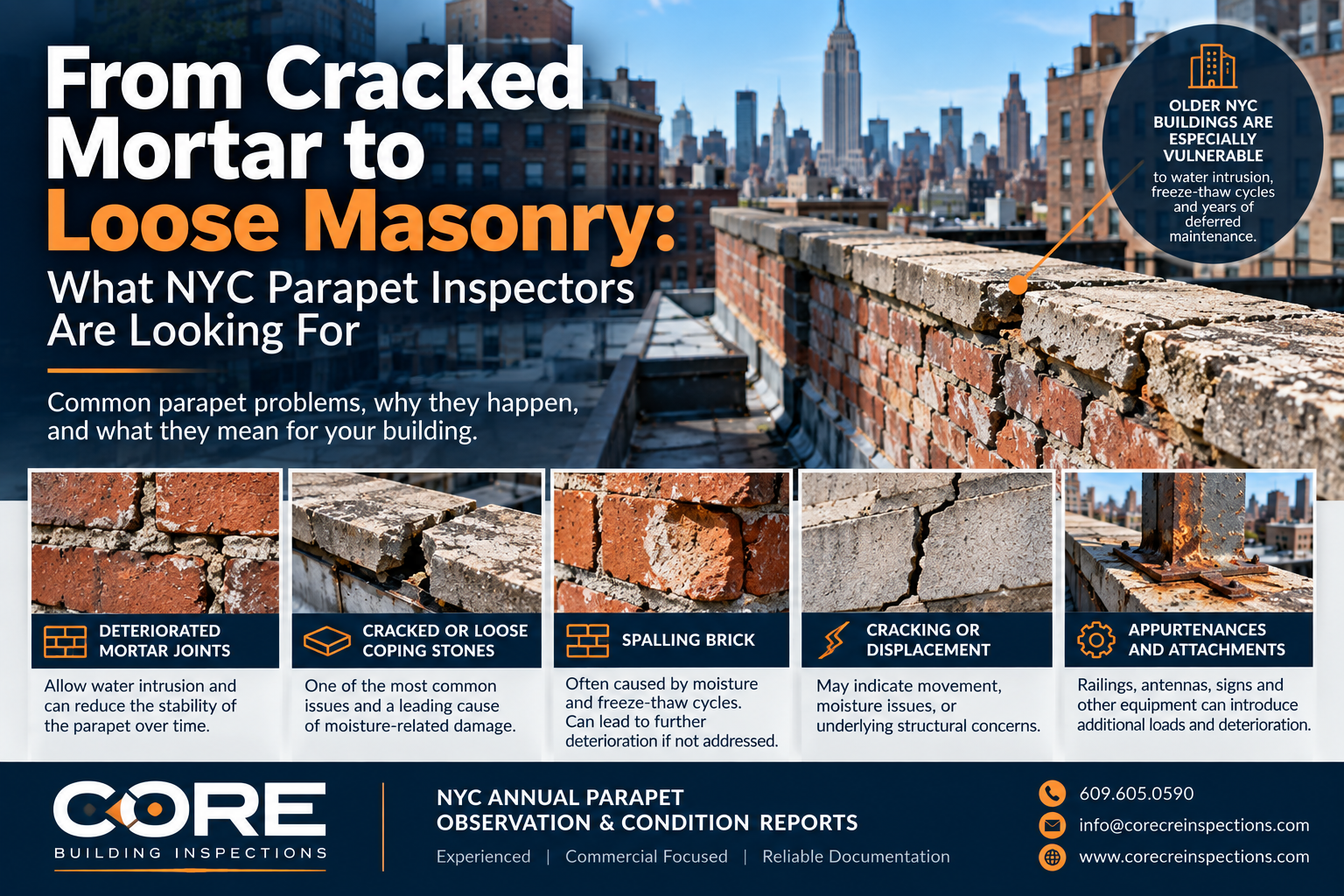
1. Deteriorated Mortar Joints
Mortar is often the first place aging becomes visible. An inspector may find mortar that is recessed, cracked, missing, loose, weathered, or previously repaired.
Minor mortar deterioration does not automatically mean a parapet is unstable. However, deteriorated joints give water a path in and reduce the bond between individual masonry units.
Location matters. Deterioration concentrated near the top of the parapet suggests moisture entering through the coping or other horizontal surfaces. Widespread deterioration points to a larger maintenance issue.
The inspector is not simply documenting “bad mortar.” The objective is to understand the extent, pattern, and potential consequences of the deterioration.
2. Loose or Displaced Coping Stones
The top of a parapet takes direct exposure to rain, snow, ice, and sun. Stone, terra cotta, or metal coping protects that surface. On many prewar Manhattan walk-ups and Brooklyn rowhouses, the original terra cotta or bluestone coping is now a century old.
When coping becomes cracked, loose, displaced, or poorly sealed, two concerns develop. The first is water infiltration. The second is physical stability.
A loose masonry unit at ground level is a maintenance issue. A loose coping stone at a roof edge several stories above a sidewalk is a potential falling-object hazard.
Inspectors pay close attention to coping condition, the joints between units, displacement, cracking, previous repairs, and any sign that a unit is no longer securely seated. Roofing page
3. Spalling Brick
Spalling occurs when part of a brick’s surface breaks, flakes, or separates. In some cases only the outer face is affected. In advanced cases, much of the brick deteriorates.
Moisture and freeze-thaw exposure are the usual contributors. Spalling matters because it tells the inspector how the wall has performed over time.
A few isolated spalled bricks may be localized deterioration. Extensive spalling points to prolonged moisture exposure or a broader material problem. Left alone, it reduces the integrity of individual masonry units.
4. Cracking
Not all cracks mean the same thing. An inspector evaluates the pattern of cracking, not just whether a crack exists.
Vertical, horizontal, and diagonal cracks, separation at corners, and cracks around earlier repairs each say something different about how the parapet has moved. Some reflect ordinary material movement. Others indicate displacement or instability that requires further evaluation.
Changes in crack width or shape from one annual observation to the next are especially significant. A photograph from last year often tells a more meaningful story than a single photograph taken today.
5. Bulging, Leaning, or Displaced Masonry
These conditions deserve particular attention. A parapet should appear plumb and stable. Visible bowing, bulging, leaning, or displacement indicates that part of the masonry assembly has moved.
Contributing factors can include deteriorated mortar, moisture infiltration, corrosion of embedded steel, inadequate restraint, original construction defects, or deterioration inside concealed portions of the wall.
During a visual observation, the inspector’s role is not to determine the precise concealed cause. It is to recognize that movement appears to have occurred and decide whether further evaluation or corrective action is warranted. Structural page
6. Failed Previous Repairs
Parapets on older NYC buildings almost always have a repair history. That is not a problem in itself. Proper repairs are part of maintaining a masonry building.
The concern arises when the repairs themselves start to fail. Inspectors commonly find:
- Failed mortar patches
- Cracked replacement masonry
- Sealant smeared over deteriorated joints
- Repointing separating from the surrounding masonry
- Previously repaired cracks that have reopened
- Temporary repairs that have stayed in place for years
A failed repair is especially informative. It often means the underlying cause was never corrected. Patching a crack does not address why the crack formed.
7. Corrosion Can Create Problems From Inside the Wall
Some of the most consequential masonry deterioration starts where it cannot be seen. Steel embedded in masonry, such as lintels, anchors, and railing posts, corrodes when exposed to moisture.
Corroding steel expands as it rusts, and that expansion pushes on the surrounding masonry. Eventually cracking, displacement, or spalling appears on the exterior.
This is one reason inspectors look for patterns rather than isolated defects. Rust staining, horizontal cracking, displaced masonry, or recurring deterioration in one location can all point to concealed steel. When concealed conditions are suspected, further evaluation may be necessary.
8. Vegetation Is More Than an Appearance Issue
Plants growing from masonry joints are an obvious sign that maintenance is needed. Roots expand within openings and contribute to further displacement.
Vegetation also tells the inspector something else: there is enough moisture and accumulated debris inside the wall to support plant growth. That alone warrants attention.
Pulling the plants without repairing the openings that let them take root treats only the symptom.
9. Parapet-Mounted Equipment Matters Too
The masonry is not the only consideration. NYC parapets frequently support or connect to other components, including:
- Railings and guard systems
- Signs
- Telecommunications equipment and antennas
- Ladders
- Fire escape components
- Miscellaneous brackets and attachments
These attachments add loads and penetrations to the masonry. Loose connections, corrosion, movement, or deteriorated anchor points create their own hazards. That is why 1 RCNY §103-15 specifically includes appurtenances in the annual observation.
One Defect Rarely Tells the Whole Story
This is the most important concept for building owners. Parapet deterioration usually involves a chain of conditions:
- A coping joint fails.
- Water enters the masonry.
- Freeze-thaw cycles repeat through the winter.
- Mortar and brick begin to deteriorate.
- Masonry becomes loose or displaced.
The loose brick is the visible problem. The failed water-management system is the underlying cause. Replacing the brick without sealing the moisture entry point lets the deterioration continue.
A good parapet assessment considers how individual observations relate to one another. That is also the approach of ASTM E2270, the standard practice for periodic inspection of building facades for unsafe conditions.
Why Annual Photographs Become More Valuable Every Year
Annual parapet observations offer something owners often overlook: a condition history.
Suppose a small crack is photographed during a 2026 observation. During the 2027 observation, the same location is photographed again. Has the crack stayed the same? Has it widened? Has the surrounding masonry started to deteriorate? Was it repaired?
The longer consistent records are kept, the easier changes are to spot. The annual requirement becomes more than a compliance exercise. It becomes basic condition monitoring for the building envelope.
Maintenance Condition vs. Potential Safety Concern
Not every defect requires emergency repairs. Buildings age, mortar weathers, sealants deteriorate, and masonry eventually needs maintenance.
The key distinction is between deterioration that represents normal maintenance and conditions that may affect stability or public safety. A qualified parapet observer weighs the nature, severity, location, and extent of each condition.
Where a condition appears unsafe, the rule requires immediate notification to DOB, public protection such as a sidewalk shed or netting, and correction within 90 days. Where deterioration is a maintenance condition, addressing it early keeps it from becoming something more serious.
The Best Time to Repair a Parapet Is Before It Becomes an Emergency
Emergency masonry work is rarely the most economical way to maintain a building. Once masonry becomes unstable, an owner may face sidewalk sheds, emergency contractor mobilization, engineering fees, scaffolding, and permits on top of the repair itself.
Routine maintenance gives the owner far more control. Annual observations identify deterioration while repairs can still be planned and bid rather than performed reactively.
That may be the greatest benefit of the requirement. It creates a reason to look closely at a part of the building that otherwise gets little attention until something goes wrong.
NYC Parapet Inspection FAQ
How often must NYC parapets be observed? Every year. The requirement under 1 RCNY §103-15 began January 1, 2024.
Is the annual parapet observation the same as a FISP (Local Law 11) inspection? No. FISP covers facades of buildings taller than six stories on a five-year cycle and is filed with DOB by a Qualified Exterior Wall Inspector. The parapet observation applies to parapets fronting a public right-of-way at buildings of any height, happens every year, and is kept by the owner rather than filed.
Do parapet reports get filed with DOB? No. Owners keep them for at least six years and must provide them if DOB asks.
What happens if an unsafe condition is found? The observer notifies DOB immediately, the owner installs public protection, and the condition must be corrected within 90 days.
NYC Annual Parapet Observation & Condition Reports
Core Building Inspections provides NYC Annual Parapet Observation & Condition Reports for qualifying commercial and multifamily properties in Manhattan, Brooklyn, Queens, the Bronx, and Staten Island.
Our assessments focus on the visible condition of the parapet and its appurtenances, including masonry deterioration, mortar joints, coping, cracking, displacement, previous repairs, moisture-related conditions, and other observable concerns. Commercial Building Inspection page
Reports include dated photographs and written observations that give owners and property managers a clear record of conditions at the time of the assessment. They are organized so that next year’s observation can be compared location by location.
When deterioration is identified, the report helps owners separate routine maintenance items from conditions that warrant further professional evaluation or more immediate attention. NYC Annual Parapet Observation & Condition Report
Core Building Inspections Commercial Property Inspections & Building Assessments CCPIA Certified No. CCPIA-003719 609.605.0590 · info@corecreinspections.com · www.corecreinspections.com