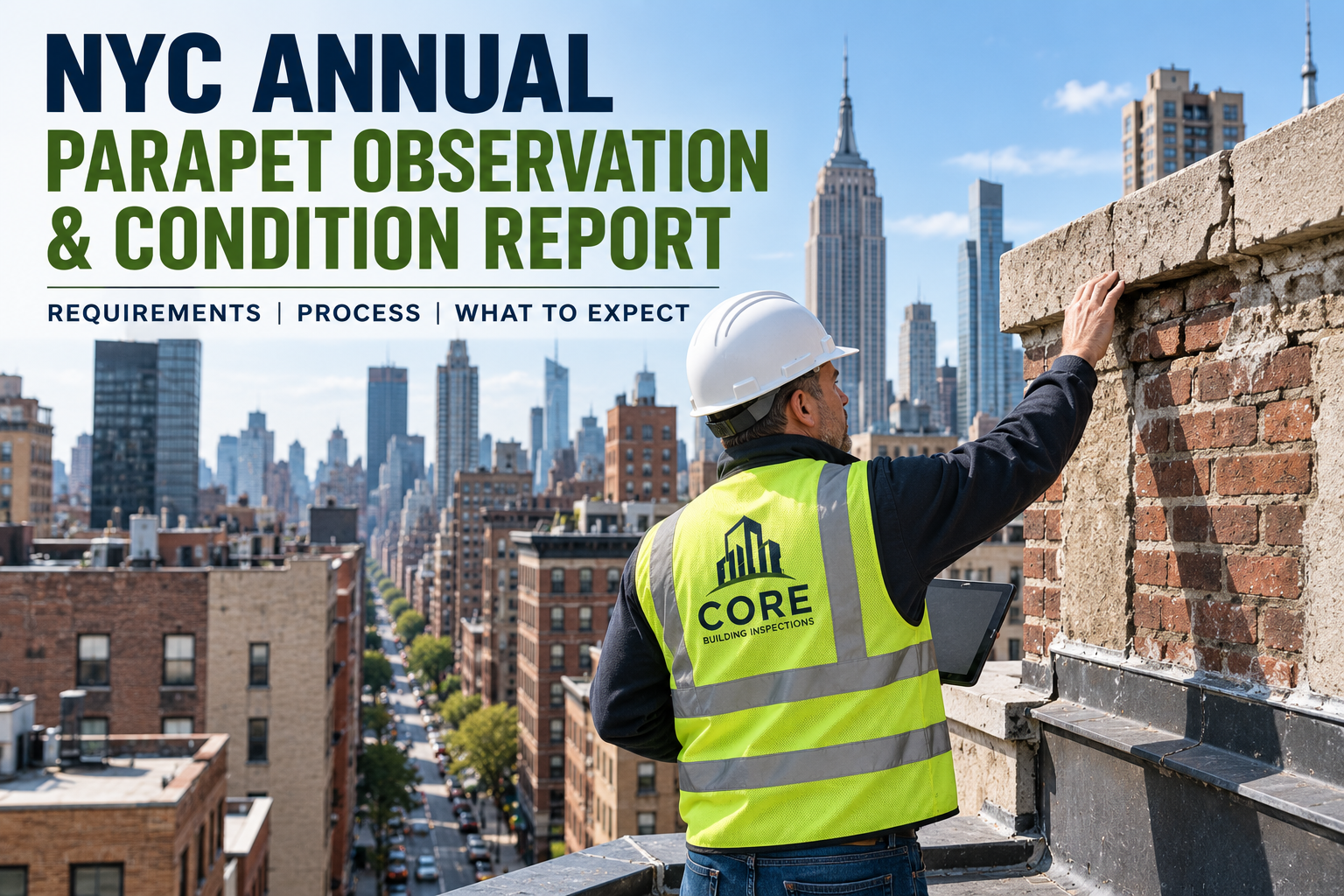
New York City building owners have another recurring safety obligation that belongs on every annual maintenance calendar: the NYC annual parapet inspection, formally the Annual Parapet Observation and Condition Report. Established under Local Law 126 of 2021 (NYC Administrative Code §28-301.1.1) and implemented through Department of Buildings rule 1 RCNY §103-15, the requirement took effect January 1, 2024. Qualifying owners must now have their parapets observed every year to identify hazardous conditions and confirm the parapet remains stable.
Unlike the Façade Inspection & Safety Program (FISP), the parapet rule is not limited to high-rise buildings. It applies to buildings with parapets fronting a public right-of-way, regardless of height, subject to a short list of exemptions. For commercial owners, property managers, investors, condominium boards, and asset managers, understanding the requirement matters for DOB compliance, but it matters just as much for preventive maintenance and long-term capital planning.
What Is a Parapet?
Under 1 RCNY §103-15, a parapet is “the part of any wall entirely above the roof line.” Parapets are everywhere in New York City’s building stock, and they are built from brick, concrete masonry units, stone, terra cotta, concrete, metal, or combinations of these materials. Many also carry cornices, railings, coping, signage, mechanical attachments, or other appurtenances.
Because a parapet projects above the roof, it is exposed to weather on multiple faces. Rain, snow, wind, temperature swings, freeze-thaw cycling, corrosion, and years of deferred maintenance all work on it at once, and that exposure is exactly why the City singled parapets out for annual attention.
Which NYC Buildings Require an Annual Parapet Inspection?
The rule applies broadly. Any building with a parapet fronting a public right-of-way, meaning a street, avenue, sidewalk, roadway, or other public place, is generally covered regardless of height. A two-story commercial building on a neighborhood avenue can be subject to the requirement just as easily as a large mixed-use tower.
There are exemptions. Detached one- and two-family homes are excluded, as are buildings where a fence or other barrier prevents access to the exterior wall. DOB has also clarified that balcony walls are not parapets under the rule, and that a cornice without a parapet is not covered, although a cornice attached to a parapet is. Owners should evaluate their own property configuration rather than assume a low-rise building is automatically exempt.
How Often Is the Observation Required?
Every year. The program began January 1, 2024, and the observation must be completed by December 31 of each calendar year. That makes the parapet observation a recurring maintenance responsibility, not a one-time inspection. The simplest approach for owners and managers is to schedule it alongside other annual building-system work, ideally in the warmer months when roof access is safer and any recommended repairs can be completed before winter.
Who Can Perform an NYC Parapet Inspection?
This is one of the most commonly misunderstood parts of the rule. The annual observation does not require a Professional Engineer or Registered Architect. It must be performed by “a person competent to inspect parapets.” The rule lists examples including bricklayers, masons, building superintendents, handymen and others in construction-related trades, architects, engineers, inspectors working for New York State-authorized insurance companies, New York State-authorized building inspectors, and “any other individual capable of identifying hazards on the parapet.”
That sets the annual parapet observation apart from FISP and other NYC structural programs that require a licensed design professional. The real question for an owner is whether the person doing the work has the experience to recognize a developing hazard, document it clearly, and explain what it means for the building.
What Happens During an Annual Parapet Observation?
The rule requires more than a glance from the sidewalk. The observation must be a close-up examination of the entire applicable parapet, typically performed from the roof, and where needed from fire escapes, scaffolding, or other safe vantage points. The goal is to get close enough to evaluate conditions that affect stability.
One specific test built into the rule is plumbness: the parapet must remain plumb within a horizontal distance of one-eighth of its cross-sectional thickness. On a typical 12-inch masonry parapet, that is roughly 1.5 inches of lean. Movement beyond that is significant because progressive displacement usually points to deterioration of the wall assembly, its mortar, its connections, or its supporting structure.
Beyond plumbness, an experienced observer looks for:
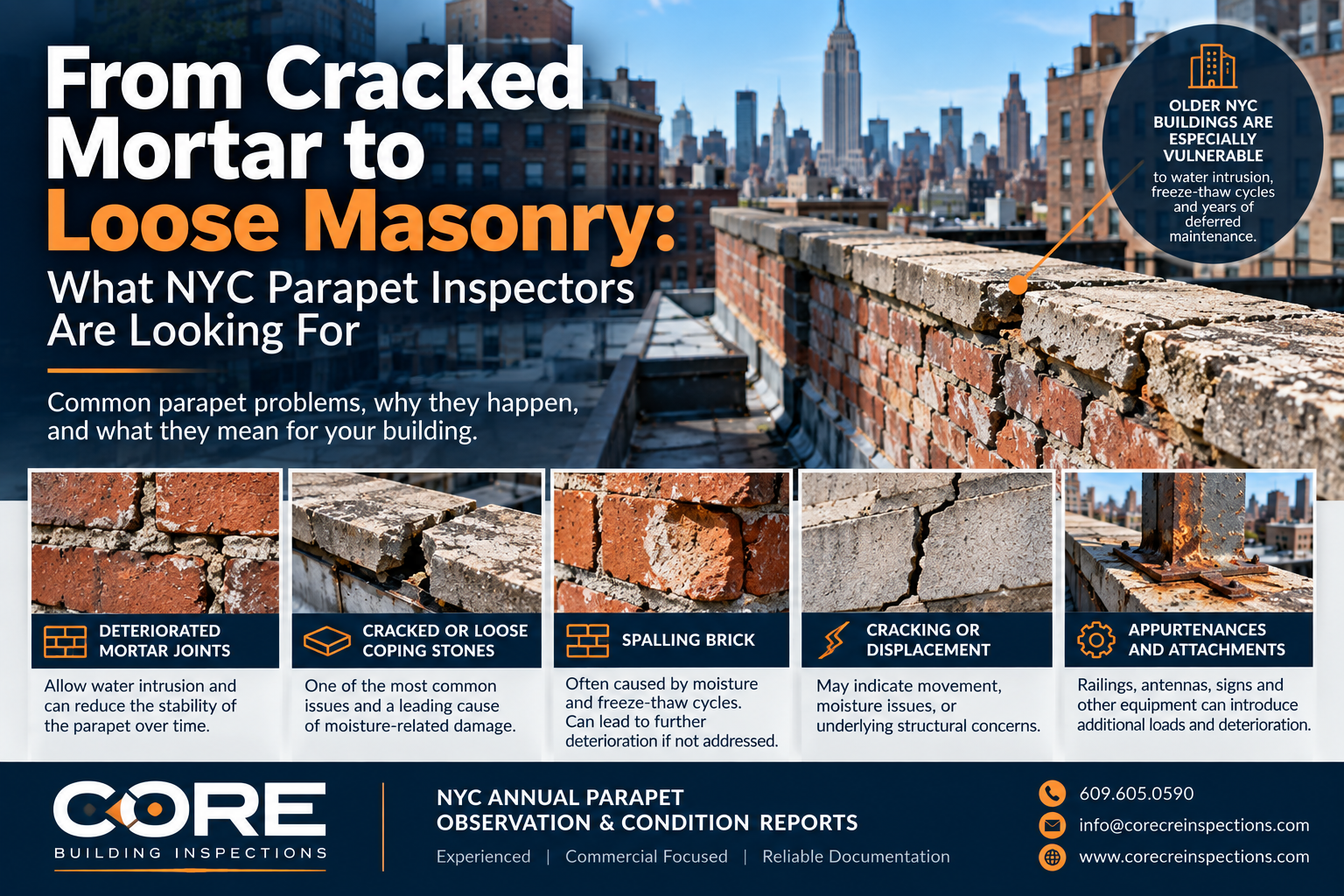
- Cracked, bulging, loose, or displaced masonry
- Deteriorated, missing, or open mortar joints
- Failed or displaced coping
- Loose stone or terra cotta units
- Corroded anchors, ties, lintels, or other embedded metal
- Deteriorated cornices and unstable appurtenances
- Evidence of water infiltration at the roof-to-parapet transition
- The quality and condition of previous repairs
Why NYC Parapets Deteriorate
A parapet is the most exposed part of the exterior wall, and water management is the whole game. Moisture gets in through failed coping joints, deteriorated mortar, cracks, open joints, failed flashing, roof-to-parapet transitions, and aged sealants. Once masonry is saturated, deterioration accelerates. In winter, absorbed water freezes and expands, and repeated freeze-thaw cycles drive mortar loss, cracking, spalling, and displacement.
Embedded steel makes it worse. As anchors, ties, and lintels corrode, the rust occupies more volume than the original metal and pushes against the surrounding masonry, cracking and displacing it from within. We see the same mechanism on older masonry buildings throughout the Northeast, from Manhattan brownstones to pre-war commercial buildings in Philadelphia and Camden County. It is why a minor maintenance item left alone for several winters can become a structural stability problem.
What Must Be Included in the Parapet Observation Report?
After the observation, a written report must be prepared for the owner. Under 1 RCNY §103-15, the report must document:
- The building address and any associated addresses
- The owner’s name, mailing address, and telephone number
- The name of the person who performed the observation
- The date(s) of the observation
- A location plan of the parapet(s) observed
- The parapet’s construction, including material and approximate height and thickness
- General conditions noted, and whether any unsafe conditions were found
- Recommended corrective actions
- Any repairs made to the parapet since the previous report
- Dated photographs documenting conditions at the time of observation
A well-prepared report does more than satisfy the rule. Year over year, it builds a condition history that is especially valuable on older masonry buildings.
Does the Report Get Filed With NYC DOB?
No. Unlike FISP, the annual parapet report is not submitted to the Department of Buildings. It is delivered to the owner, who must retain it for at least six years and produce it if DOB requests it. Owners should keep each year’s report together with the photographs, repair invoices, contractor documentation, permits, engineering evaluations, and prior parapet reports. That file becomes the parapet’s performance record.
How Should Parapet Condition Be Classified?
The rule itself defines only one condition category: a hazardous or unsafe condition that triggers immediate action. In practice, a useful report goes further and gives the owner a clear read on where the parapet stands. At Core Building Inspections, we classify observed conditions in three tiers, similar to the language owners may recognize from FISP:
Safe. No observed condition indicates a hazard at the time of observation. Routine monitoring and maintenance should continue.
Requires Maintenance. The parapet is stable but shows deterioration that should be repaired to prevent further degradation, such as localized mortar loss, open coping joints, or minor cracking. These findings are the most valuable from a capital planning standpoint because they give ownership the chance to act before a problem becomes an emergency.
Unsafe. A hazardous condition exists that requires immediate action. This is where the observation moves from routine maintenance to public safety.
What Happens If an Unsafe Condition Is Found?
The person performing the observation must immediately notify DOB, and the owner must immediately install public protection, such as a sidewalk shed, fencing, safety netting, or restricted access, which must remain in place until the condition is corrected. The unsafe condition must be corrected within 90 days of notification to DOB, and DOB has stated there are no extensions of that deadline.
That 90-day window is one of the strongest reasons to manage parapets proactively. Once a parapet is classified unsafe, ownership loses control of the schedule and the budget. An emergency repair can stack contractor mobilization, engineering, permits, access equipment, sidewalk protection, and masonry restoration into a single unplanned capital expenditure.
Annual Parapet Observations vs. FISP Inspections
The two programs are frequently confused, but they are different requirements.
The annual parapet observation focuses only on qualifying parapets. It occurs every year, applies regardless of building height, does not require a PE or RA, is not filed with DOB, and centers on parapet stability and hazardous conditions.
FISP (Local Law 11) is a broader exterior-wall program for buildings taller than six stories. It requires a Qualified Exterior Wall Inspector, a critical examination of all exterior walls and appurtenances on a five-year cycle, and filing of a technical report with DOB. For buildings subject to FISP, DOB has confirmed that if the FISP report includes all information required by 1 RCNY §103-15, no separate parapet report is required for that year.
Why Annual Parapet Observations Matter for Capital Planning
The rule is written around public safety, but owners should also use it for capital planning. Parapets rarely fail overnight. The typical progression runs from minor mortar deterioration to water penetration, freeze-thaw damage, loose masonry, wall movement, and finally reconstruction. Catching deterioration early gives ownership options: repointing, coping repairs, flashing improvements, sealant replacement, localized rebuilding, or cornice repair, all budgeted on the owner’s timeline rather than DOB’s.
Consider two similar buildings. At Building A, the annual observation identifies deteriorating mortar and several failed coping joints. Ownership budgets the work for the next construction season, the masonry is repointed, the coping is resealed, and water entry is cut off. At Building B, the same conditions are noted and deferred. A few winters later the masonry begins to move, loose material develops over the sidewalk, and the building needs immediate public protection, emergency mobilization, engineering, permits, reconstruction, and follow-up inspections. The difference is not maintenance. It is capital management.
Why Buyers Should Review Parapet Reports During NYC Due Diligence
For investors acquiring New York City commercial property, the annual parapet reports are a readily available window into the building envelope. During due diligence, buyers should request prior parapet reports, repair documentation and photographs, contractor invoices, open DOB violations, masonry repair permits, engineering reports, and FISP filings where applicable.
A series of reports shows whether deterioration is stable, progressing, or being repeatedly patched without addressing the cause. That directly affects capital expenditure projections, and it is exactly the kind of history a seller will not volunteer.
Parapet Observations and Property Condition Assessments
An annual parapet observation and a Property Condition Assessment serve different purposes but complement each other. The parapet observation satisfies a specific NYC safety requirement. A PCA prepared in accordance with ASTM E2018-15 evaluates the entire asset, including roofing, exterior walls, structure, HVAC, plumbing, electrical, paving, site improvements, interiors, and life-safety systems, and translates observed conditions into immediate repairs, remaining useful life, opinions of probable cost, and a long-term capital reserve schedule.
For owners and investors, pairing compliance observations with a broader condition assessment gives a far more complete picture of the property than either provides alone.
Don’t Treat the Annual Observation as a Checkbox
New York City has an enormous inventory of older masonry buildings whose parapets have seen decades, sometimes more than a century, of weather, movement, and patch repairs. Older construction is not inherently unsafe, but aging masonry requires maintenance.
The most valuable parapet observation is not the one that simply satisfies the annual requirement. It is the one that tells ownership what condition the parapet is in today, what is beginning to deteriorate, what should be repaired, what should be monitored, and what will become expensive if it is deferred. That turns a compliance requirement into an asset-management tool: inspect, maintain, monitor, plan.
NYC Annual Parapet Inspections | Core Building Inspections
Core Building Inspections provides NYC Annual Parapet Observation and Condition Reports for commercial and multifamily properties subject to 1 RCNY §103-15. Our observations document parapet construction and condition, identify deterioration and hazardous conditions, include dated photographic documentation, and deliver a clear written report owners can keep with their building records. For larger commercial assets, the parapet observation can be coordinated with ASTM E2018-15 Property Condition Assessments and capital planning services.
Core Building Inspections is led by David Vitarelli, a New Jersey-licensed inspector (NJ License No. 24GI00245900) and CCPIA-certified commercial property inspector (CCPIA-003719), serving New York City, New Jersey, Pennsylvania, Delaware, and the greater Philadelphia metropolitan region from our South Jersey base.
To schedule an annual parapet observation, visit corecreinspections.com or call 609.605.0590.
Independent inspections. Better information. Smarter capital decisions.
Internal Links
What Is a Property Condition Assessment?
How Northeast Weather Impacts Commercial Building Lifecycles
Philadelphia Façade Inspections
External Authority Links
1 RCNY §103-15: https://www.nyc.gov/assets/buildings/rules/1_RCNY_103-15.pdf
NYC DOB Parapet FAQ: https://www.nyc.gov/site/buildings/safety/parapets-frequently-asked-questions.page